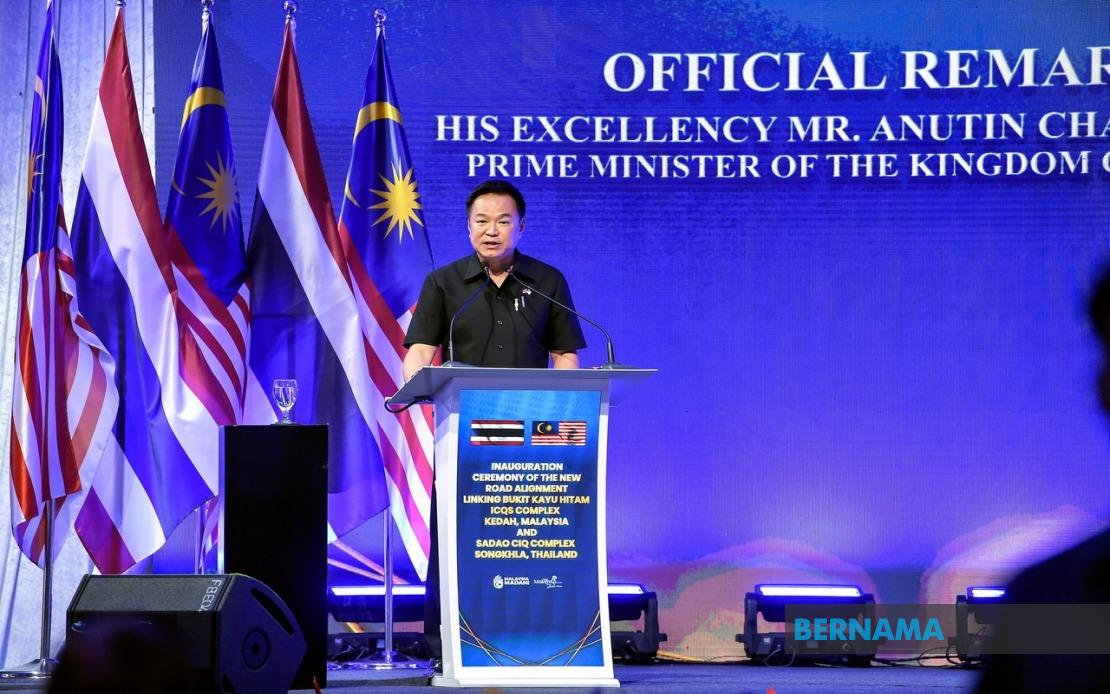
Thai Prime Minister Anutin Charnvirakul has reiterated his government's determination to fill critical gaps in Southeast Asia's transport network, declaring that improved road and rail connectivity between Malaysia and Thailand forms the backbone of regional economic growth. Speaking at the inauguration of a newly aligned highway linking the Sadao Customs, Immigration and Quarantine Complex on the Thai side and the Bukit Kayu Hitam Immigration, Customs, Quarantine and Security Complex in Kedah, Anutin emphasised that these infrastructure investments represent far more than bilateral convenience—they are essential stepping stones to integrating the region's supply chains with major economic powers including China and Russia.
The event, which took place on the Malaysia-Thailand border, was co-inaugurated by Anutin and Malaysian Prime Minister Datuk Seri Anwar Ibrahim, underscoring the shared commitment of both nations to deepening economic ties. This alignment, the culmination of collaborative efforts between Bangkok and Kuala Lumpur, addresses long-standing logistical challenges at what remains the busiest crossing point along the entire Malaysia-Thailand border. By reducing congestion and streamlining clearance procedures, the new road configuration promises tangible benefits for businesses relying on swift border transit, particularly those in manufacturing, agriculture, and e-commerce sectors that have grown increasingly dependent on seamless cross-border operations.
Anutin's vision extends well beyond the immediate Malaysia-Thailand corridor. He outlined an ambitious agenda whereby Thai exports and Chinese goods can leverage Malaysian territory as a transit route to Singapore and Indonesia, creating new efficiencies for supply chains that currently navigate congested existing corridors. This bidirectional flow reflects sophisticated regional thinking—rather than seeing Malaysia simply as a destination market, Thai planners recognise the strategic value of Malaysia's geographic position as a distribution hub for goods destined for Southeast Asia's wealthier southern markets. For Malaysian policymakers, this represents an opportunity to position the country as indispensable infrastructure for regional trade, generating customs revenue and logistics services even from goods that do not remain within Malaysian territory.
Beyond the Bukit Kayu Hitam-Sadao link, both governments have already begun preliminary discussions on three additional cross-border connectivity initiatives. The Songkhla-Kedah corridor would connect Thailand's maritime trade hub with northern Malaysia's industrial zones. The Satun-Perlis route addresses southwestern connectivity, while the Narathiwat-Kelantan link targets the northeastern sector. Each project targets specific geographic and economic contexts; collectively, they represent a fundamental reimagining of how southern Thailand and northern Malaysia can function as an integrated economic zone rather than as separate markets divided by political borders. For Malaysian readers, particularly those in Kedah, Perlis, and Kelantan, these initiatives signal potential for job creation in transport, logistics, hospitality, and small-scale commerce.
The strategic significance of these infrastructure commitments cannot be overstated in the current geopolitical context. Southeast Asia faces mounting pressure to diversify its trading relationships and reduce dependence on any single economic partner. By facilitating direct, efficient routes from China and Russia through Thailand into Malaysia and onward to Singapore, the region creates alternative pathways for trade that do not rely exclusively on maritime routes vulnerable to disruption. This terrestrial alternative gains particular importance as tensions in global shipping lanes persist and companies seek to mitigate supply chain risks through geographic diversification. Malaysian businesses, which have historically struggled with logistics costs relative to regional competitors, stand to benefit substantially from reduced transit times and lower border-crossing expenses.
Anwar's presence alongside Anutin signals that Malaysia views these infrastructure projects as central to its own economic strategy, not merely as accommodations to Thai interests. The Malaysian Prime Minister's personal involvement in the ceremony, including greeting Anutin and his wife Thananon Charnvirakul, reflects the diplomatic weight accorded to connectivity initiatives within Malaysia's broader regional policy. This alignment between the two governments matters considerably because infrastructure investments of this scale require sustained political commitment across multiple election cycles and changes in administration. By securing buy-in from both premiers, these projects acquire a degree of insulation from political disruption that many cross-border initiatives in Southeast Asia unfortunately lack.
Anutin's explicit commitment to resolving outstanding border procedures demonstrates awareness that infrastructure alone cannot achieve seamless connectivity without accompanying institutional reforms. Customs processes, security protocols, quarantine standards, and documentation requirements often create friction points that reduce the practical benefits of improved physical links. By pledging to harmonise these systems wherever possible, Thai leadership acknowledges that the new road alignment's true value depends on streamlined clearance procedures that match the highway's quality. For Malaysian traders and travellers, this represents a potential watershed moment—the difference between having a new road and actually being able to use it efficiently depends on whether both governments follow through on procedural simplifications.
The economic implications for Malaysia's northern states merit particular attention. Kedah, Perlis, and Kelantan have historically occupied peripheral positions within Malaysia's economic geography, overshadowed by the more developed central and southern regions. Enhanced connectivity with Thailand's relatively prosperous southern provinces—Songkhla and Satun—could catalyse development in northern Malaysia by attracting manufacturing investment, cross-border retail activity, and tourism. Workers in these states would gain access to Thai employment markets, potentially commanding higher wages than available domestically. Consumers would access Thai goods and services more cheaply, effectively broadening their purchasing power. Agricultural producers could more easily reach Thai markets, particularly valuable given complementarity in seasonal production cycles between the two countries.
Thailand's emphasis on facilitating movement for people alongside goods reveals broader thinking about regional integration. Tourist flows between Malaysia and Thailand have rebounded strongly post-pandemic, and easier border crossing procedures would expand these numbers substantially. Business professionals conducting work across the border would face fewer obstacles, enabling formation of cross-border firms and ventures. Students might pursue educational opportunities more easily. This people-to-people dimension of connectivity often receives less attention than cargo movement, yet it generates multiplier effects throughout local economies and builds social foundations for sustained bilateral cooperation. When citizens of neighbouring countries interact regularly in commerce and travel, political tensions tend to diminish and mutual understanding deepens.
The timing of these connectivity pledges warrants consideration within Malaysia's recent political context. Having navigated a period of considerable domestic political instability, Malaysia's government appears eager to demonstrate to investors and neighbouring countries that it remains capable of ambitious, forward-looking policy implementation. Infrastructure projects serve this signalling function powerfully—they announce to markets and to regional peers that Malaysia possesses both the political stability and institutional capacity to execute complex, long-term commitments. For Datuk Seri Anwar Ibrahim's administration, association with major cross-border infrastructure initiatives provides tangible achievements to present to voters, particularly in northern states where employment and economic growth remain priority concerns.
Looking forward, the success of these initiatives will depend on factors beyond the control of infrastructure planners. Global economic growth rates, shifts in regional supply chains driven by geopolitical considerations, and technological change affecting logistics will all influence whether these transport links achieve their full potential. However, by investing in physical capacity now, Malaysia and Thailand are creating optionality—they are ensuring that if demand exists for such connectivity, the supply will be available. In a region where infrastructure frequently lags behind potential, this proactive approach distinguishes Malaysia and Thailand from less forward-thinking neighbours and positions them advantageously for capturing opportunities that arise from regional economic integration.

