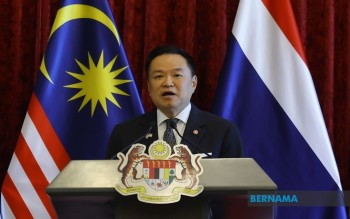
Thailand's Prime Minister Anutin Charnvirakul has signalled strong optimism that his country and Malaysia will breach the US$30 billion bilateral trade threshold by 2027, marking a substantial expansion of economic ties between the two Southeast Asian neighbours. Speaking during a high-level visit to Kuala Lumpur, Anutin underscored Thailand's confidence in reaching the ambitious milestone, particularly given that current bilateral commerce already hovers near the US$28 billion mark. The declaration came during a joint press conference with Malaysian Prime Minister Datuk Seri Anwar Ibrahim following a memorandum of understanding exchange at the Perdana Putra Complex in Putrajaya, signalling renewed political commitment to deepening economic integration at the highest levels.
The existing trade relationship between Malaysia and Thailand already reflects the profound interdependence characteristic of mature regional partnerships. Thailand currently ranks as Malaysia's largest trading partner within the ASEAN bloc, a status that underscores the strategic importance both nations place on their commercial relationship. With approximately US$28 billion in annual bilateral trade already flowing between the two economies, the gap to the US$30 billion target represents relatively modest growth of less than 8 percent over the three-year period. Nevertheless, the symbolic and practical significance of reaching this threshold extends beyond mere numerical achievement, representing a deliberate acceleration of economic cooperation at a time when regional supply chains and trade patterns face shifting geopolitical pressures.
Anwar's public commitment to the initiative reflects Malaysia's determination to leverage its institutional machinery toward realising shared prosperity goals. The Malaysian Prime Minister explicitly tasked both his Ministry of Foreign Affairs and the Ministry of Investment, Trade and Industry with prioritising the bilateral trade expansion effort, indicating that achieving the target constitutes a formal government objective rather than a casual aspiration. This institutional embedding suggests Malaysia views the partnership not as peripheral to its economic agenda but as central to broader regional integration objectives. By channelling diplomatic and trade promotion resources toward Thailand specifically, Malaysia signals recognition of Thailand's importance as both a market and a production hub for integrated Southeast Asian manufacturing networks.
Beyond the headline trade figures, both leaders identified strategic sectors as focal points for deepening cooperation. Anutin explicitly nominated food security, energy security, and digital economy advancement as priority domains for future collaboration. These sectoral emphases reflect current regional preoccupations and vulnerabilities. Food security concerns have intensified across Southeast Asia following global supply disruptions and climate variability affecting agricultural output, making bilateral cooperation in agricultural trade and food production infrastructure increasingly urgent. Energy security similarly emerged as critical following geopolitical tensions affecting global energy markets and heightened awareness of regional energy independence. The explicit prioritisation of high-tech industries within the digital economy agenda speaks to both nations' ambitions to climb global value chains beyond traditional manufacturing and commodity production.
The complementary economic structures of Malaysia and Thailand create natural conditions for supply chain integration and value-added production. Malaysia's strengths in petrochemicals, semiconductors, and advanced manufacturing align productively with Thailand's capabilities in automotive components, electrical appliances, and agricultural processing. Anutin's emphasis on building upon these complementary strengths suggests both governments recognise that the US$30 billion target becomes attainable through deliberate sectoral targeting rather than across-the-board trade expansion. This strategic approach maximises the likelihood of sustainable, quality trade growth focused on higher-margin, technology-intensive products rather than commodity-dependent commerce vulnerable to price volatility.
The planned joint trade committee meeting signals institutional mechanisms designed to sustain momentum beyond this bilateral visit. By committing to establish more ambitious successor trade targets following achievement of the US$30 billion milestone, both governments have created a framework for continuously escalating economic integration. This progressive target-setting approach reflects lessons learned from successful regional partnerships and indicates awareness that bilateral trade relationships function optimally when anchored to specific, time-bound objectives with clear accountability mechanisms. The joint committee structure also provides forums for addressing non-tariff barriers, regulatory harmonisation, and supply chain coordination challenges that often constrain trade growth despite official political support.
Anutin's visit itself carries symbolic weight within broader Thailand-Malaysia relations, marking his first return to Malaysia since his reappointment as Thai Prime Minister in March 2026. This timing and sequencing conveys that reinforcing bilateral partnerships constitutes a priority for Thailand's leadership as it consolidates domestic political authority. Official bilateral visits of this calibre typically signal commitment to relationship-building at moments when domestic political fortunes stabilise, suggesting Anutin views the Malaysia relationship as sufficiently important to feature prominently in his government's early diplomatic agenda. The two-day duration further indicates substantive engagement beyond ceremonial diplomacy.
For Malaysian stakeholders, the enhanced bilateral relationship presents concrete opportunities across multiple sectors. Malaysian manufacturers dependent on Thai inputs or integrated within Thai-centric production networks benefit from explicitly strengthened government support for bilateral commerce. Malaysian exporters targeting the Thai market gain from enhanced political commitment to reducing trade friction and facilitating market access. Energy-intensive Malaysian industries may benefit from improved coordination on energy supply arrangements, while Malaysian agricultural enterprises could access new opportunities within Thailand's food security initiatives. The explicit government backing for trade expansion creates business confidence that investment in Thai market penetration and supply chain development represents strategically prudent deployment of capital.
The emphasis on tourism within Anwar's broader statement about strengthening friendship and collaboration across multiple fields acknowledges that people-to-people connections complement and sustain formal economic partnerships. Cross-border tourism generates employment, cultural understanding, and informal business networks that fortify official bilateral relations. Both Malaysia and Thailand possess substantial tourism sectors competing for regional and international arrivals, and joint tourism promotion efforts could increase visitor flows to the entire region while distributing economic benefits across both economies. This multidimensional approach to bilateral relations—incorporating commerce, investment, energy, food systems, and tourism within a coherent strategic framework—positions the Malaysia-Thailand partnership as a template for deeper ASEAN integration more broadly.

