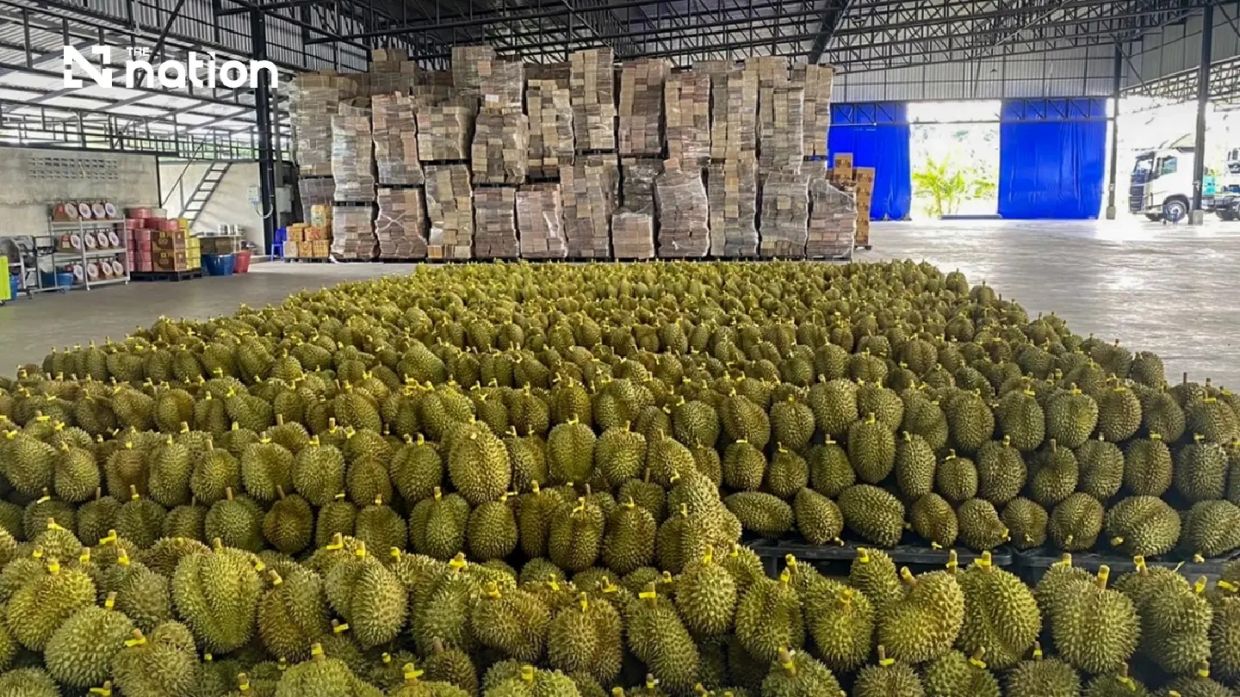
Thailand has reached a watershed moment in its agricultural trade with China, crossing the THB100 billion threshold in fresh durian exports during the first half of 2026—a figure that underscores the nation's deepening reliance on premium fruit sales to its largest regional buyer. The country shipped more than 870,000 tonnes across 53,665 containers to China by mid-year, with total export value hitting THB100.08 billion, positioning Thailand firmly on track to meet its full-year target of THB150 billion in durian revenues.
The landmark achievement is not simply a matter of increased volume or favourable market conditions. Rather, it reflects a deliberate governmental restructuring of how Thai durian reaches Chinese consumers, built on overhauling the entire quality assurance framework from farm to port. Minister of Agriculture and Cooperatives Suriya Jungrungreangkit prioritised this transformation during his first 90 days in office, moving away from ad-hoc problem-solving towards a cohesive, system-wide governance model designed to eliminate the defects that had previously eroded buyer confidence.
At the core of this overhaul sits the "Four Nos" protocol—a set of stringent non-negotiable standards prohibiting immature fruit, pest infestation, false origin claims, and contamination by Basic Yellow 2, a harmful dye occasionally used to artificially enhance fruit appearance. These criteria, combined with a four-layer PLUS screening mechanism targeting plant health threats, represent Thailand's commitment to addressing the sanitary and phytosanitary concerns that had haunted its trade relationship with Beijing. Previous detection of cadmium residues, seed borer damage, and mislabelled shipments had repeatedly threatened market access, necessitating a more rigorous preventive approach.
The structural reforms go considerably deeper than stricter inspection protocols. The Department of Agriculture now coordinates seamlessly with the National Bureau of Agricultural Commodity and Food Standards, the Department of Agricultural Extension, customs authorities, provincial governments, testing laboratories, exporters, and Chinese regulatory counterparts. This integrated ecosystem allows information to flow continuously from production sites through packing facilities to testing labs and ultimately to the issuance of electronic phytosanitary certificates. The result is transparency at every node and responsiveness that accelerates clearance without compromising safety standards.
For Malaysia and other Southeast Asian exporters watching from the sidelines, Thailand's strategy offers a compelling case study in how agricultural bureaucracies can evolve to become enablers rather than obstacles. By reducing the number of separate inspection checkpoints and converting saved time into proactive trade facilitation—such as pre-clearance consultations with Chinese authorities—Thailand has managed to streamline commerce without lowering standards. This approach contrasts sharply with the traditional regulatory bottleneck in which each shipment triggers multiple overlapping reviews, often causing costly delays and spoilage.
Minister Suriya has framed the durian success as foundational to a broader vision of transforming Thailand's entire agricultural export ecosystem. He emphasises that the gains extend beyond headline trade figures to encompassing farmer stability, operator competitiveness, and international credibility. The modernised system is explicitly designed to become a template for other high-value crops, potentially lifting the performance of Thai rubber, rice, cassava, and aquaculture products through the same integrated quality-and-facilitation methodology. This multiplier effect could substantially enhance Thailand's position as Southeast Asia's agricultural powerhouse.
The role of digital infrastructure—particularly the electronic phytosanitary certificate platform—deserves specific attention for regional policymakers. By automating the issuance and transmission of compliance documentation, Thailand has compressed processing times while creating an auditable digital trail that satisfies Chinese inspectors' need for traceability. Such systems are relatively inexpensive to scale but require sustained commitment to interoperability standards and staff training. Countries like Vietnam, Indonesia, and the Philippines, all significant agricultural exporters, face similar pressure to modernise their certification infrastructure to compete effectively in Chinese markets.
China's appetite for Thai durian remains voracious, driven by rising middle-class consumption and the fruit's premium positioning in urban supermarkets across major cities. However, this dependence is a double-edged sword. Any recurrence of quality issues or detection of contaminants could trigger sudden import restrictions that devastate Thai farmers and exporters. The Thai government's investment in preventive systems and transparency thus serves as insurance against such disruptions, reducing the likelihood of punitive trade actions. This stability is increasingly valuable as China tightens food safety standards and leverages trade leverage in broader geopolitical negotiations.
Rapibhat Chandarasrivongs, Director-General of the Department of Agriculture, has articulated the transformation in terms of Thailand's evolution toward "Smart Regulation"—a framework grounded in science, technology, and data-driven risk assessment rather than blanket enforcement. This philosophy acknowledges that effective governance need not burden industry participants but rather should work in tandem with operators to identify genuine risks and streamline legitimate commerce. For Malaysian regulators grappling with similar export challenges, this model suggests that investment in analytical capacity and digital tools often yields better outcomes than expanding compliance staff.
The durian export surge also illustrates how agricultural modernisation can generate stable income for rural communities. Thai farmers benefit not only from higher volumes moving to market but from the reduced uncertainty that accompanies systematic quality assurance. When purchasers know that shipments meet consistent standards, they negotiate more confidently and offer more predictable pricing. This predictability allows farming families to make longer-term investments in their operations, diversification, and livelihoods—outcomes that often escape headline coverage yet represent the genuine measure of agricultural policy success.
Looking ahead, the challenge for Thailand lies in sustaining these reforms through potential political transitions and market fluctuations. The systems established under Suriya's tenure will require ongoing resource allocation and institutional commitment to prevent backsliding. Chinese buyers will also continuously raise the bar, demanding traceability innovations and sustainability certifications that extend beyond current quality measures. For Thailand to maintain its durian dominance and leverage it as a springboard for broader agricultural excellence, the government must treat the quality-management framework as a permanent institutional asset rather than a temporary initiative tied to a particular minister's tenure.

