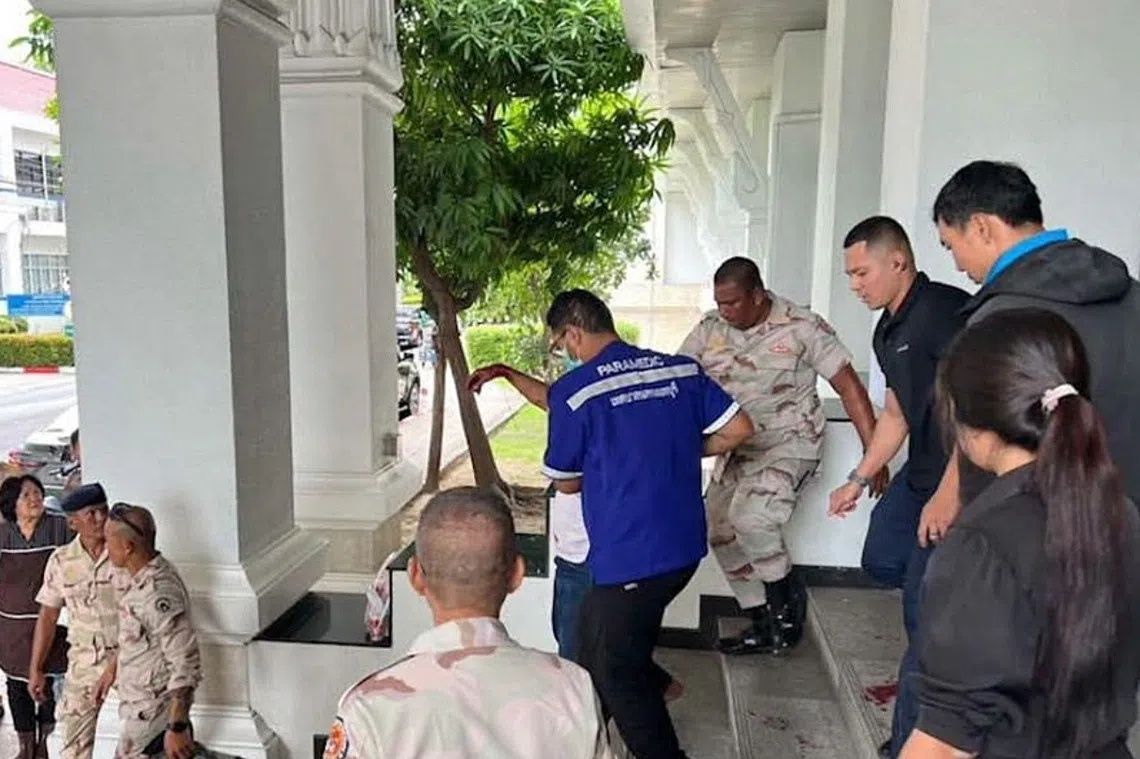
Thailand's struggle with firearms violence has intensified dramatically, with authorities reporting a shooting at a local government office on the outskirts of Bangkok on Monday that has further intensified calls for stricter gun regulations across the nation. The incident, involving a former lawmaker who opened fire at provincial officials, comes at an especially fraught moment for the Southeast Asian country, which is still reeling from one of its worst mass shooting incidents in recent memory that unfolded at a school in the same province just days earlier.
According to Major General Dejrapee Kongdee, the provincial police commander, the suspected shooter—identified as a former member of parliament—targeted a senior provincial official and his driver during the Monday assault. Both victims sustained injuries and were subsequently transported to medical facilities for treatment, the officer confirmed to international news agencies. The suspect was apprehended at the scene, bringing the immediate threat to an end, though details regarding the perpetrator's motivation and background remain under investigation.
The timing of this latest incident underscores the severity of Thailand's current firearms situation and the broader security anxieties gripping the nation. On Friday, a 14-year-old student carried out a shooting rampage at Debsirin Nonthaburi School that proved catastrophic in its human toll. The teenager first opened fire on his own grandparents before proceeding to the educational institution, where he wounded and killed multiple individuals before ultimately turning the weapon on himself. The attack resulted in nine confirmed deaths and wounded more than twenty others, marking Thailand's deadliest mass shooting event in nearly four years—a sobering reminder of how quickly violence can escalate and the devastating consequences when access to firearms remains insufficiently regulated.
The proximity of these two violent incidents has created a heightened sense of urgency within Thai society and among government officials tasked with public safety. Rather than treating the school shooting as an isolated tragedy that might gradually fade from public consciousness, Thai citizens are confronted with the reality that such violence can recur with alarming frequency. The interval between Friday's school massacre and Monday's government office attack is merely seventy-two hours, a timeframe that has crystallized public concern about whether current security measures and gun control protocols are adequate to protect civilians going about their daily lives.
In response to the escalating violence, Prime Minister Anutin Charnvirakul has signaled his government's intention to pursue comprehensive gun control legislation. During remarks made as schools resumed operations on Monday, the Prime Minister reaffirmed his commitment to implementing stricter measures governing firearm ownership, distribution, and registration across Thailand. This policy pivot reflects broader recognition among Thai leadership that existing regulations have failed to prevent individuals from obtaining weapons and using them in attacks that claim innocent lives.
The return of students to classrooms on Monday proceeded under heightened security conditions that would have been unimaginable in Thai schools just weeks ago. Metal detectors were installed at educational institutions, and enhanced screening procedures were implemented to verify the identity and intentions of all individuals entering campus grounds. These visible security measures serve as a tangible reminder to students and parents alike that the educational environment, traditionally conceived as a sanctuary for learning and development, has now become a space requiring active threat mitigation and protective infrastructure.
Thailand's gun violence problem reflects broader challenges common across the Asia-Pacific region regarding firearm accessibility and enforcement of existing weapons regulations. Unlike some nations with deeply entrenched gun ownership cultures, Thailand does not have a constitutional right to bear arms, yet firearms remain relatively accessible through legal channels and informal markets. The proliferation of weapons, combined with inadequate regulation and enforcement, has created conditions where individuals experiencing personal crises, grievances, or mental health challenges can too readily transform their distress into mass casualty events.
The school shooting perpetrator's age—merely fourteen years old—raises additional questions about juvenile access to firearms and the adequacy of family-level safeguards and parental oversight regarding weapon storage and security. Investigators will likely examine whether the teenager obtained the firearm through legal channels, theft, or black market transactions, findings that could inform future policy discussions about closing regulatory loopholes and strengthening enforcement mechanisms.
For Malaysian and broader Southeast Asian observers, Thailand's current crisis carries cautionary implications about the importance of maintaining strong gun control frameworks and continuously evaluating their effectiveness. Malaysia has historically maintained comparatively strict firearms regulations that have contributed to lower rates of gun violence compared to several regional neighbors. However, the Thai experience demonstrates that even societies without mass gun ownership cultures remain vulnerable to devastating mass shooting incidents when regulatory frameworks prove insufficient or enforcement lapses occur.
The international attention focused on Thailand's gun violence crisis also reflects how such incidents transcend national borders in their implications, generating regional concern about security and public safety standards. Thailand, as a major tourist destination and regional economic hub, faces potential impacts on visitor confidence and international business activity if perceptions of personal safety deteriorate significantly in the wake of multiple high-profile shooting incidents occurring in rapid succession.
Moving forward, Thai policymakers will face pressure to translate the Prime Minister's rhetorical commitment to gun control into concrete legislative measures that strengthen existing regulations and improve enforcement capabilities. The challenge will involve balancing legitimate security concerns with recognition that the vast majority of licensed firearm owners operate responsibly and use weapons for lawful purposes such as hunting or sport shooting. Nonetheless, the convergence of two major shooting incidents within seventy-two hours suggests that current safeguards may require substantial reinforcement to prevent future tragedies.
The path forward for Thailand will necessarily involve comprehensive examination of how firearms enter circulation, who possesses access to weapons, what screening and training requirements apply to gun owners, and what mental health resources exist to identify and assist individuals at risk of violence before they acquire weapons. International best practices from jurisdictions that have successfully reduced gun violence through regulatory reform will likely inform Thai policy discussions as the nation confronts what many observers regard as a critical moment for public safety reform.

