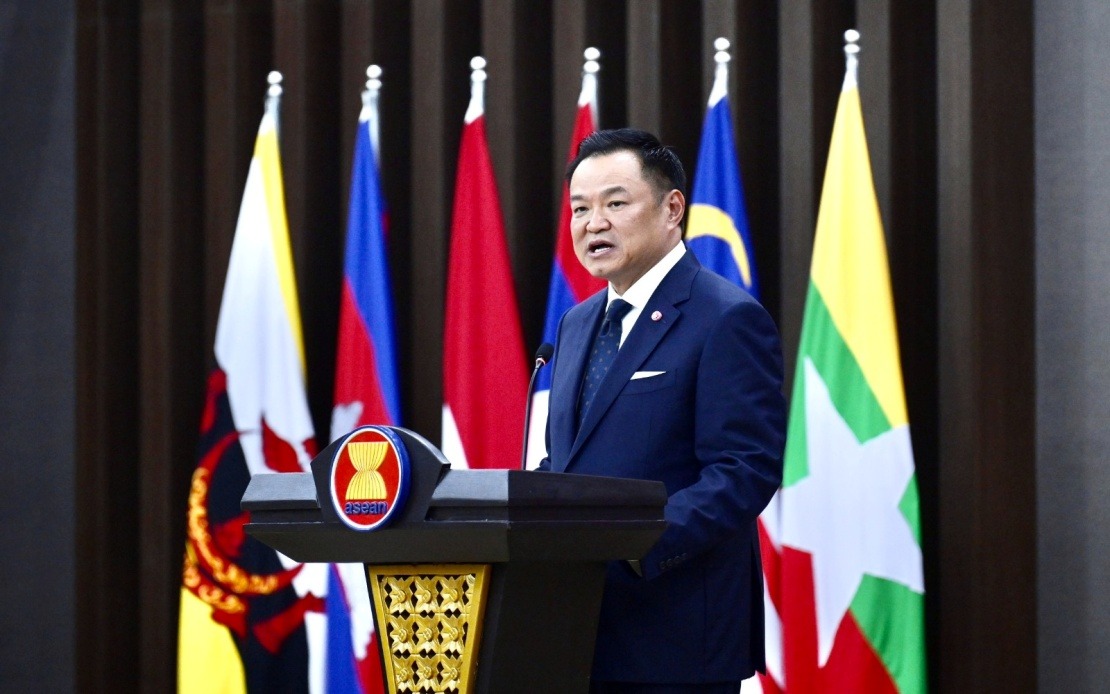
Thai Prime Minister Anutin Charnvirakul has delivered a three-part call for ASEAN to reinvent itself as a more cohesive, resilient and people-focused regional bloc. Speaking at the ASEAN Secretariat in Jakarta during an official visit to Indonesia, Anutin articulated a vision that goes beyond the organisation's traditional consensus-building approach, arguing that the grouping must adapt to navigate an increasingly complex geopolitical landscape while maintaining its core principles of unity and non-interference.
The prime minister's overarching argument rested on the premise that regional problems demand regional solutions. In an era marked by interconnected crises spanning geopolitics, economics, technology and security, no single ASEAN member state possesses sufficient resources or leverage to address these challenges unilaterally. This framing is particularly significant for Southeast Asia, where smaller nations like Thailand, Malaysia, Singapore and Vietnam have historically relied on multilateral forums to amplify their voice on the global stage. By emphasising collective action, Anutin has effectively restated a fundamental rationale for ASEAN's existence while signalling that the bloc must evolve its mechanisms to remain relevant.
Central to Anutin's proposal is a reexamination of how ASEAN operates. He specifically advocated for greater flexibility in applying the bloc's founding principles of consensus and non-interference, without abandoning them entirely. This marks a delicate rhetorical balance; many observers view ASEAN's consensus requirement as a brake on decisive action, particularly when member states hold divergent interests or when powerful external actors attempt to divide the group. By suggesting that consensus and non-interference should be applied more flexibly, Anutin has opened space for discussion about whether ASEAN can become more agile without losing the diplomatic suppleness that has made it invaluable to its members, especially smaller economies that benefit from a rules-based regional order.
The Thai premier outlined four concrete areas where ASEAN must prioritise action. Strengthening supply chains represents a response to the post-pandemic realisation that regional economies remain vulnerable to disruptions originating beyond Southeast Asia. Food and energy security carries obvious weight for a region that depends on imported oil and faces climate-related agricultural pressures. Digital connectivity and skills development acknowledge that Southeast Asia's youth must compete in a technology-driven global economy, while many countries still grapple with uneven broadband access and education gaps. Expansion of cooperation with middle powers and the Global South signals Thailand's view that ASEAN should cultivate strategic partnerships beyond traditional Western allies, diversifying its options and reducing dependence on any single power.
An underlying theme in Anutin's remarks was the necessity of proactive rather than reactive governance. By insisting that ASEAN must prepare for crises before they materialise, he implicitly critiqued the organisation's historical tendency to convene emergency meetings only after disaster strikes. This perspective gains traction when considering ASEAN's delayed responses to the Myanmar coup in February 2021, the Rohingya refugee crisis, and maritime disputes in the South China Sea. Building institutional capacity for foresight and early warning systems could enhance regional stability, though implementing such measures would require members to cede some autonomy to collective decision-making bodies—a prospect that sits uneasily with ASEAN's non-interference doctrine.
Thailand's position on Myanmar, articulated through Anutin's speech, reflects a pragmatic middle path between critics demanding ASEAN impose sanctions and voices arguing for engagement with the junta. The concept of "calibrated re-engagement" suggests maintaining dialogue while conditioning progress on observable improvements in governance and human rights. The International Committee of the Red Cross' visit to Aung San Suu Kyi, and reports that she remains in good health, are presented as evidence that this approach yields tangible outcomes. For Malaysian and other Southeast Asian readers, Thailand's strategy on Myanmar carries implications; if Bangkok's softer engagement strategy gains traction within ASEAN, it may influence how the region collectively manages other internal crises and transitions.
Thailand's bilateral relations with Cambodia also featured prominently in Anutin's Jakarta address. By pledging to rebuild mutual trust and resolve differences peacefully under international law, the Thai premier signalled willingness to move beyond historical grievances and border disputes that have occasionally strained the two countries' ties. This commitment to peaceful resolution through established legal frameworks demonstrates how ASEAN members are attempting to operationalise the principle of non-interference while still addressing legitimate security and sovereignty concerns. For Malaysia, which shares similar border complexities with Thailand and Indonesia, such precedents matter; they suggest that regional disputes need not become destabilising if managed through existing diplomatic and legal channels.
The timing of Anutin's visit merits attention. This represents the first official visit by a Thai prime minister to Indonesia in fifteen years—a substantial gap that underscores how diplomatic relations at the highest level had atrophied. Thailand's current prime minister, who assumed office in September 2025, appears intent on revitalising these crucial bilateral and multilateral ties. Indonesia, as ASEAN's largest economy and a founding member, wields disproportionate influence over the bloc's direction. A warming of Thai-Indonesian relations could facilitate consensus on key strategic issues and demonstrate to external powers that ASEAN retains capacity for unified action.
The framing of ASEAN's success in terms of tangible benefits to ordinary citizens represents a departure from technocratic discussions of regional integration. By emphasising stronger economic opportunities, improved security and effective action against transnational crime, Anutin has implicitly acknowledged that ASEAN legitimacy depends on delivering observable improvements in citizens' lives. This is particularly relevant for Malaysia, where public discourse increasingly scrutinises whether regional integration translates into job creation, safer streets and stable prices. Building ASEAN's popular legitimacy may prove as important as maintaining diplomatic protocols.
ANutin's declaration that Thailand intends to play a more active role in shaping ASEAN's future ahead of the bloc's sixtieth anniversary next year carries strategic weight. Thailand, historically overshadowed by Indonesia and Vietnam in regional affairs, appears positioned to become a more assertive voice for institutional reform and strategic adaptation. This ambition aligns with Thailand's geographic centrality in mainland Southeast Asia and its growing economic importance. For Malaysian policymakers and analysts, monitoring how Thailand's agenda resonates with other ASEAN members will provide insight into whether the regional organisation can genuinely evolve or whether divergent interests will frustrate ambitious reform initiatives.

