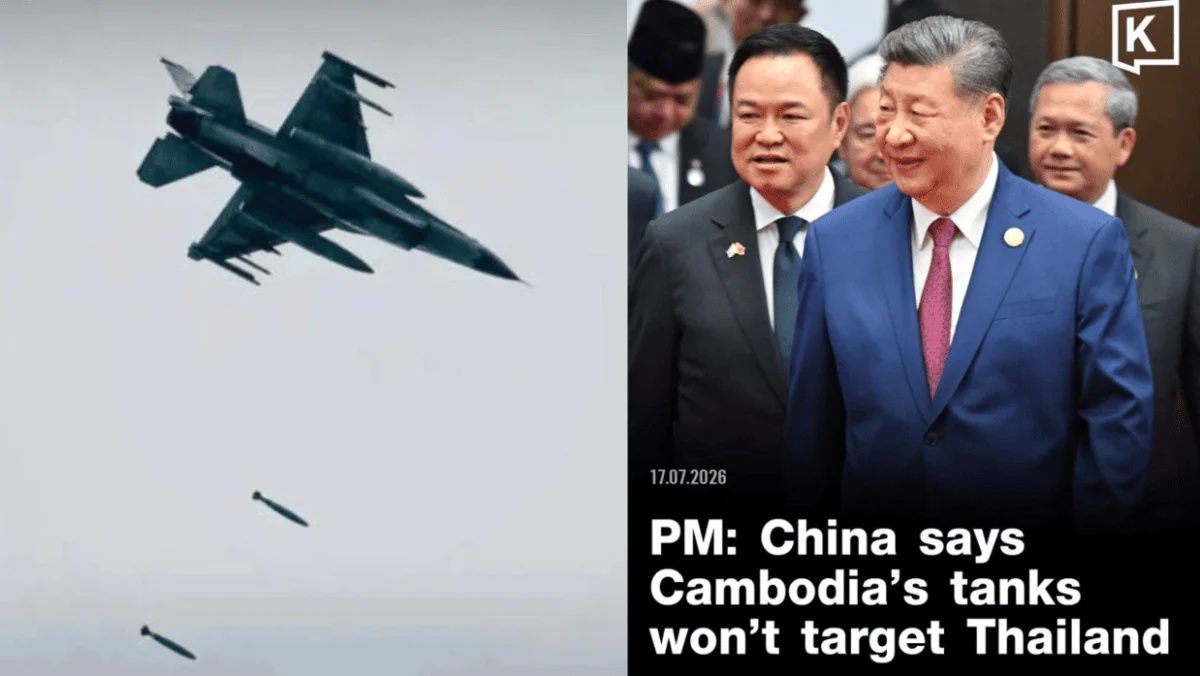
Thailand's recent expressions of concern about Chinese-supplied tanks arriving in Cambodia have exposed a fundamental inconsistency in how Bangkok frames regional military dynamics. Prime Minister Anutin Charnvirakul has stated that China assured Thailand the tanks would not be deployed against Thai forces, citing an existing procurement arrangement that was merely delayed due to border tensions. Yet this claimed reassurance remains unverified by Beijing's official statements, which instead emphasised peaceful dialogue between the two neighbours. The murkiness surrounding the "assurance" itself highlights how Thai political narratives have transformed what may be diplomatic courtesy into evidence of Cambodia's purported military aggression.
What makes this episode particularly instructive is the glaring asymmetry in how Thailand measures military preparedness and threatens. While Bangkok expresses alarm over Cambodia's tank deliveries, Thailand simultaneously operates a substantially larger armed force equipped with advanced F-16 and Gripen fighter jets, sophisticated surveillance systems, and numerous other modern weapons platforms. The disparity is substantial: Reuters has documented Thailand's significant superiority in both personnel numbers and equipment quality. Yet despite this overwhelming advantage, Thai military and government authorities consistently present Cambodia's comparatively modest defensive upgrades as imminent strategic threats warranting aggressive posturing.
This contradiction became particularly evident in mid-2026 when Thailand's Joint Information Centre announced continuous intelligence monitoring, ground patrols, and aerial surveillance operations along the border. More tellingly, Thai officials publicly emphasised their F-16 and Gripen fighters' ability to conduct all-weather operations and deploy weapons systems effectively. The Royal Thai Air Force subsequently described nighttime F-16 sorties near the Cambodian frontier as exercises demonstrating round-the-clock operational readiness. These actions, described by Thailand's defence ministry as "area-control measures," represent precisely the type of militarised rhetoric and visible force projection that Bangkok simultaneously claims to fear from Cambodian hands.
The underlying pattern extends further back. In June 2025, Thailand's military publicly announced preparations for "high-level military operations" and declared that army, navy, and air force units had elevated their combat readiness. This rhetoric was not mere bluster—by December 2025, the Royal Thai Air Force had confirmed conducting deep strikes against weapons facilities in Cambodia's Battambang province, explicitly framing the airstrikes as necessary to degrade Cambodian military capability. In both major confrontations during 2025, Thai forces initiated hostilities following extended periods of border provocation and inflammatory military announcements.
The logical inconsistency is stark: Thailand cannot reasonably classify its own fighter deployments, surveillance missions, military reinforcements, and area-control operations as routine national defence measures while simultaneously characterising every Cambodian weapon acquisition as evidence of aggression or provocation. International security arrangements do not function under dual standards where one nation enjoys unlimited latitude for military preparation while another must justify every piece of equipment it possesses. If Thailand's F-16 exercises, nighttime border patrols, and publicly announced combat readiness represent legitimate national security policy, then Cambodia's acquisition of defensive tanks falls squarely within comparable bounds of sovereign military management.
Behind the tank controversy lies a more revealing concern: Thailand's discomfort with any reduction in its overwhelming military dominance. Bangkok appears considerably more relaxed when it possesses unquestionable air superiority, vastly superior resources, and a credible capacity to threaten military escalation without meaningful consequence. Anxiety emerges when Cambodia acquires sufficient defensive capabilities to complicate or increase the costs of potential Thai military coercion. This is not necessarily evidence of fear regarding a Cambodian invasion—Cambodia has neither the capability nor demonstrated intent for such action. Rather, it reflects concern about the erosion of effective Cambodian deterrence, which might make future military pressure by Thailand more difficult to execute.
Under international law, the sovereignty and equality of states constitute foundational principles. The UN Charter obligates nations to resolve disputes peacefully, prohibits threats or force against territorial integrity, and recognises legitimate self-defence rights when armed attack occurs. Importantly, international law does not classify aggression by counting weapons acquisitions. The relevant questions concern whether force has been threatened or employed, whether borders have been violated, whether ceasefire commitments are being honoured, and whether disputes proceed through peaceful channels.
Frompractical and legal perspectives, defensive procurement differs fundamentally from offensive military action. Tanks in storage warehouses do not constitute the equivalent of fighter aircraft actively patrolling contested airspace. A weapons delivery does not, by itself, alter borders or threaten neighbouring populations. Military equipment sitting in inventory represents potential capability, whereas Thai fighter operations near the border and confirmed airstrikes represent actual military force projection. The distinction matters profoundly for any serious assessment of who poses genuine security risks and who is merely defending sovereign prerogatives.
Cambodia's right to modernise its defence forces derives from fundamental principles of state sovereignty, not from Thai political permission or approval. King Sihanouk's nation, like all UN members, possesses inherent rights to acquire defensive equipment through lawful international procurement and to maintain armed forces proportionate to reasonable security needs. No international obligation requires Cambodia to remain militarily subordinate to Thai superiority indefinitely, nor does international law prohibit a smaller state from acquiring equipment that enhances its deterrent capability.
The broader regional implications of Thailand's posture deserve consideration. If larger or militarily dominant states routinely frame any defensive capability improvement by smaller neighbours as unacceptable threats, the international system becomes destabilised. Such logic incentivises arms races and undermines the peaceful settlement mechanisms that the UN Charter promotes. Southeast Asia, already navigating complex territorial disputes and great power competition, benefits from clarity that state sovereignty permits reasonable self-defence preparation without requiring approval from more powerful neighbours.
Moreover, Thailand's public alarm serves as a cautionary reminder that military dominance alone does not guarantee strategic stability. Excessive reliance on superior firepower, combined with frustration when that advantage diminishes, can drive states toward military adventurism. The December 2025 airstrikes in Battambang demonstrated this dynamic: when Thailand possessed unquestioned air supremacy, it employed it. Bangkok's current anxiety about Cambodian tanks reflects recognition that unchallenged military dominance is fading, which should counsel restraint rather than escalation.
For Malaysia and other regional observers, the Thai-Cambodian dynamic illuminates important principles about how military relationships should function in a rules-based international order. States must be held to consistent standards regarding military preparation and use of force. Claims of security threat require substantive evidence rather than mere capability counts. And smaller states must retain genuine capacity to defend themselves without requiring permission from militarily superior neighbours. These principles benefit all Southeast Asian nations, particularly those without overwhelming military resources.

