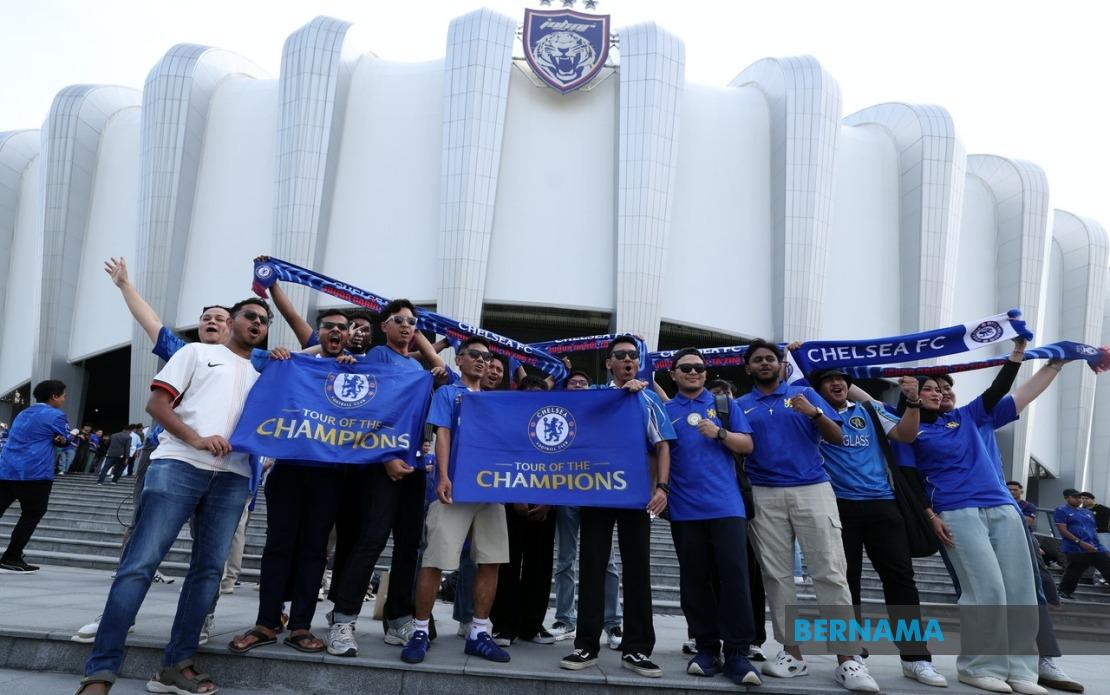
The Sultan Ibrahim Stadium in Iskandar Puteri transformed into a vibrant tapestry of crimson and blue on Saturday afternoon as football enthusiasts from across the region converged on the venue for a historic encounter between English Premier League champions Chelsea FC and Malaysian champions Johor Darul Ta'azim. From mid-afternoon onwards, the grounds became increasingly crowded as supporters sporting the distinctive colours of both clubs arrived in steady streams, creating an electric atmosphere that spoke to the growing appetite for world-class football in Malaysia.
The diversity of the crowd was immediately striking, spanning generations and demographics. Families brought their children to witness the spectacle, while groups of young fans energised the atmosphere with chants and displays of team spirit. Supporters seized every opportunity to capture memories against the stadium's striking architectural backdrop, turning the venue into an impromptu photo gallery as the evening progressed. The visual impact of thousands dressed in matching jerseys created the kind of sea-of-colour scenes that typically characterise major international football events, underlining the drawing power of top-tier club football when brought to Malaysian soil.
The commercial dimensions of the match were equally apparent, with merchandise vendors reporting brisk business throughout the afternoon and evening. Temporary retail stalls selling limited-edition items drew long queues as supporters sought to commemorate their attendance with exclusive memorabilia. This surge in merchandise activity reflects broader trends in Malaysian football consumption, where international fixtures increasingly carry significant commercial value beyond mere sporting interest, benefiting local vendors and creating employment opportunities around major events.
Geographic reach extended well beyond Johor's borders, with supporters from the Klang Valley making the journey south specifically for the occasion. Ahmad Danial Muhammad, a 28-year-old Chelsea devotee from Bangsar in Kuala Lumpur, represented this cross-country migration of fans. His connection to Chelsea spanned nearly two decades, tracing back to the Didier Drogba era when the club established itself as a major force in English football. For supporters like Ahmad, the presence of a Premier League club in Malaysia eliminated the traditional barrier of international travel costs and logistics, transforming what would normally require a transatlantic journey into a weekend excursion. He articulated what many international football fans in Malaysia feel: the rarity and value of witnessing elite players perform live without leaving the country.
The appeal extended across the border into Singapore, with supporters from the island nation taking the opportunity to attend. Tan Wei Sheng, a 34-year-old Chelsea fan from Singapore, demonstrated the logistical coordination some supporters undertook to ensure optimal viewing conditions. His decision to depart at midday specifically to navigate the Johor Causeway ahead of peak congestion illustrated the level of dedication the fixture inspired. Beyond the football itself, he highlighted the stadium's infrastructure as a draw, reflecting satisfaction among international observers regarding Malaysian sporting facilities and organisational capacity. His family's participation suggested that the match functioned as more than sporting entertainment—it represented a significant weekend experience worth cross-border travel and coordination.
For domestic supporters, the fixture carried symbolic weight extending beyond the 90 minutes of play. Mohd Khairul Anuar Ismail, a JDT loyalist from Melaka, contextualised the match within broader narratives surrounding Malaysian football's international standing. The selection of the Sultan Ibrahim Stadium as the venue for Chelsea's Malaysian engagement represented, in his assessment, validation that domestic clubs had achieved sufficient status to attract global names. This perspective highlights how international fixtures function within local football cultures not merely as entertainment but as indicators of progress and recognition. The implicit argument—that such matches would not occur without elevated standards in local football—resonates with long-standing Malaysian football discourse emphasising development and competitive advancement.
Female supporters constituted a notable and vocal segment of the crowd, reflecting diversification in Malaysian football's fanbase over recent years. Safiyah Rosli, a 32-year-old JDT supporter from Batu Pahat, articulated connections between Chelsea's appearance and broader political and institutional dimensions of Malaysian football governance. Her reference to Tunku Mahkota Ismail's leadership framework situated the match within narratives of strategic vision and administrative commitment to football development. This perspective demonstrates how international fixtures become inscribed within local political and institutional contexts, with supporters interpreting them as reflections of governance quality and long-term planning rather than isolated sporting events.
Logistical management proved largely effective despite anticipated challenges. By 7 pm—one hour before kickoff—traffic along principal routes to the stadium remained slow but navigable, suggesting that infrastructure planning and police coordination had successfully mitigated congestion risks. The Royal Malaysia Police's security presence and traffic management reflected recognition that international fixtures of this magnitude required comprehensive planning. Such coordination demonstrates the institutional capacity required to host major sporting events and the seriousness with which Malaysian authorities approached hosting Chelsea FC.
The fixture itself represented a convergence of multiple narratives within Southeast Asian football. For Malaysian fans, it symbolised aspirational standing within global football hierarchies and validated investments in domestic club development. For Chelsea, the match constituted part of broader international engagement strategies increasingly common among European clubs seeking to expand commercial and fan bases. For the region more broadly, the event demonstrated that geographic proximity to Asia no longer relegated Malaysian football to secondary status; instead, elite clubs actively sought opportunities to engage with Malaysian supporters and facilities. The attendance figures and atmosphere suggested that this particular fixture would be remembered as a milestone in contemporary Malaysian football history, marking a moment when the country's football infrastructure and fan culture successfully intersected with global elite-level club football.

