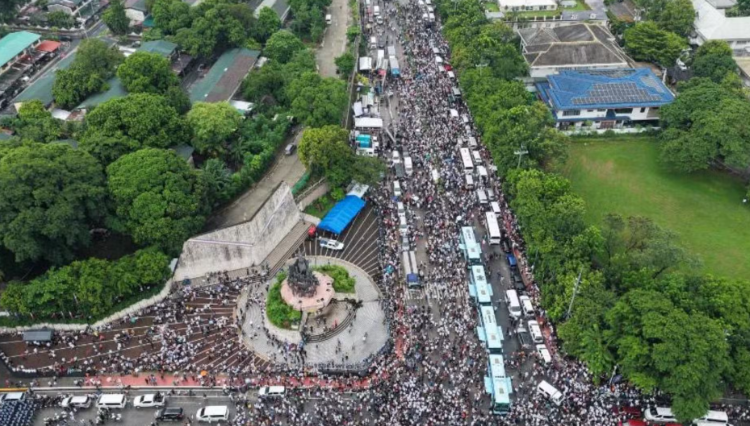
Manila witnessed a massive mobilisation on Tuesday as thousands of followers from the Iglesia Ni Cristo (INC), one of the Philippines' most influential religious organisations, descended onto the capital's streets to oppose criminal charges against Senator Rodante Marcoleta. The demonstration paralysed traffic across the sprawling EDSA thoroughfare during morning rush hour, with authorities initially tallying around 8,000 protesters but expecting the number to swell throughout the day. The unexpected disruption forced many commuters to endure lengthy delays, with only designated bus lanes remaining passable, underscoring the scale of the gathering and the sect's organisational capacity.
Marcoleta's legal predicament emerged just a day before the rally, when Ombudsman Jesus Remulla announced that the senator would face graft charges relating to his failure to declare 75 million pesos in unused campaign funds. This undeclared amount, valued at approximately 1.2 million US dollars, represents a significant compliance breach in Philippine electoral law. The timing of the charges carries weighty political implications, arriving precisely as the Senate prepares to convene for Vice President Duterte's impeachment trial, which officially commences on July 6. Marcoleta, as both a devoted INC member and a stalwart Duterte supporter, occupies a strategic position in the proceedings—his expected vote against conviction could prove decisive in preventing her removal.
The Iglesia Ni Cristo has long functioned as a potent political force in Philippine democracy, traditionally marshalling its substantial membership as a unified voting bloc. Historically intertwined with the Duterte family's political ascendancy, the organisation has repeatedly demonstrated its capacity to mobilise adherents for causes aligned with the former first family's interests. The 2022 presidential elections witnessed this bloc power on full display, and subsequent years have seen the INC consistently align with Duterte-aligned politicians facing legal challenges. The group's willingness to stage Tuesday's disruptive rally signals the organisation's determination to defend one of its prominent members and, by extension, to signal support for Duterte during her escalating constitutional crisis.
INC spokesman Edwil Zabala framed the protest as a demand for judicial impartiality rather than a crude political manoeuvre. In a Facebook video message, Zabala declared that the organisation's members gathered to ensure authorities heard their voice, pledging that incarceration would not silence their advocacy. The spokesman specifically invoked concerns about selective prosecution, arguing that differential application of justice constitutes an injustice itself. This rhetorical positioning—emphasising fairness and equal treatment under law—attempts to elevate the rally beyond mere political partisanship, though the timing and focus on a government adversary suggest deeper strategic calculations at play.
Marcoleta's legal troubles represent merely one strand in a broader pattern of legal jeopardy ensnaring Duterte loyalists. Senator Jose Estrada, another prominent member of the former president's political faction, faces serious corruption allegations stemming from his alleged participation in a massive scheme involving fraudulent flood control infrastructure projects. These charges emerged last month and generated considerable public anger over the apparent misappropriation of public funds. Similarly, Senator Ronald Dela Rosa, celebrated in certain circles for his enforcement role in the deadly anti-drug campaign, has absconded to avoid arrest on an International Criminal Court warrant. The convergence of these legal pressures on multiple Duterte allies creates a sense of coordinated vulnerability within their political network, potentially motivating collective responses like Tuesday's INC rally.
The Iglesia Ni Cristo's trajectory regarding flood control corruption reveals important nuances in the organisation's political positioning. In November, the sect mobilised hundreds of thousands of members in a separate demonstration addressing the flood control scandal, framing it as a national disgrace demanding accountability. Notably, many speakers at that earlier gathering directed blame toward President Ferdinand Marcos, suggesting the INC's capacity to balance competing political interests while maintaining its core commitment to the Duterte faction. More recently, in January 2025, the organisation orchestrated another mammoth rally opposing Duterte's impeachment, underscoring its role as the former president's most reliable institutional supporter despite her dramatic rupture with Marcos.
Vice President Duterte's impeachment proceedings represent the culmination of months of constitutional turbulence. Remarkably, the Supreme Court previously reversed an impeachment initiated by the House of Representatives, suggesting significant judicial complexity surrounding the charges. Yet the House pursued fresh impeachment proceedings last month, leading to the trial now scheduled to begin on July 6. The Senate requires sixteen affirmative votes from its twenty-four-member body to convict and remove Duterte from office while permanently barring her from future electoral participation. Marcoleta's expected opposition to conviction gains significance in this arithmetically tight contest, potentially preventing the attainment of the necessary supermajority.
The political rupture between Duterte and President Marcos—once close allies—fundamentally reshaped Philippine political alignments since Marcos assumed office. The deterioration manifested publicly when Marcos cancelled his planned luncheon with members of the foreign press corps on Tuesday, instead choosing to monitor the unfolding INC demonstration. This decision reflected the administration's concern regarding the rally's scale and implications, suggesting that presidential officials viewed the mobilisation as a significant political event rather than a routine protest. The chief executive's reallocation of his schedule underscored the demonstration's capacity to command elite attention and perhaps influence national political dynamics.
For Malaysian observers and Southeast Asian analysts more broadly, Tuesday's events illuminate the continuing relevance of institutional religious actors in Philippine democratic processes. Unlike some regional democracies where secularisation has marginalised religious organisations from formal politics, the Iglesia Ni Cristo maintains formidable capacity to mobilise members around explicitly political causes. This reality complicates conventional framings of Philippine democracy as a purely institutional contest among competing elites and political families. Instead, the INC's mobilisation reveals how powerful sectarian organisations function as shadow institutions mediating between electoral politics and civil society. The sect's strategic intervention on behalf of Marcoleta and, through him, Duterte, demonstrates that religious communities remain vital actors in contemporary Philippine governance struggles.
The broader implications extend beyond immediate legal proceedings. Tuesday's protest signals that despite mounting legal pressures and political setbacks, the Duterte faction retains access to substantial organisational resources capable of commanding public attention and disrupting ordinary governance. The INC's demonstrated willingness to subordinate normal civic routines—reflected in the paralysed traffic and disrupted commutes—indicates the organisation's confidence in its political mandate and its members' commitment to collective action. Whether such shows of force ultimately influence judicial outcomes or simply reinforce factional solidarity remains uncertain, but the spectacle itself validates the Iglesia Ni Cristo's continued role as a decisive actor in Philippine political struggles.

