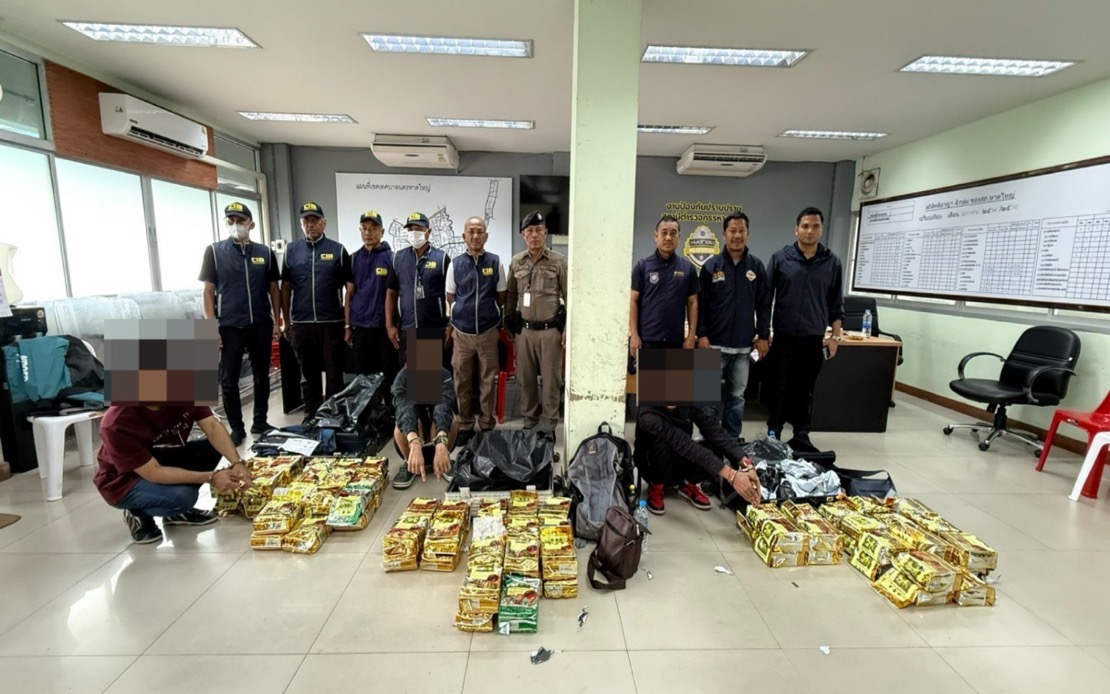
Thai narcotics authorities have apprehended three Malaysian men at Hat Yai Railway Station in Songkhla province following the discovery of a significant quantity of crystal methamphetamine concealed within travel luggage. The arrests, made on July 31, represent a significant interdiction in the ongoing efforts to combat transnational drug trafficking networks operating across the Malaysia-Thailand border.
The contraband, weighing 87 kilograms, was concealed across three wheeled suitcases and three backpacks when officers from the Tawan Hat Yai unit intercepted the suspects immediately upon their arrival at the station. The coordinated operation involved multiple Thai law enforcement agencies, including railway police, the Crime Suppression Division, the Anti-Trafficking in Persons Division, tourist police, the Narcotics Suppression Bureau, and the Region 9 Office of the Narcotics Control Board. This multi-agency approach underscores the significance Thai authorities place on disrupting major drug trafficking operations.
According to Ratchapon Palakul, director of the ONCB Region 9 Office, the three men had boarded a train in Bangkok with the destination of Hat Yai, where they were subsequently detained. Upon preliminary questioning, one of the detained individuals revealed details regarding the financial incentives offered by the trafficking syndicate. Each suspect had reportedly been promised RM8,000—equivalent to approximately 21,000 baht—to successfully transport the drugs across the international border into Malaysian territory. This compensation structure offers insight into the operational economics of these criminal networks and suggests the drugs were destined for distribution within Malaysia's domestic market.
The discovery carries particular significance for Malaysian authorities and the regional drug enforcement landscape. Crystal methamphetamine, commonly referred to colloquially as "ice," remains one of the most problematic synthetic drugs circulating throughout Southeast Asia. The sheer volume seized—87 kilograms—would represent a substantial street supply capable of servicing thousands of users and generating considerable illicit revenue for the trafficking organization. Had the consignment successfully crossed into Malaysia, it would have constituted a major supply infusion for local drug markets already grappling with methamphetamine proliferation.
Under Thai law, the three suspects face serious criminal charges relating to possession and trafficking of Category 1 narcotics with intent to distribute. Upon conviction, they potentially face up to 15 years imprisonment and fines reaching 1.5 million baht, approximately RM183,000. These penalties reflect Thailand's stringent approach to drug trafficking, a stance that has drawn international attention and remains controversial in some quarters due to concerns about enforcement methods, yet continues to define Bangkok's commitment to supply-side drug control.
The investigation into the matter remains active, with Thai law enforcement agencies prioritizing the identification of higher-level operatives within the smuggling network. The syndicate's mastermind and any additional accomplices remain at large, representing ongoing investigative priorities. Thai authorities recognize that apprehending street-level couriers, while important for disrupting immediate supply chains, constitutes only one component of comprehensive drug interdiction strategy. Understanding the organizational structure, funding mechanisms, and supply chains of these transnational operations provides crucial intelligence for dismantling trafficking networks at their source.
This incident illustrates the persistent challenges confronting regional governments in managing cross-border drug trafficking. The Malaysia-Thailand border, despite increased surveillance and cooperation initiatives, continues to serve as a transit corridor for contraband moving between production centers and consumer markets. The sophistication employed by smuggling organizations—utilizing commercial transportation networks, concealment methods, and financial incentive structures—demonstrates the adaptive nature of these criminal enterprises.
For Malaysian policymakers and law enforcement, the case reinforces the importance of sustained intelligence sharing and coordinated border operations with neighboring Thailand. The successful interdiction resulted directly from effective Thai enforcement and intelligence capabilities; however, preventing drugs from entering Malaysia ultimately requires comprehensive regional cooperation spanning intelligence gathering, port and border security, and demand reduction initiatives. The RM8,000 incentive offered to each courier also underscores the profitability calculations driving supply-side trafficking—individuals facing limited economic opportunities become vulnerable recruitment targets.
The broader context of Southeast Asian drug markets reveals methamphetamine as increasingly prominent across the region. Production facilities, particularly in the Golden Triangle area straddling Laos, Thailand, and Myanmar, continue manufacturing supplies despite international pressure and enforcement operations. These drugs subsequently flow through established trafficking routes into Malaysia, Singapore, and other regional destinations. The 87-kilogram seizure represents one among numerous interdictions occurring regularly, suggesting the true volume of successful smuggling operations remains substantially larger than law enforcement captures.

