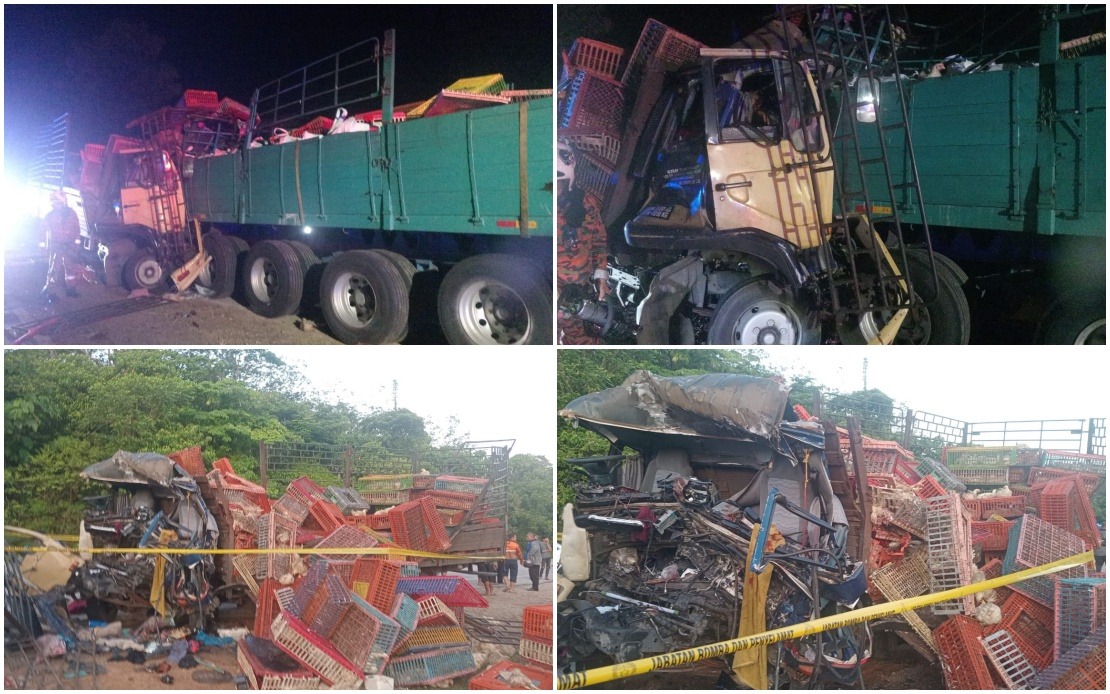
A fatal collision on the East-West Highway in Tanah Merah has claimed three lives following an early morning crash involving a five-tonne lorry carrying chicken. The incident occurred in the early hours of July 21, when the vehicle struck a trailer that was parked beside the road, resulting in all three occupants of the lorry becoming trapped inside the wreckage.
The victims have been identified as Norazeman Abdul Aziz, 42, who was operating the lorry, alongside two passengers: Mohammad Zakwan Mohd Nor, 16, and Mohd Haikal Hanifah, 29. All three men were confirmed dead at the scene by Health Ministry personnel after firefighters successfully extracted them from the damaged vehicle. The bodies were subsequently transferred to police custody for investigation and further procedures.
Emergency responders received notification of the accident through the NG999 emergency line at 4.26 am, prompting the Kelantan Fire and Rescue Department to dispatch personnel from both the Kemahang Fire and Rescue Station and the Tanah Merah station. The firefighting teams arrived at the crash location approximately 15 minutes later, at 4.41 am, to find the mangled five-tonne lorry embedded against the trailer parked on the highway's shoulder.
The rescue operation proved complex, requiring firefighters to employ extrication techniques to free the three trapped occupants from the crushed cabin of the lorry. According to a spokesperson from the Kelantan Fire and Rescue Department, the operation mobilized 12 firefighters with two engines from the respective stations. The scale of the response reflects both the severity of the collision and the difficulty rescue personnel faced in accessing and removing the victims from the wreckage.
This incident underscores persistent road safety challenges on Malaysia's major highways, particularly along the East-West Highway corridor that connects Kelantan to other northern states. The stretch through Tanah Merah has witnessed numerous accidents over the years, often involving commercial vehicles such as lorries engaged in agricultural or industrial transport. Early morning hours present particular hazards due to reduced visibility, driver fatigue, and the presence of stationary vehicles on roadsides that may not be adequately illuminated or marked.
The circumstances surrounding why the trailer was parked on the roadside remain unclear from initial reports, though investigations will likely focus on determining whether proper safety protocols were observed. This detail becomes critical in establishing liability and whether regulatory oversights contributed to the tragedy. Road transport operators and enforcement agencies face mounting pressure to implement stricter parking regulations and visibility standards for vehicles left unattended on active highways.
For Malaysian readers, particularly those in the northern corridor, such incidents highlight the importance of adhering to road safety measures, maintaining adequate following distances, and remaining alert during night-time driving. Commercial transport operators must balance operational demands with passenger and public safety, ensuring vehicles are adequately maintained and drivers receive sufficient rest. The loss of a teenage passenger raises additional concerns about passenger transport practices and supervision protocols.
The incident also reflects the demanding conditions faced by emergency response teams across Malaysia's states. The coordinated effort between multiple fire stations and the rapid deployment of rescue personnel demonstrate established protocols, yet the tragic outcome emphasizes that prevention remains superior to even the most well-executed rescue operation. Enhanced road infrastructure, better lighting, and stricter enforcement of parking and vehicle maintenance standards could potentially prevent such occurrences.
Autonomous and commercial vehicle safety remains an evolving challenge for Southeast Asia, with Malaysia's road fatality statistics among the highest in the region. This collision adds to the growing toll of highway accidents that claim lives daily across the country. Authorities and stakeholders must continue strengthening enforcement mechanisms, driver training programs, and road infrastructure improvements to reduce such tragedies.
The police investigation into this collision will determine whether mechanical failure, driver negligence, visibility issues, or other factors precipitated the crash. Findings from such inquiries often inform policy adjustments and industry guidelines, making transparent investigation outcomes valuable for broader road safety initiatives. Families of the deceased and the broader Kelantan community await clarity on the circumstances that led to this preventable loss of life.

