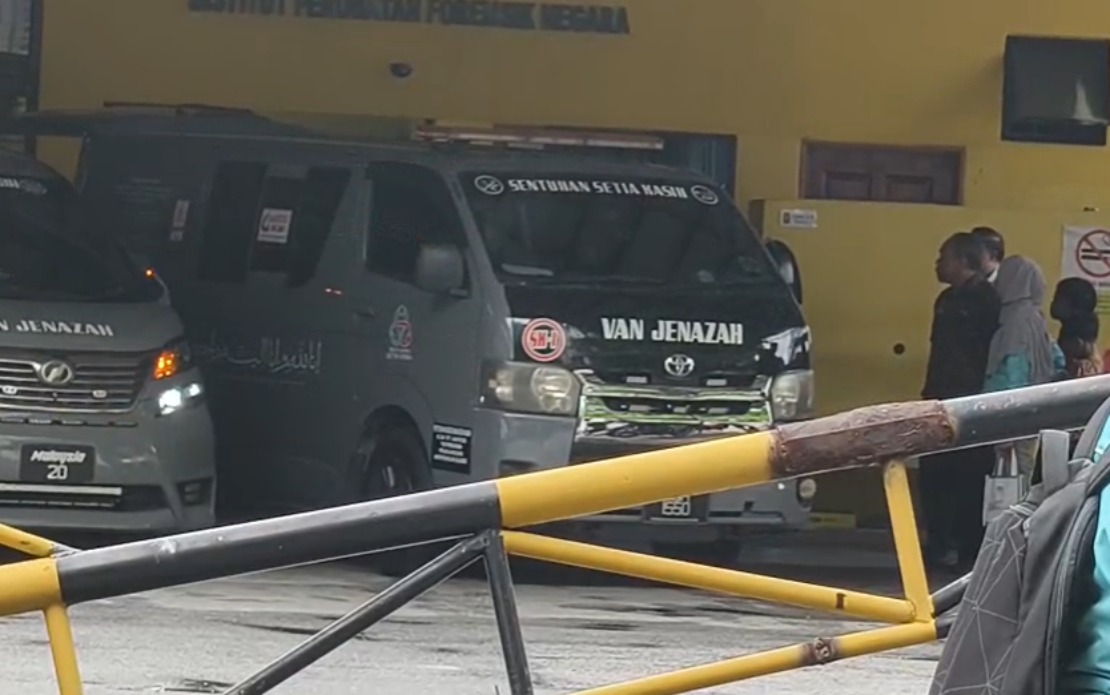
A tragic accident involving a Malaysian Immigration Department (JIM) lorry has claimed the lives of three members of a Perak family in Kuala Lumpur, with authorities completing post-mortem procedures by late Monday afternoon. The remains of Shaik Mohd Firdaus Shaikh Yahya, aged 53, and his two daughters Siti Nor Sazlin, 25, and Siti Darwisyah Auni, 12, were released from the National Institute of Forensic Medicine at Kuala Lumpur Hospital around 5:45 pm following completion of the medical examination. Three hearses conveyed the bodies to their next of kin for funeral arrangements, marking the conclusion of the investigative phase at the medical facility.
The incident unfolded in the early morning hours on Jalan Sultan Ismail when the JIM Black Maria lorry, empty of passengers at the time, allegedly breached traffic regulations at the Maju Junction intersection. Travelling toward Chow Kit with its emergency beacon and siren activated for what officials described as a planned raid against undocumented migrants, the vehicle reportedly proceeded through a red light. This violation placed it on a collision course with a Proton Saga that was lawfully proceeding through the intersection on a green signal, setting in motion a sequence of events that would prove fatal for the family travelling in the sedan.
The impact between the two vehicles proved devastating. The force of the collision caused the heavier JIM lorry to lose traction and skid across the roadway, subsequently mounting the kerb and striking four pedestrians who happened to be in the vicinity. The out-of-control vehicle also collided with an Inokom Matrix multi-purpose vehicle before coming to rest. The multiple points of impact created a scene of considerable chaos, with emergency services responding to injuries across several individuals and the involvement of multiple vehicles.
Amongst those affected, four people sustained injuries during the sequence of collisions, though details regarding the extent of their injuries and identities have been reported with one victim described as being in serious condition. The exact circumstances surrounding who was occupying which vehicle and how pedestrians came to be struck remain part of the ongoing investigation. For Malaysian readers familiar with road safety concerns in urban areas, this incident underscores recurring tensions between emergency vehicle operations and adherence to traffic laws designed to protect all road users.
The case has been classified under Section 41(1) of the Road Transport Act 1987, the statutory provision governing traffic offences of this nature. This classification typically addresses situations involving motor vehicles operating contrary to prescribed regulations, and investigators will need to establish precisely how and why the JIM lorry proceeded through the red light, whether equipment failures or human error contributed to the accident, and what safety protocols were in place for the emergency operation.
Following Islamic custom and practice, the three deceased are scheduled for ritual bathing and shrouding at Jamiul Ehsan Mosque on Jalan Pahang in Kuala Lumpur, where funeral prayers will be conducted before transport to their final resting place. Their burial will take place at Kampung Air Hitam Labu Muslim Cemetery in Kampar, Perak, returning them to their home state. This aspect of the incident carries particular significance for the bereaved family and their community in Perak, who will now contend with the sudden and traumatic loss of three loved ones.
The circumstances of this collision raise important questions about emergency vehicle operation and public safety in urban environments. While JIM lorries operating with emergency signals are performing legitimate law enforcement functions, the prioritisation of speed and response time must be balanced against the fundamental requirement that all road users, including emergency vehicles, maintain traffic discipline. The incident demonstrates that even authorised emergency operations cannot operate outside the framework of road safety regulations without serious consequences.
For the broader Malaysian driving public, the accident serves as a sobering reminder of how rapidly road conditions can change and how critical split-second decisions become in traffic situations. The involvement of a government agency vehicle and the fatalities that resulted will likely generate discussion about training standards, accountability mechanisms, and whether current protocols sufficiently protect the public from overzealous emergency operations. Investigators will need to determine whether the JIM vehicle's operator had received appropriate training for high-speed urban navigation and whether supervision protocols were adequate for the raid operation being conducted.
The incident also highlights the vulnerability of pedestrians and ordinary motorists to accidents involving larger government vehicles. The Proton Saga occupants, who appear to have been following traffic regulations correctly, bore the brunt of the collision through no apparent fault of their own. This asymmetry in risk exposure, where ordinary citizens face consequences from potential operational failures by state actors, continues to provoke debate about institutional accountability and the need for robust safety cultures within government agencies responsible for law enforcement activities.

