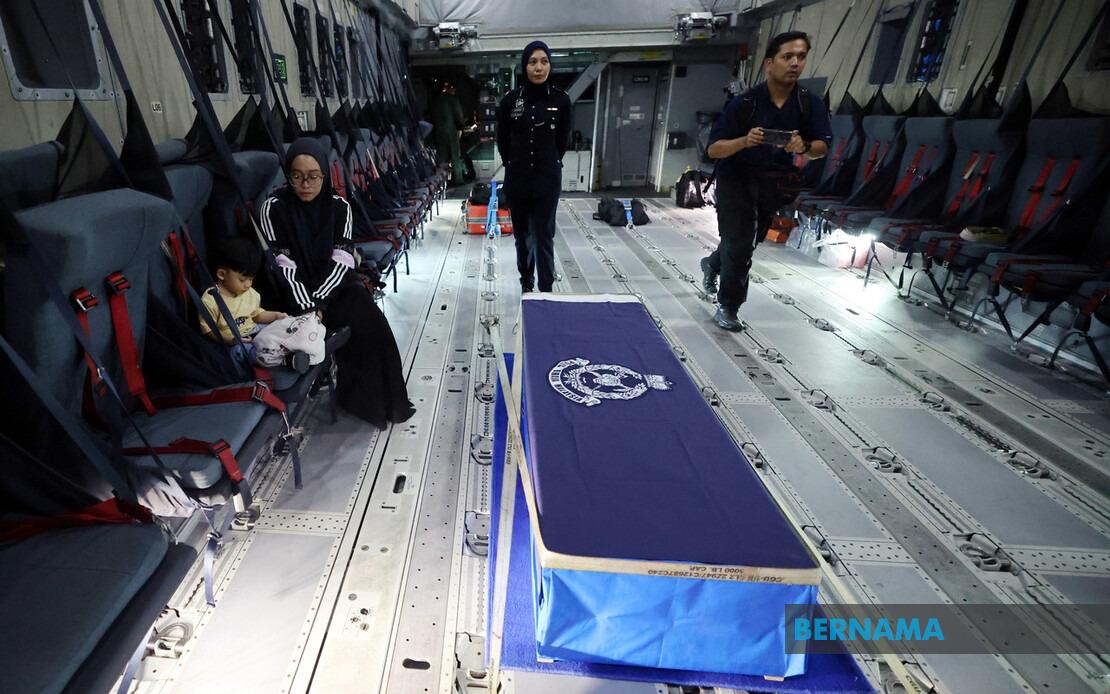
The mortal remains of three Royal Malaysia Police officers were transported to their respective home states on the evening of August 7 following a fatal electrocution incident in Beaufort, Sabah. The coordinated repatriation operation involved both the Royal Malaysian Air Force and the police air operations division, reflecting the significance of the tragedy and the administrative protocols governing the movement of fallen personnel.
Corporal Mohamad Nur Hafiz Ibrahim, aged 29 from Kelantan, and Constable Muhammad Raimi Ismarubee, aged 26 from Terengganu, departed Kota Kinabalu International Airport at 7.10 pm aboard an RMAF aircraft. The flight plan took the aircraft first to the RMAF Air Base in Kuantan before proceeding to Gong Kedak in Terengganu, where the two officers' remains would be received by their families and respective state authorities for final rites according to Islamic observances.
The third casualty, Corporal Chiu Teck Siong, a 40-year-old officer from Sarawak, was transported separately via the Royal Malaysia Police Air Operations Force facility in Kota Kinabalu before boarding a dedicated police aircraft bound for Sarawak. The decision to split the repatriation reflected logistical considerations and the geographic distribution of the officers' origins across Malaysian states, underscoring the national dimension of the tragedy.
All three officers had undergone post-mortem examinations at Queen Elizabeth Hospital in Kota Kinabalu starting at noon on August 7. The Forensics Department completed its procedures and released the bodies at approximately 2.56 pm, clearance that enabled the evening repatriation flights to proceed as scheduled. Such examinations are standard procedure in cases of sudden or unexplained deaths, ensuring that authorities establish precise cause of death and preserve evidence for any subsequent investigations.
The electrocution incident occurred at approximately 5.50 pm on August 6 outside Weston Police Station in Beaufort. Circumstances surrounding the exact cause—whether stemming from faulty electrical infrastructure, weather conditions, or other environmental factors—remained under investigation during the repatriation period. Such details typically emerge from formal inquiries conducted by police and occupational safety authorities in the following weeks.
The deaths underscore the occupational hazards faced by law enforcement personnel in Malaysia and the often-overlooked risks associated with police station infrastructure across the country. Beaufort, located in the southwestern region of Sabah, is a historically significant colonial-era town where such incidents prompt questions about the maintenance standards and safety protocols governing police facilities in rural and semi-urban areas.
For the families of the three officers, the repatriation signified the beginning of grieving processes that would unfold according to religious and cultural customs. In Malaysia's multi-religious society, the handling of such tragedies reflects deep communal values around honouring public service and acknowledging the sacrifices made by those in uniform. The involvement of high-level transport assets—military and police aircraft—demonstrates institutional recognition of the gravity of losing serving officers.
The incident raises broader concerns about infrastructure safety within government facilities across Malaysia. Police stations, like all public buildings, must maintain electrical systems meeting stringent safety standards to protect both officers and the public who enter these premises. Investigations into the Beaufort incident would likely examine whether applicable regulations were followed, whether maintenance schedules had been observed, and whether any warning signs had been overlooked.
From a regional perspective, such tragedies are not unique to Malaysia. Law enforcement agencies across Southeast Asia operate in varied infrastructure conditions, and electrocution remains an occupational risk in jurisdictions where building maintenance lags behind operational demands. The incident provides a sobering reminder of the importance of workplace safety compliance, particularly in institutional settings where officers spend extended periods.
The loss of three experienced officers—with Chiu's 40 years suggesting a career-long commitment to policing—represents institutional knowledge and operational capacity lost to the police force. The Royal Malaysia Police would need to document lessons learned from the incident and implement any recommended safety improvements across comparable facilities nationwide. Such institutional learning, while never compensation for loss of life, serves to prevent future tragedies.
As investigations proceeded into the circumstances of the electrocution, the focus for families and colleagues remained on the funeral arrangements unfolding in Kelantan, Terengganu, and Sarawak. The swift repatriation ensured that communities could gather to honour the fallen officers and provide support to grieving relatives, fundamental aspects of Malaysian society's response to tragedy within the police service.

