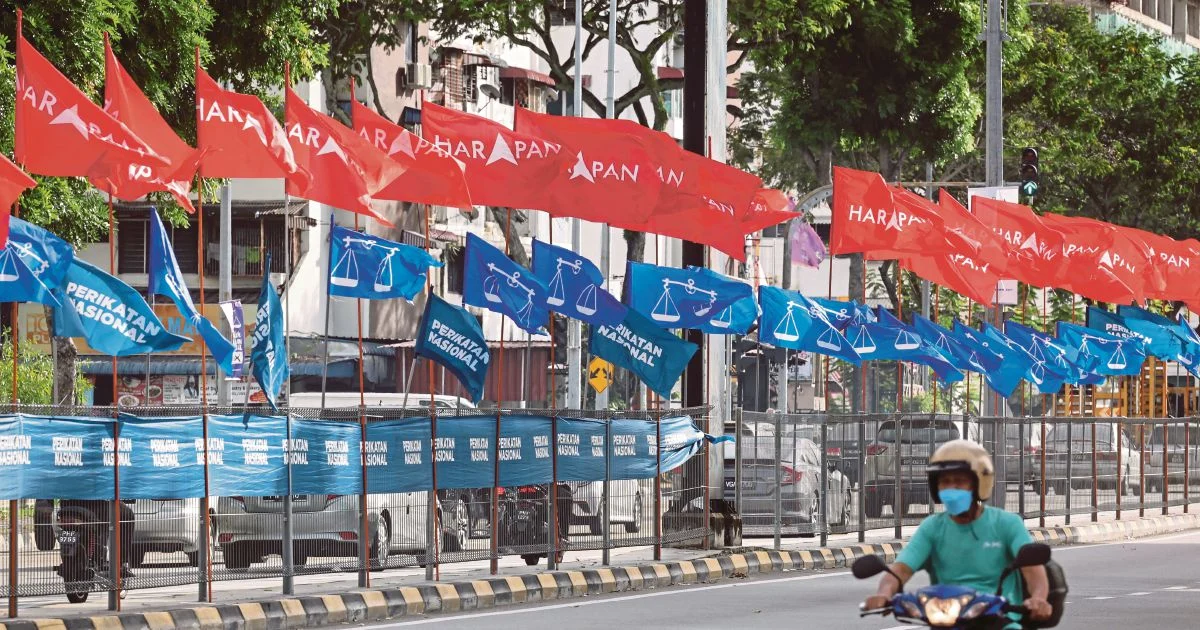
The upcoming Johor state election will be dominated by three-cornered fights, with Barisan Nasional, Pakatan Harapan and Perikatan Nasional all fielding candidates in 33 of the 56 available state seats. This configuration represents a significant shift in the electoral landscape of Malaysia's southern stronghold, breaking away from the traditional two-way contests that have characterised state politics in recent decades.
The presence of three major political coalitions simultaneously contesting nearly 60 per cent of all state seats fundamentally alters the competitive dynamics and voter choice calculus across Johor. Rather than facing binary electoral choices between established rivals, voters in these constituencies will now weigh competing visions and manifestos from three separate political frameworks, each claiming legitimacy and electoral viability. This multiplicity of options reshapes campaign strategies, messaging priorities and the likely distribution of votes across the peninsula's most industrialised state.
Barisan Nasional, as the incumbent coalition holding significant ground in Johor, faces a notably fragmented challenge compared to previous electoral cycles. The traditional two-sided confrontation that historically favoured the ruling coalition has given way to a more complex matrix where vote-splitting becomes a critical variable. Seats that BN has long considered safe territory now present unpredictable outcomes, as voters potentially distribute their support across three competing alternatives rather than consolidating behind an opposition challenger.
Pakatan Harapan's strategy in these three-way contests reflects the coalition's ongoing effort to regain foothold in a state where its support has remained contested and volatile. The presence of PN as an additional competitor significantly complicates PH's pathway to victory in many constituencies. Rather than executing a straightforward anti-establishment campaign, PH must now articulate distinctive policy platforms that differentiate it from both BN's incumbent position and PN's alternative Islamist-leaning approach, whilst simultaneously persuading voters that its coalition remains the viable opposition force.
Perikatan Nasional's expanded presence in 33 seats underscores the coalition's determination to establish itself as a meaningful force in Johor politics beyond its traditional strongholds. PN's entry into such a substantial portion of the electoral battlefield suggests considerable organisational capacity and confidence in its ability to compete effectively. The coalition's positioning relative to the Islamist-oriented infrastructure that has bolstered its credibility in certain demographics becomes particularly significant in three-way contests where ideological differentiation carries enhanced electoral weight.
The remaining 23 state seats, where three-way contests do not materialise, maintain more traditional bipolar structures. These constituencies likely reflect either PN's stronger incumbency positions, areas of consolidated opposition support, or regions where one major coalition has chosen strategic withdrawal to avoid splitting votes against a stronger local competitor. The geographic distribution of these two-cornered contests provides important insight into where each coalition considers itself strongest and where pragmatic concessions or tactical decisions have been made.
Three-way electoral configurations introduce pronounced volatility into vote distribution models and seat projections. Traditional swing analysis becomes substantially more complex when multiple parties compete for the same voter pool. Marginal seats that might have changed hands decisively in a bipolar contest can now produce entirely different outcomes through subtle shifts in vote distribution. A candidate winning with 35 or even 40 per cent of the vote could emerge victorious if opposition support fragments sufficiently, fundamentally reshaping expectations about what constitutes a safe or vulnerable seat.
Voter behaviour in three-way contests typically demonstrates reduced predictability compared to binary electoral choices. Undecided voters and swing constituencies become even more consequential, as determining which coalition will ultimately attract this pivotal segment becomes significantly more uncertain. Media coverage, ground-level campaign execution, and local issue salience gain enhanced importance in environments where marginal shifts in voter preference can dramatically alter electoral outcomes across multiple constituencies simultaneously.
The implications for Johor's governance extend beyond simple seat arithmetic. A fragmented electoral outcome producing a parliament where no single coalition commands overwhelming dominance could necessitate post-election negotiations, coalition-building, or even minority government scenarios. The state's economic development priorities, infrastructure investment trajectories and administrative continuity could all be influenced by the complexity of forming stable governing coalitions from three substantially weakened parliamentary positions.
For Malaysian political observers, the Johor election serves as a critical test case for the sustainability of three-coalition frameworks in state-level competition. The outcome will provide valuable data about whether Malaysia's electorate is genuinely gravitating toward multiple competing centres of political power or whether institutional pressures ultimately consolidate support around fewer alternatives. This electoral configuration also reflects broader regional patterns, as three-cornered fights have become increasingly prevalent across Southeast Asia's democratic systems.
The campaign period leading to polling day will inevitably focus substantial attention on these 33 three-way constituencies, as they represent the genuine battlegrounds where electoral outcomes remain genuinely uncertain. Candidates operating in these environments must appeal to broader segments of the electorate whilst maintaining party discipline and ideological consistency—a challenging balance that often determines whether campaigns successfully mobilise core supporters or alienate fence-sitters through perceived inconsistency or unclear positioning.

