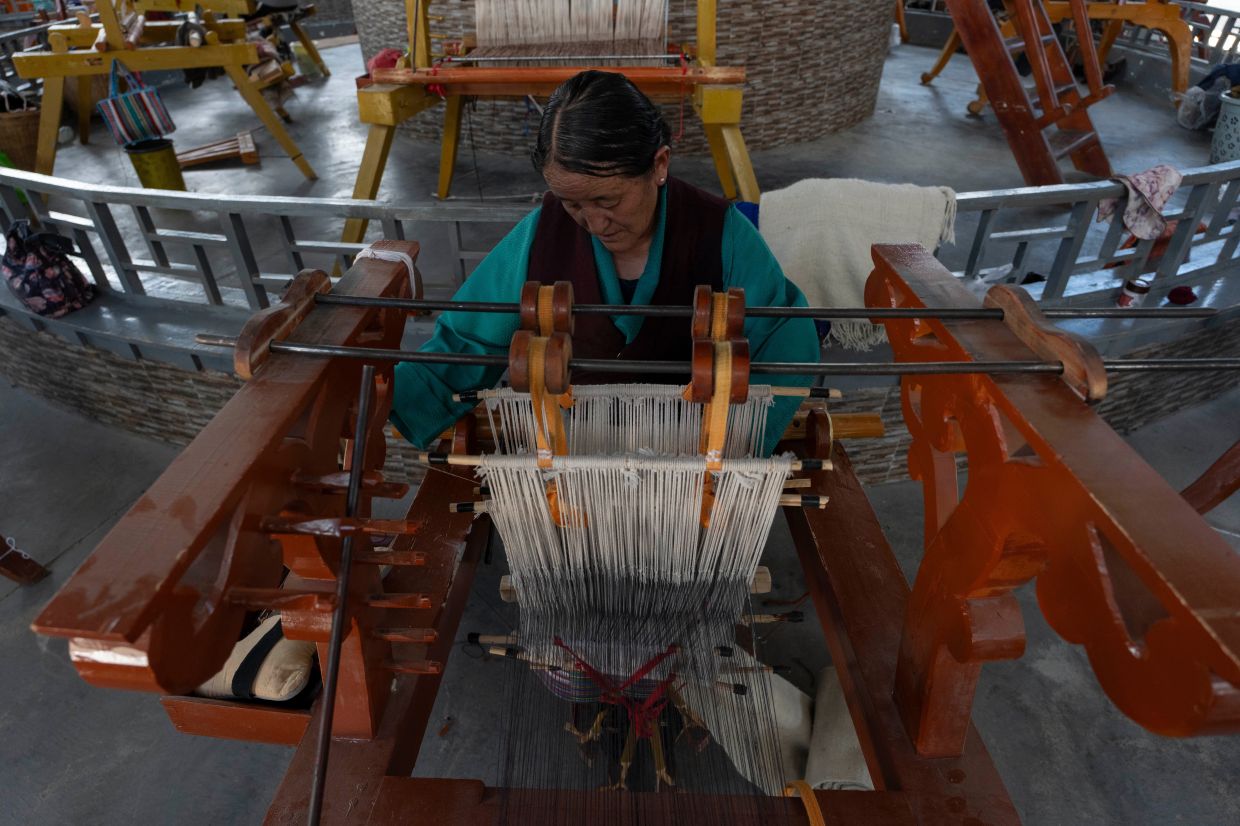
In a modest workshop on the Tibetan plateau, more than a hundred artisans work steadily at wooden looms, their hands moving in rhythmic motions perfected over centuries. The shuttle slides through rows of wool yarn in a hypnotic pattern—pull tight, repeat, continue. This is how Pulu, the traditional woolen fabric that has draped the shoulders of Tibetan people for hundreds of years, comes to life. At the Ethnic Huaji Handwoven Cooperative in Shannan, located at approximately 3,700 metres above sea level, this heritage craft remains not merely a nostalgic memory but a living, breathing economic reality for the community.
The cooperative, established in 2008 by master artisan Pasang, employs more than 100 people from the surrounding region, many of whom would otherwise struggle to find meaningful work. This employment extends notably to individuals with disabilities, reflecting a broader commitment to inclusive economic development in rural Tibet. The venture addresses a critical concern that Pasang witnessed firsthand—the near-extinction of a craft that had survived centuries of change. When he began learning from his parents, fewer than ten people in the entire region still possessed the knowledge to weave Zeter, the finest and most prestigious variety of Pulu, making the cooperative's existence almost a race against time.
Zeter represents the pinnacle of Tibetan weaving expertise. Distinguished from ordinary Pulu by its exceptional softness and delicacy, Zeter is crafted exclusively from the premium wool harvested from the necks and backs of sheep raised around Shannan. The spinning process itself demands greater skill and patience than standard Pulu production, as the finer wool resists traditional processing methods. According to Pasang, this superior quality earned Zeter such prestige that it was historically presented as a ceremonial tribute from Tibetan rulers to the Chinese imperial court during the Ming dynasty—a testament to its rarity and value across the centuries.
The craft's historical significance extends deep into Tibet's cultural narrative. Local tradition attributes the introduction of weaving techniques to the 7th century marriage between King Songtsen Gampo and Princess Wencheng of China. Statues commemorating this union stand at the centre of the workshop, surrounded by the wooden looms where modern artisans continue the work that legend says began with the princess's cultural contribution to Tibet. In the official historical accounts emphasised by Chinese authorities, this marriage symbolises the interconnected destiny of Tibetan and Chinese civilizations—a narrative that Pasang himself echoes when describing how Pulu weaving represents cultural synthesis rather than isolation.
Beyond its historical and cultural dimensions, the cooperative demonstrates how traditional crafts can address contemporary economic challenges in remote regions. The workshop operates as both a production facility and a training centre, with experienced instructors teaching newcomers the intricate techniques required for quality weaving. Tsering Yangchen, an 80-year-old resident who migrated to Shannan seeking employment, exemplifies the cooperative's impact on vulnerable populations. After struggling to find work in her adopted county, she joined the workshop where patient instruction transformed her into a skilled weaver. Her experience underscores how heritage crafts can provide dignified employment and social inclusion where other economic opportunities remain scarce.
The cooperative's commercial footprint has expanded steadily since its founding. The on-site showroom displays a diverse range of finished products—scarves, shawls, jackets, bags, and decorative items—all crafted from Pulu and Zeter wool. While the primary market remains within Tibet itself, the workshop has begun attracting customers from other regions of China, gradually building recognition for its distinctive products. This market expansion, however modest by national standards, represents significant progress for a craft that nearly disappeared within living memory.
The recognition of Pulu weaving as part of China's national intangible cultural heritage further legitimises preservation efforts and provides institutional support for the cooperative's mission. This official designation acknowledges what Pasang has devoted his life to demonstrating: that ancient crafts possess enduring cultural value beyond nostalgia or tourism. For younger Tibetans growing up in an era of rapid modernisation, the cooperative offers proof that mastering traditional skills need not condemn one to economic hardship. Instead, it can provide meaningful, reasonably paid work while contributing to the survival of cultural practices that define Tibetan identity.
The broader implications of the Ethnic Huaji Handwoven Cooperative extend across Southeast Asia and the wider region. As rural communities throughout the Himalayan and plateau regions grapple with youth migration to cities, economic stagnation, and cultural erosion, the cooperative model presents a viable alternative to accepting cultural loss as inevitable. By creating sustainable employment within the traditional craft sector, Pasang's enterprise demonstrates that heritage preservation and economic development need not conflict. Instead, when properly structured and marketed, cultural traditions can become economic assets that benefit entire communities while maintaining the skills and knowledge systems that define particular peoples.
The cooperative's success also raises important questions about cultural authenticity and economic justice in heritage industries. Notably, the workshop pays fair wages to its workers and maintains quality standards that reflect genuine traditional methods rather than mass-market approximations. Workers like Tsering Yangchen wear the garments they produce, attesting to the functional quality and authentic value of the products. This stands in contrast to heritage industries elsewhere that exploit cultural narratives while providing minimal benefit to the communities whose traditions they commodify.
Looking forward, the sustainability of the cooperative depends on attracting and retaining younger weavers willing to invest years in mastering a craft that offers modest financial rewards compared to urban employment. Pasang's expressed hope that younger generations will continue the practice reflects both optimism and underlying concern about transmission. Each artisan trained represents not merely an additional production worker but a guardian of centuries-old knowledge. The cooperative thus functions simultaneously as a business enterprise, cultural institution, and repository of living heritage that validates the experiences and identities of the Tibetan plateau communities it serves.

