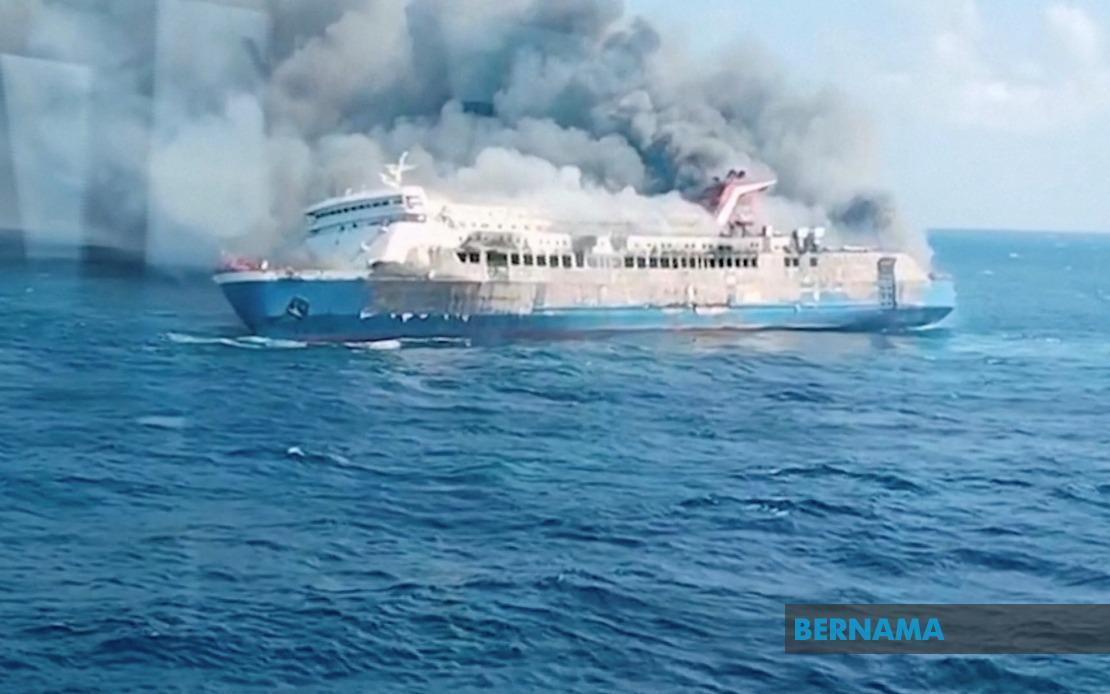
Rescue authorities in Indonesia have mobilized significant military and civilian maritime assets to locate dozens of people unaccounted for following a catastrophic fire aboard the KMP Mutiara Sentosa II passenger ferry in the northern waters off Madura. The coordinated search effort, entering its second day on Monday, reflects the scale of the incident and the challenge of locating missing persons in open ocean conditions. The deployment underscores Indonesia's commitment to mounting rapid response operations following maritime disasters, a critical capability given the archipelago's extensive shipping corridors and reliance on sea-based transport.
The passenger ferry was operating under a full manifest, carrying 232 passengers alongside 39 crew members when fire broke out in waters north of Sumenep, Madura, at approximately 8.24 am local time on Sunday. Maritime officials reported that flames rapidly consumed much of the vessel, rendering portions of the ship unusable and hampering evacuation efforts. The speed at which the fire spread highlighted vulnerabilities in maritime safety protocols and raised questions about onboard fire suppression systems and emergency preparedness measures—issues that are particularly pertinent to regional shipping operations across Southeast Asia, where passenger ferries remain a vital transportation backbone despite recurring safety concerns.
The Surabaya Search and Rescue Office, under the leadership of Chief Nanang Sigit, has coordinated the deployment of an expanded roster of search assets following the initial response. In addition to the Indonesian National Armed Forces warship KRI Bung Hatta-370, rescue teams have positioned the State Ship Grantin P.211 and patrol vessel Manyar 5003 across the affected waters. The East Java Police contributed helicopter assets to enable aerial surveillance and extend the geographic reach of the operation. This multi-agency approach demonstrates standard procedures for large-scale maritime emergencies in Indonesia, integrating military, civilian maritime authorities, and police resources to maximize search effectiveness across both surface and airborne domains.
As of Monday's update, rescue personnel had successfully evacuated 229 survivors to Tanjung Perak Port in Surabaya, where medical personnel conducted immediate health assessments and treatment. The concentration of survivors in a single designated port facility streamlined medical triage procedures and allowed healthcare providers to document injuries systematically. However, the significant discrepancy between total persons aboard and those accounted for indicates that rescue operations remain ongoing and the final casualty figures remain uncertain. The evacuation of survivors to a major port rather than dispersed coastal settlements enabled coordinated response but also raised logistical challenges for families seeking information about missing relatives.
Five fatalities had been confirmed and transported to Bhayangkara H.S. Samsoeri Mertojoso Hospital in Surabaya by Monday morning, though maritime authorities anticipated that additional bodies might be recovered during continued search operations. Identification of deceased victims typically requires time, particularly in maritime disaster scenarios where bodies may require forensic examination. The hospital's role as a dedicated casualty reception facility reflected Indonesia's established protocols for managing mass casualty events, though the emotional and administrative burden on families awaiting identification results represents an often-overlooked aspect of maritime disasters.
The KMP Mutiara Sentosa II fire occurs within a troubling pattern of maritime incidents affecting Indonesian shipping routes. Ferry operations in Indonesia and across the wider Southeast Asian region have experienced periodic accidents linked to aging vessel fleets, insufficient maintenance, overcrowding, and inconsistent enforcement of international maritime safety standards. While Indonesia has implemented various regulatory frameworks and safety improvements following previous disasters, implementation gaps remain, and vessel inspection protocols vary across provinces and port authorities. The incident raises questions about whether the KMP Mutiara Sentosa II had undergone recent safety certifications and whether its fire suppression systems had been properly maintained.
For Malaysian observers, the incident carries particular relevance given the shared maritime environment and the frequency of regional vessel movement across the Strait of Malacca and through Indonesian waters. Malaysian shipping operators and passengers using Indonesian ferry routes should recognize that safety standards and emergency preparedness vary significantly across vessels and operators. The rescue operation's apparent effectiveness in evacuating the majority of passengers also demonstrates that when systems function properly, survival rates in maritime emergencies can be substantial, provided that vessels are equipped with functional lifeboats and crew members are adequately trained in evacuation procedures.
The broader implications extend to maritime governance across Southeast Asia. The incident underscores the need for harmonized safety standards, regular inspections, mandatory crew training, and transparent incident reporting systems that enable authorities to identify systemic vulnerabilities. Regional cooperation through organizations such as the Association of Southeast Asian Nations could facilitate information sharing about vessel safety records and support capacity-building initiatives in maritime emergency response. Indonesian authorities' relatively rapid mobilization of search assets suggests that early warning systems and inter-agency communication protocols are functioning, though the incident also indicates that prevention—through robust maintenance and safety enforcement—remains preferable to emergency response.
The search operation's continuation into its second day emphasizes the challenges of maritime rescue in open water, where weather conditions, sea state, and visibility significantly impact recovery efforts. Search and rescue personnel face not only the technical difficulty of locating missing persons in expansive ocean areas but also the physical and psychological demands of sustained operations. Families of missing passengers meanwhile confront uncertainty and anxiety as the operation proceeds, a human dimension that international incident response protocols sometimes inadequately address. Support services for affected families and trauma counseling for rescue personnel represent important but often underfunded aspects of maritime disaster response.
Looking forward, the KMP Mutiara Sentosa II incident will likely trigger investigations by Indonesian maritime authorities into the vessel's operational history, maintenance records, crew qualifications, and the specific circumstances that allowed fire to spread so rapidly. Such investigations typically require several weeks and can generate recommendations that extend beyond the specific vessel to influence industry-wide practices. The findings may prompt regulatory changes, either through increased inspection frequency, mandatory equipment upgrades, or revised crew training requirements. Regional shipping operators and passengers should monitor authorities' final conclusions, as these investigations often reveal systemic issues that affect multiple vessels and operators.

