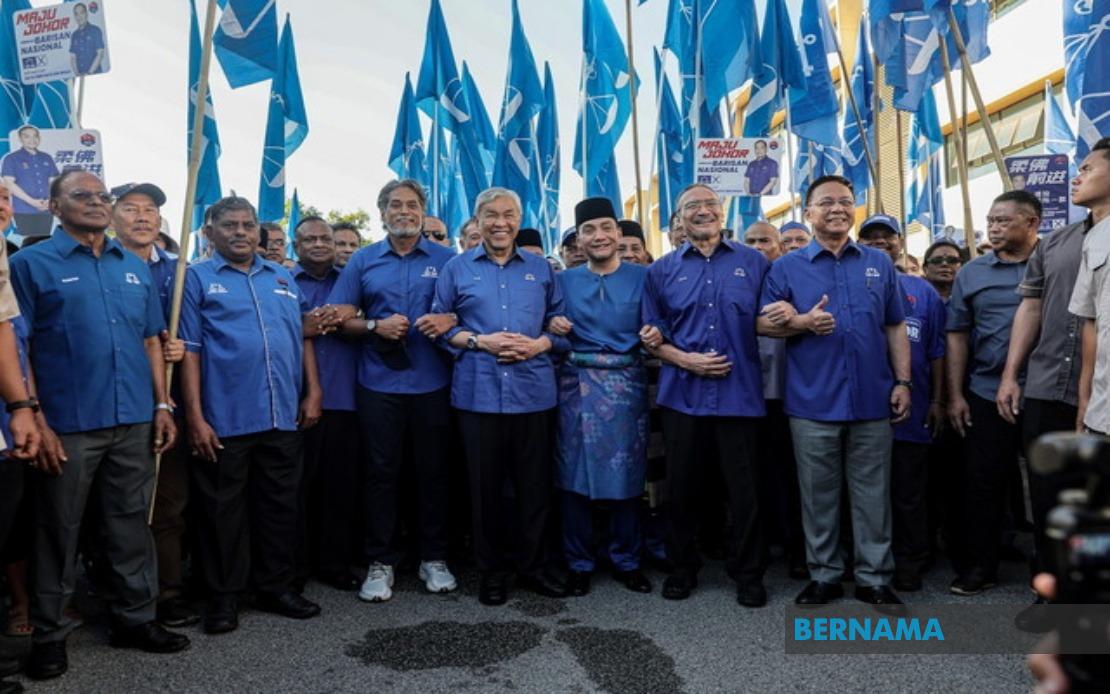
Johor's Barisan Nasional leadership moved swiftly to assert its electoral readiness as Datuk Onn Hafiz Ghazi, the coalition's state chairman, lodged his nomination papers for the upcoming state election. The ceremony took place at the Muafakat Hall of the Simpang Renggam District Council at 9.10 am, with the incumbent Machap state assemblyman receiving visible backing from UMNO's highest echelons. The appearance of senior party figures alongside Onn Hafiz underscored the coalition's determination to project a unified front heading into what promises to be a closely watched electoral contest in one of Malaysia's most politically significant states.
The show of strength was unmistakable. UMNO president Datuk Seri Dr Ahmad Zahid Hamidi made the journey to Simpang Renggam to witness Onn Hafiz's filing, a gesture laden with symbolic weight in Malaysian political circles. Alongside him came Sembrong MP Datuk Seri Hishammuddin Tun Hussein, whose presence bridged parliamentary and state-level politics, as well as former minister Khairy Jamaluddin. The attendance of these heavyweight figures signals that Kuala Lumpur's UMNO leadership views the Johor campaign as strategically vital, not merely a routine state election but a bellwether for broader coalition fortunes.
Former Johor Menteri Besar Datuk Seri Hasni Mohammad added another layer to the delegation, his presence invoking continuity with the state's recent political past. The gathering of such a phalanx of party elders at a nomination ceremony—an event that typically involves routine administrative procedures—reflected deeper anxieties within BN about maintaining dominance in Johor. Historically, the state has served as a BN stronghold, but recent electoral trends have prompted the coalition to intensify its ground game and leadership engagement.
The nomination centre itself became a focal point for partisan energy as supporters from various BN component parties converged on the venue. Dressed in party colours and armed with banners and flags, these grassroots supporters created the visual spectacle that has become standard fare in Malaysian electoral contests. Their presence was not merely decorative; it demonstrated that party machinery had been mobilized well ahead of polling day, with local chapters and branch structures galvanized to show support for candidates.
Onn Hafiz's political trajectory has made him a significant figure within Johor BN circles. As the incumbent Machap state assemblyman, he carries both the advantage of incumbency and the burden of defending his seat against challengers who may capitalize on any perceived governance gaps. His elevation to BN state chairman reflected broader organisational changes within the coalition aimed at tightening coordination between federal and state-level structures. The deployment of top federal UMNO leadership to his nomination filing suggested that his electoral success was being treated as emblematic of broader coalition performance across the state.
For Malaysian observers of electoral politics, the gathering signalled continuity in BN's approach to state elections: marshalling federal resources and prestige to bolster state campaigns. This model has served the coalition well historically, particularly in Johor where federal patronage networks have deep roots. However, the intensity of effort on display—bringing the UMNO president himself to a nomination ceremony—also hinted at underlying concerns about complacency or erosion of the coalition's traditional support base.
The Johor state election represents another crucial test for BN's ability to consolidate power in a context where opposition coalitions have grown increasingly sophisticated in their campaigning and ground organisation. Unlike the 2022 general election, which saw BN perform credibly in parliamentary contests, state elections often pivot on local issues and community-level grievances. Johor, with its significant Chinese and Indian populations alongside its Bumiputera majority, requires BN to maintain its carefully calibrated multi-ethnic appeal.
The presence of Hishammuddin, who commands significant influence in Sembrong and enjoys a substantial profile in national politics, underscored the parliamentary-state nexus that BN seeks to leverage. Cross-fertilisation between federal and state campaigns has become standard in Malaysian electoral contests, with MPs and state assemblymen operating as interlocking networks of political patronage and resource distribution. The Johor election will likely see extensive mobilisation of such networks as the campaign progresses.
Khairy Jamaluddin's attendance carried particular significance given his previous ministerial roles and his standing within younger UMNO circles. His presence represented an attempt to project generational continuity and modernity within the party, countering any narrative that BN campaigns rely solely on veteran politicians. The inclusion of party figures spanning different age cohorts and political backgrounds reflected a deliberate strategy to present BN as an inclusive coalition capable of appealing across demographic divides.
The Simpang Renggam nomination centre, located in the northern part of Johor, served as the venue for this carefully orchestrated display of party unity and organisational strength. The choice of location itself carried strategic implications, as northern Johor districts have historically been competitive battlegrounds where BN's dominance cannot be assumed. The mobilisation of grassroots support in this region, alongside the dramatic arrival of federal leadership, sent clear signals to local voters about the coalition's commitment to retaining control.
As the 16th Johor state election campaign unfolds, nomination days like this will multiply, with opposition coalitions launching their own candidates and mounting parallel shows of organisational prowess. The electoral calendar will accelerate dramatically in the coming weeks, transforming Johor's towns and villages into campaigning grounds where established parties and emerging challengers vie for voter attention. Onn Hafiz's filing, bolstered by his party's leadership apparatus, represents merely the opening move in what promises to be a fiercely contested state election with implications extending well beyond Johor's borders into the broader Malaysian political landscape.

