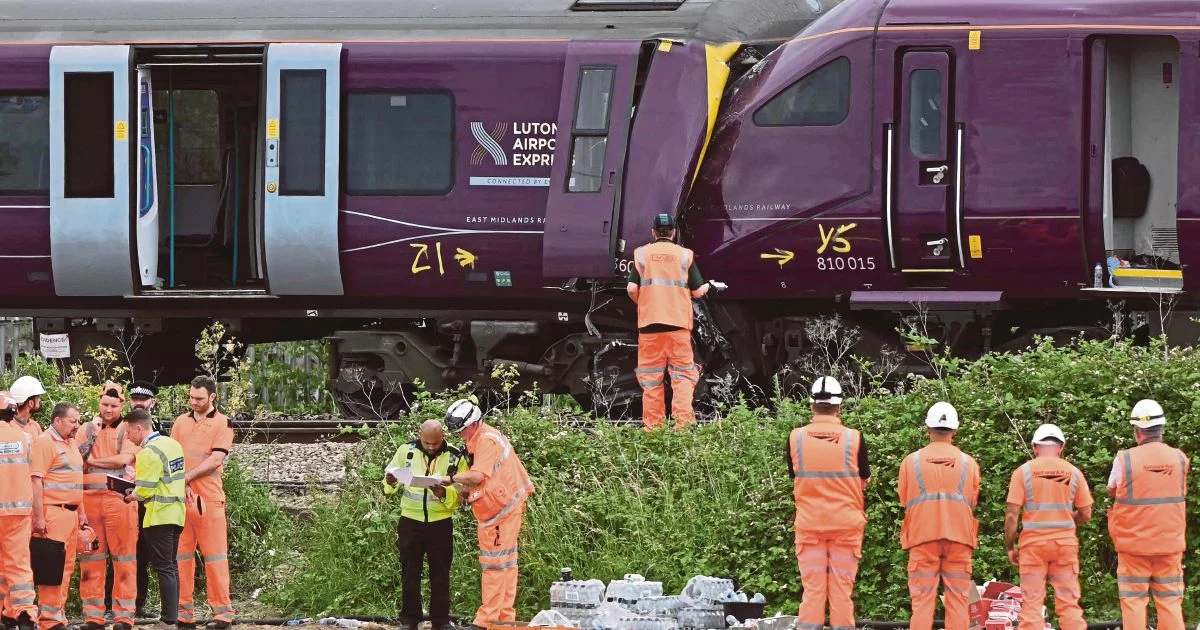
A major rail incident unfolded north of London on Saturday as UK accident investigators moved swiftly to determine the circumstances surrounding a train collision that claimed one life and sent 28 people to hospital. The driver fatality marks a stark reminder of the inherent risks facing railway staff who operate heavy machinery carrying hundreds of passengers daily across congested corridors. Among the injured, nine passengers and personnel sustained injuries deemed critical by emergency services, underscoring the severe violence of the impact.
The collision occurred in the Bedford area, a region that forms part of England's busy Midlands Main Line network connecting London with cities further north. Bedford itself sits roughly 50 miles from central London and serves as a crucial rail hub for commuters and long-distance travellers. The timing of the incident on a Saturday suggests the trains may have carried substantial passenger loads, though exact figures remain unclear pending full investigation. This section of the network experiences significant daily traffic, making any disruption a substantial logistical concern for both passengers and railway operators.
Emergency response teams mobilised rapidly to the scene, extracting casualties from wreckage and triaging the injured according to severity. The presence of nine critically injured individuals meant that hospital emergency departments across Bedfordshire and neighbouring counties had to activate major incident protocols, coordinating bed availability and specialist trauma teams. The speed and coordination of such responses represent decades of refinement in UK emergency planning, yet they underline the capacity for rail incidents to overwhelm local healthcare resources simultaneously.
For Malaysia and Southeast Asian observers, such incidents prompt reflection on regional rail safety standards. While UK railways operate under stringent regulatory frameworks with decades of safety culture embedding, developing nations across Southeast Asia continue building comprehensive rail networks that must balance expansion with safety rigour. The incident serves as a case study in how even mature, well-established rail systems can experience catastrophic failures, suggesting that ongoing vigilance, investment in infrastructure maintenance, and driver training protocols remain perpetually necessary regardless of a nation's development stage.
Investigators from the UK's dedicated accident investigation authority would have secured the scene to preserve evidence, including examining track conditions, signal systems, and train telemetry data that typically records speed and operational parameters in the moments preceding collision. Weather conditions at the time, driver fatigue protocols, maintenance schedules for both trains involved, and communication between rail control centres would fall within the scope of preliminary inquiries. Modern rail incidents rarely result from single-factor causes; instead, they typically emerge from confluence of mechanical, human, and systemic elements that collectively overwhelm safety margins.
The driver fatality raises particular questions about protective systems and cabin design. Train operators in Britain work within strictly regulated shift patterns intended to minimise fatigue-related errors, though human factors remain difficult to entirely eliminate. Whether the deceased driver was operating under standard conditions or responding to an emergency situation would significantly influence the investigation's direction. Preliminary reports typically emerge within days, though comprehensive findings often require weeks or months as metallurgists examine wreckage, engineers model collision scenarios, and regulators interview witnesses.
Rail networks across Southeast Asia, including Malaysia's KTM Berhad operations and the newer MRT systems in Kuala Lumpur, operate under frameworks increasingly influenced by international safety standards. This UK incident provides valuable comparative data, particularly regarding response protocols, investigation methodology, and the human and infrastructure factors that contribute to rail safety. Malaysia's expansion of rail infrastructure through projects like the Klang Valley Double Tracking and planned high-speed rail corridors will require vigilant application of lessons learned from incidents abroad.
Passenger confidence in rail networks hinges significantly on perceived safety and the transparency of investigation processes following incidents. Public communication during the immediate aftermath carries weight in maintaining public trust, particularly as details of casualties spread through media and social channels. UK authorities would likely emphasise their commitment to determining facts objectively and implementing remedial measures, a transparency approach that contrasts with some international responses that prioritise minimising reputational damage over information sharing.
The broader implications extend to workforce safety culture and investment in preventive infrastructure. Driver wellbeing, robust maintenance schedules, investment in collision avoidance systems, and staff training represent significant ongoing costs for railway operators globally. Yet the human and economic costs of major incidents—in this case, one life lost and 28 injured—render such investments undeniably cost-effective. Malaysia's rail operators would benefit from studying this incident's investigation outcomes, particularly recommendations regarding signalling systems, train spacing protocols, and emergency response coordination that might enhance safety across regional networks as they expand to meet growing demand.