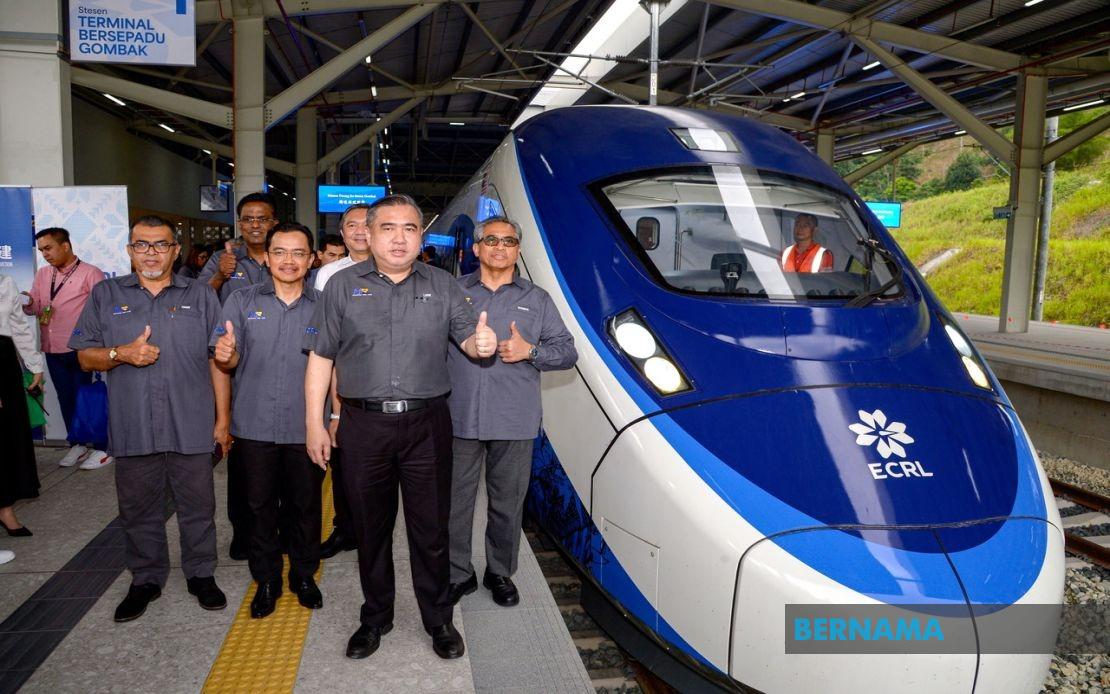
Malaysia's Transport Minister Anthony Loke Siew Fook has set an ambitious December 2024 target for the East Coast Rail Link (ECRL) Phase 1 service to commence between Kota Bharu and Gombak, dramatically accelerating the project's original January 2027 completion date. The acceleration aims to deliver regional connectivity benefits years earlier than previously planned, though the minister has emphasised that achieving this accelerated timeline remains contingent upon the satisfactory progression of ongoing technical validation processes.
The expedited schedule hinges primarily on the successful completion of two critical testing phases: System Integration Testing (SIT) and Fault-Free Run (FFR). These validation procedures represent standard but rigorous international protocols designed to ensure that complex railway systems function safely under operational conditions. Loke has stressed repeatedly that Malaysia Rail Link Sdn Bhd and primary contractor China Communications Construction Company Ltd must intensify their efforts to complete these phases while maintaining uncompromised safety standards. The minister's insistence on this point reflects broader government concerns about public confidence in major infrastructure projects, particularly those involving international partnerships.
The accelerated certification timeline represents a significant departure from conventional railway project management practices. Typically, testing and certification processes consume two to three months, a period that Loke indicated the government hopes to compress substantially. To facilitate this compression, the Land Public Transport Agency (APAD) is being mobilised to streamline administrative and bureaucratic requirements associated with testing protocols and certification sign-offs. This institutional coordination signals a whole-of-government approach to realising the transportation benefits of the ECRL investment, even as it raises questions about whether procedural shortcuts might inadvertently introduce safety vulnerabilities.
Phase 1 of the ECRL project currently stands at 95.08 percent completion as of July 2024, representing substantial physical and systems integration progress. The comprehensive 640-kilometre corridor linking Kelantan's capital to Malaysia's industrial heartland in Selangor has required unprecedented coordination between Malaysian authorities and Chinese contractors. Beyond mere construction completion, the railway infrastructure must now demonstrate that its electrical systems, signalling protocols, and operational mechanics integrate seamlessly across this extended distance.
The SIT process beginning this month represents the first major validation checkpoint, systematically testing how various technical subsystems communicate and coordinate across the entire network. This precedes the FFR scheduled for September, during which the first train set and electric locomotive must traverse 8,000 kilometres under APAD supervision without passenger load, simulating real operational conditions to verify safety and reliability benchmarks. These stages are sequential rather than parallel, meaning delays in SIT directly cascade through the project timeline.
Loke's emphasis on pre-shipment testing conducted in China provides additional context for the acceleration ambitions. Train components and locomotives underwent extensive factory validation before delivery to Malaysia, theoretically reducing the burden of Malaysian-stage testing. However, railway systems inherently behave differently on purpose-built networks than in factory environments, making comprehensive local validation non-negotiable regardless of prior testing pedigree.
For Malaysian transport users and Southeast Asian observers, the ECRL Phase 1 acceleration carries substantial implications. Successful earlier delivery would represent a genuine achievement in megaproject execution, delivering regional connectivity that can reduce intercity travel times and encourage economic integration between Malaysia's east and west coasts. Conversely, any safety incidents resulting from compressed testing timelines would severely damage confidence in major infrastructure initiatives and potentially prejudice future government commitments to large-scale transportation projects.
The project's Phase 2 extension, connecting Gombak to Port Klang, maintains its original December 2027 completion target with operations commencing January 2028. This staging allows Phase 1 to function independently and prove operational viability before the network extends further westward toward critical port and industrial infrastructure. The two-phase approach provides a built-in validation mechanism whereby Phase 1 performance data directly informs Phase 2 optimisation strategies.
Loke's repeated reassurances about safety prioritisation—stating bluntly that government officials harbour greater anxiety about potential risks than the general public—reflect an implicit acknowledgement that acceleration pressures can create institutional temptation to compromise rigour. The minister's willingness to articulate this tension suggests confidence in the underlying project management discipline, though such confidence requires continuous institutional reinforcement throughout compressed timelines.
The ECRL represents one of Malaysia's most significant infrastructure commitments in recent decades, with total investment exceeding RM60 billion. Its successful implementation carries geopolitical significance beyond transportation efficiency, demonstrating Malaysia's capacity to execute complex infrastructure partnerships with Chinese entities while maintaining safety and quality standards. Any deviation from these standards would reverberate through government credibility and future bilateral project negotiations across the region.
The December target therefore functions simultaneously as an operational milestone, a political commitment, and an institutional test of whether Malaysia's regulatory frameworks can accommodate acceleration pressures without creating safety vulnerabilities. The presence of high-level officials including the Chief Secretary to the Government and Chinese Ambassador Ouyang Yujing at the launch underscores the project's visibility and the stakes attached to its successful realisation within the accelerated timeframe.

