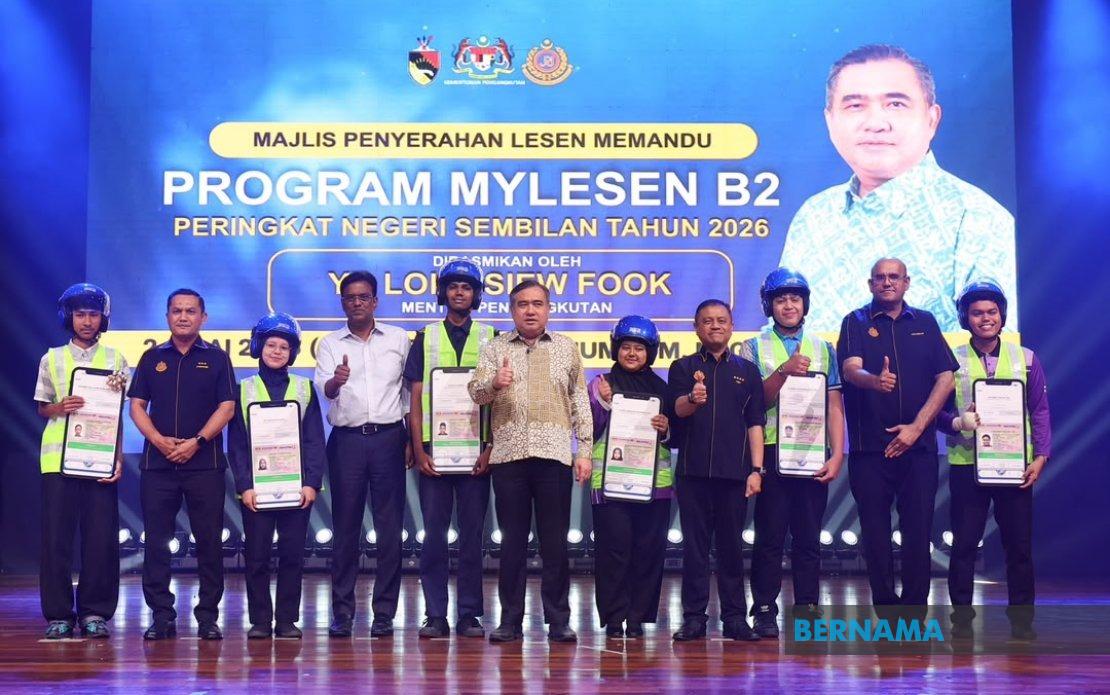
Transport Minister Anthony Loke has issued a pointed reminder to young Malaysians receiving motorcycle licences through the government's MyLesen B2 Programme, stressing that the free certification carries a duty to ride safely and respect traffic regulations. Speaking at a licence presentation ceremony in Seremban on July 2, Loke emphasised that the document represents permission to travel legally on public roads, not a ticket to engage in dangerous or illegal driving behaviour.
The minister's warning reflects serious concerns about road safety among Malaysia's younger demographic. According to ministry data, approximately 60 per cent of annual road fatalities in the country involve motorcyclists and pillion riders, with the vast majority of victims aged under 30. This demographic concentration underscores why the government is targeting young licence recipients with safety messaging, positioning road awareness as integral to the licensure process itself.
Loke used the occasion to paint a stark picture of the stakes involved in road behaviour. He appealed directly to recipients to prioritise their personal safety and that of their peers, framing weekend rides and social outings as opportunities to demonstrate maturity rather than recklessness. He specifically cautioned against illegal racing on public roads and any involvement in organised speed-testing activities, characterising such conduct as incompatible with responsible licence-holding.
The MyLesen B2 Programme has emerged as a flagship government initiative aimed at democratising access to motorcycle licences among lower-income Malaysians. Since its launch in 2023, the scheme has enabled over 100,000 individuals nationwide to obtain riding credentials without cost, thereby removing a significant financial barrier to legal mobility. The programme is explicitly designed to support employment prospects, educational access, and socioeconomic advancement by ensuring that financial constraints do not prevent young people from legally commuting to work or study.
Negeri Sembilan represents a microcosm of the programme's expansion. The state's participant quota has doubled from 1,000 in the previous year to 2,300 this year, reflecting growing demand and government commitment to rural and semi-urban accessibility. Of the expanded cohort, 1,979 individuals have successfully obtained their Learner's Driving Licence, while 1,879 have progressed through training to secure their Probationary Driving Licence, indicating a high completion rate among enrolled participants.
Legislative reinforcement of road safety messaging has coincided with these initiatives. The Dewan Rakyat recently passed the Road Transport (Amendment) Bill 2026, which significantly strengthens penalties for illegal racing and speed testing across all vehicle categories. Under the new provisions, individuals apprehended by the Road Transport Department or police for participation in organised illegal racing now face not merely monetary fines but potential imprisonment, elevating the offence from administrative to criminal status. This legislative shift reflects parliamentary recognition that voluntary compliance messaging alone has proven insufficient to deter organised street racing culture, particularly among young riders.
Loke's remarks also underscore the Transport Ministry's dual commitment to both accessibility and safety. The MyLesen B2 Programme is not framed as a standalone licence distribution initiative but as part of a holistic strategy to build what ministry officials describe as a more comprehensive and sustainable transport ecosystem. This ecosystem encompasses not just licence issuance but also training standards, safety equipment requirements, and enforcement mechanisms designed to protect new riders from themselves and from other road users.
Equipment standards featured prominently in Loke's safety directives. He explicitly urged all new licence holders to wear only SIRIM-certified helmets whenever riding or travelling as pillion passengers, underscoring that safety gear remains non-negotiable regardless of journey distance or perceived risk. The emphasis on certification standards reflects evidence that substandard or counterfeit protective equipment contributes to injury severity in motorcycle accidents, a concern particularly acute in Malaysia's warm climate where riders may be tempted to forgo or minimise helmet use.
The presence of senior Transport Ministry and Road Transport Department officials at the Seremban event—including Secretary-General Datuk Seri Jana Santhiran Muniyan and Road Transport Department Director-General Datuk Aedy Fadly Ramli—signalled institutional commitment to programme implementation and safety reinforcement. Their attendance conveyed that road safety messaging originates from the highest levels of transport governance, lending weight to the minister's warnings and framing motorcycle safety as a national rather than merely local concern.
For Malaysian policymakers, the MyLesen B2 Programme exemplifies how social inclusion initiatives can be paired with public safety objectives. By removing cost barriers while simultaneously intensifying safety messaging and strengthening legal consequences for dangerous behaviour, the government attempts to expand legal mobility access without creating a cohort of unlicensed or safety-indifferent riders. However, the programme's long-term success depends partly on whether legislative penalties and safety messaging can actually influence behaviour among young riders drawn to motorcycle culture, whose attraction to speed and risk-taking may exceed rational cost-benefit calculations regarding legal consequences.

