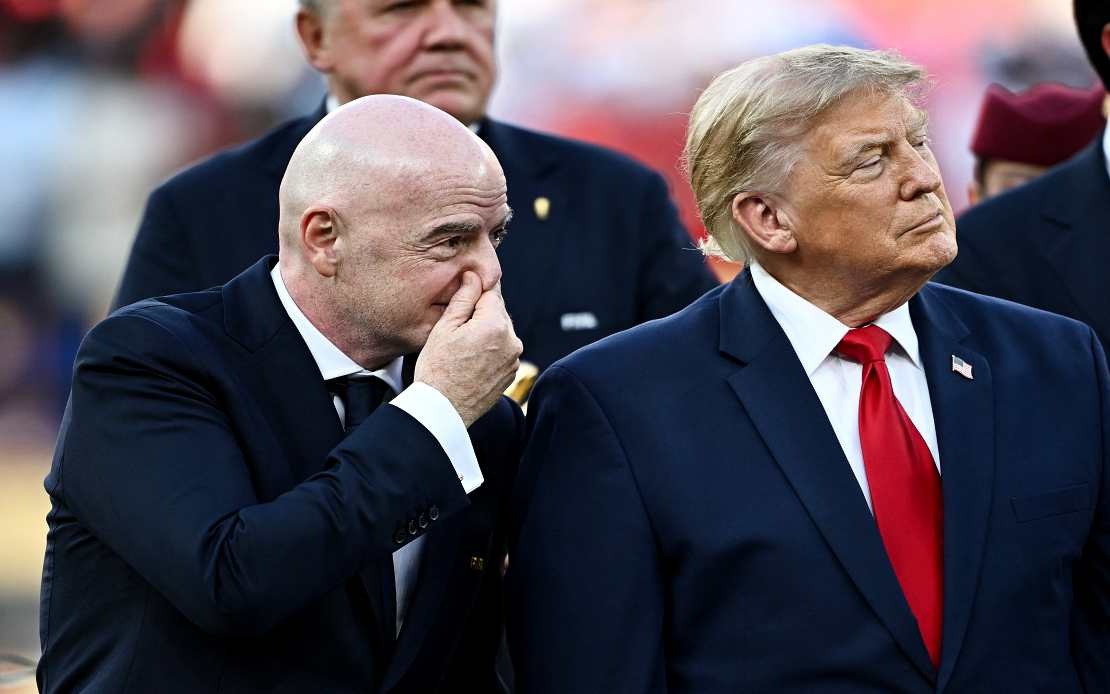
United States President Donald Trump has moved to bolster FIFA President Gianni Infantino's embattled position, issuing a forceful endorsement of the football leader on Truth Social just as multiple continental confederations have mounted an unprecedented challenge to his authority. Trump's intervention marks an unusual diplomatic moment in international sports governance, with the American leader weighing in directly on internal FIFA disputes at a moment of significant institutional turbulence.
The latest crisis engulfing world football's governing body centres on a proposed restructuring of FIFA's commercial architecture that would have transferred approximately one-fifth of the organisation's media and commercial rights to a newly formed private entity. FIFA announced plans in July to raise US$4.2 billion by selling roughly 20 per cent of this new venture to private investors, fundamentally reshaping how the global body monetises its most valuable assets, including broadcasting and sponsorship rights for the World Cup and other major tournaments.
Infantino's stewardship of the proposal has triggered an extraordinary level of co-ordinated institutional resistance. The Union of European Football Associations (UEFA), the Asian Football Confederation (AFC), and the Confederation of North, Central American and Caribbean Football (CONCACAF) together published an open letter challenging the initiative and demanding an independent investigation into the commercial arrangement's details and legitimacy. This tripartite criticism represents a rare moment of unity among regional bodies that typically compete for influence within FIFA's political ecosystem.
Trump's defence of Infantino was unambiguous and emphatic. Speaking through his social media platform, the former and current president characterised the FIFA chief as fantastic and credited him with overseeing the most successful World Cup tournament by far in the competition's history, claiming the 2022 edition in Qatar had generated four times the previous record for success metrics. Trump further argued that dismissing Infantino would represent a catastrophic strategic error, asserting that FIFA would never replicate such commercial triumphs or financial performance under different leadership.
The underlying commercial controversy gained additional complexity when media reports suggested that investment capital for the proposed entity could originate from the foundation of Joshua Kushner, brother of Jared Kushner, who served as Trump's son-in-law and senior advisor during the Trump administration. This family connection potentially explains Trump's public intervention on behalf of Infantino, as the arrangement would have benefited financially from a circle within Trump's own political and familial orbit.
Responding to the mounting institutional pressure, Infantino convened an emergency assembly of FIFA's uppermost leadership in early August. During this critical gathering, the organisation's governing figures publicly reaffirmed their backing for the president despite the swirling controversy. Infantino acknowledged during the meeting that mistakes had occurred in the management of the FIFA Forward Enterprise commercial initiative, offering an apology for these missteps to assembled officials. This limited admission of fault represented an attempt to stabilise his position while maintaining ultimate authority over the organisation.
However, the continental football bodies refused to accept these internal reassurances. UEFA subsequently announced that all member associations would boycott FIFA competitions unless the commercial rights proposal was entirely scrapped. This threat of an organised withdrawal from FIFA-organised fixtures constituted perhaps the most serious challenge to FIFA's authority in recent years, given Europe's dominant position in global football economics and viewership.
Faced with the prospect of widespread competitive boycotts and the loss of enormous broadcasting and sponsorship revenues that such actions would entail, FIFA's leadership eventually capitulated to the pressure campaign. Infantino announced that the federation had formally abandoned its intentions to sell commercial rights to private investors through the proposed new entity. The reversal represented a significant tactical defeat for the president and those who had championed the restructuring initiative as necessary for modernising FIFA's financial architecture.
For Malaysian and Southeast Asian football observers, these boardroom machinations carry implications extending beyond simple institutional politics. The proposed commercial restructuring would have affected how AFC member nations, including Malaysia, received distributions from FIFA's vast commercial revenues generated through World Cup broadcasting and sponsorship arrangements. The eventual abandonment of the scheme suggests that AFC's negotiating power, when wielded in concert with European and North American confederations, remains formidable within FIFA's governance structure.
The episode also underscores how international sports governance intersects with geopolitical and family business interests. Trump's public defence of Infantino appears directly connected to potential financial gains for associates within his political circle, illustrating how supposedly independent global sporting institutions remain vulnerable to influence from powerful national political actors. For smaller football nations within AFC, this reality reinforces the importance of maintaining unified continental positions on matters affecting commercial revenue distribution and organisational autonomy.
Infantino's position, despite surviving this immediate challenge with the backing of FIFA's internal power structure, has been measurably weakened by the episode. His willingness to withdraw the commercial rights proposal demonstrates that his authority depends on maintaining consensus among continental confederations, rather than on absolute power as international football's chief executive. Future attempts to reshape FIFA's governance or financial arrangements will likely encounter more sceptical reception from UEFA, AFC, and CONCACAF, each now proven capable of mobilising collective resistance.
The outcome also establishes that even presidential-level political interventions from major football-playing nations, as Trump's defence demonstrated, cannot override the collective interests of continental confederations when they unite behind a clear position. This suggests an important counterweight to any single nation's ability to shape FIFA policy unilaterally, though Trump's intervention succeeded in at least publicly complicating the narrative around Infantino's leadership during the critical moment when pressure was mounting.

