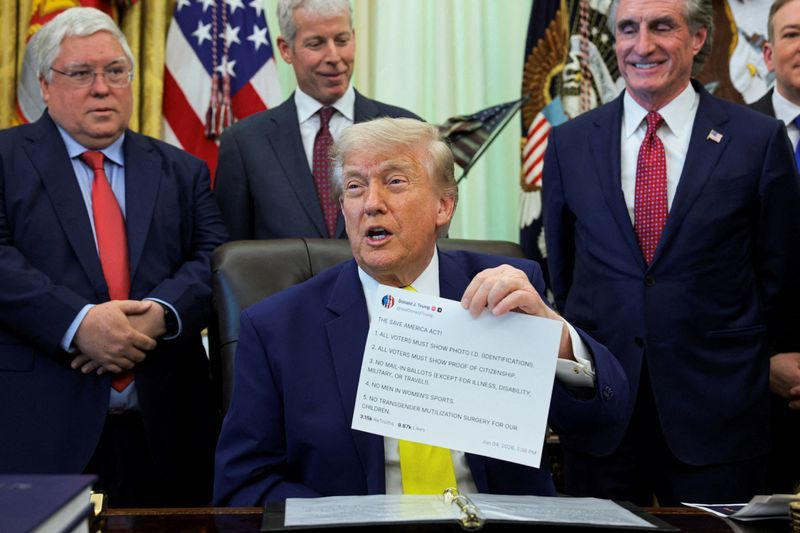
Donald Trump faces a federal lawsuit challenging a controversial service that provides wealthy subscribers with early access to his Truth Social posts, potentially giving them an unfair advantage in responding to market-moving announcements. The complaint, filed Wednesday in Manhattan federal court, targets Truth API, a feed service launched by Trump Media & Technology Group that charges up to $100,000 per month for accelerated access to posts from ten high-profile accounts, including Trump's own account.
The plaintiffs in the case—the Intercept and the Freedom of the Press Foundation—argue that the service fundamentally undermines democratic principles by creating a two-tiered information system. Under their theory, average citizens and media organizations would receive Trump's announcements on a delayed basis, while wealthy subscribers gain immediate knowledge of statements that could influence stock markets, commodity prices, and other financial instruments. This disparity, they contend, transforms the president's official communications into a profit-generating commodity that benefits both Trump personally and his favored insiders.
Truth API launched on August 1, just days after Democratic Senators Elizabeth Warren of Massachusetts and Adam Schiff of California formally requested that the U.S. Securities and Exchange Commission investigate whether the service violated market integrity rules. The senators raised concerns that enabling subscribers to trade on advance notice of presidential announcements—particularly those regarding tariffs, trade policy, and geopolitical developments—would constitute unfair enrichment of Wall Street elites while potentially harming ordinary investors who lack such privileged access.
Trump's substantial financial stake in the venture underscores the plaintiffs' core complaint. The president holds a 41.3% ownership stake in Trump Media through his Donald J. Trump Revocable Trust, valued at approximately $950 million according to Reuters data. His eldest son, Donald Trump Jr., serves as a Trump Media director and oversees the trust, creating a direct family financial incentive to maximize subscriber revenue. This arrangement means that every dollar paid for Truth API access flows partially into Trump's personal wealth, raising what constitutional scholars would term a classic conflict of interest.
The lawsuit specifically targets what it characterizes as a violation of the First Amendment's guarantee of equal access to government information. The complaint argues that when a sitting president uses official channels to announce government policy—whether on tariffs, international conflicts, or economic measures—those announcements constitute constitutionally protected speech that must be equally available to all citizens. By selling early access rights, the plaintiffs contend, the administration creates an unlawful two-tier system that privileges those able to pay substantial subscription fees.
During Trump's second White House term, analysis of his Truth Social activity reveals a significant pattern: thousands of his posts and reposts—numbering between 9,000 and 11,000—were never accompanied by official White House statements through conventional government channels. This suggests that Truth Social has become Trump's primary mechanism for government announcements, making the paid-access model particularly problematic. Citizens who do not subscribe to Truth API or who encounter the service only after the initial window of early access may effectively be excluded from timely receipt of critical government information.
The lawsuit seeks an injunction preventing the White House from posting official government announcements exclusively on Truth Social while the paid-access feed remains operational. This remedy would force the administration to simultaneously publish any material government announcements through traditional channels—White House press releases, official government websites, or notification systems—ensuring equal and simultaneous access for all citizens regardless of their ability to pay subscription fees.
Trump Media's response dismisses the lawsuit as a partisan attack on free speech. A company spokesperson argued that numerous platforms and news outlets already disseminate Trump's content through subscription services, suggesting that Truth API is merely one of many legitimate news distribution channels. The company contends that blocking the service would constitute censorship orchestrated by left-wing activists seeking to damage Trump and harm shareholders. Kevin McGurn, Trump Media's interim Chief Executive, characterized Truth API on an earnings call as simply enabling subscribers to receive news "fractionally faster" than the general public.
Beyond Trump's direct financial interest, the Truth API service includes early access to posts from other senior administration officials, including Vice President JD Vance, Health and Human Services Secretary Robert F. Kennedy Jr., FBI Director Kash Patel, and the White House account itself. This expansion of the paid-access model to multiple government voices multiplies the potential for market manipulation and information asymmetry across the entire executive branch, not merely the president's personal communications.
The regulatory environment for this dispute remains uncertain. The SEC's three current commissioners are Republicans, making swift agency action unlikely. However, the federal courts may take a different view of constitutional questions regarding equal access to government information and the propriety of allowing presidents to monetize official announcements. The case represents a fundamental clash between Trump's claimed property rights in his communications and the democratic principle that government information should be equally accessible to all citizens.
For Malaysian and Southeast Asian readers, this case illuminates broader tensions in how political leaders globally navigate the intersection of personal wealth, social media platforms, and governance. As regional leaders increasingly establish their own social media channels to bypass traditional media, questions about information equity and market manipulation become directly relevant. The lawsuit suggests that courts may ultimately impose limits on how aggressively political figures can commercialize their official communications, a principle with potential implications across the Asia-Pacific region.
The outcome of this litigation will likely establish important precedent regarding the boundaries of presidential communication rights and the constitutional constraints on monetizing official announcements. Whether courts view Truth API as legitimate entrepreneurial activity or constitutionally impermissible profiteering from government office remains to be determined, but the case fundamentally challenges assumptions about how modern leaders can leverage their official positions for personal financial gain through new media platforms.

