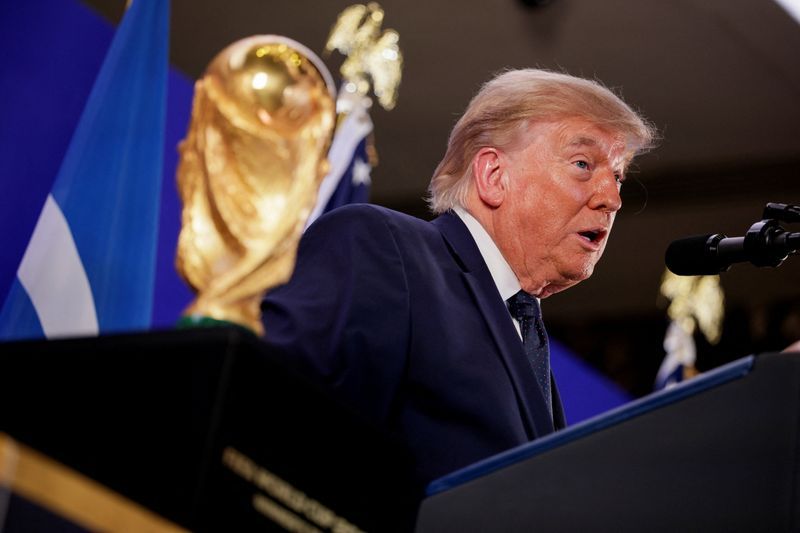
Donald Trump will occupy a place of prominence at Sunday's World Cup final between Argentina and Spain at New York/New Jersey Stadium, where he has been invited to sit alongside FIFA President Gianni Infantino and present the trophy to the winning nation. The US President's appearance marks his return to the tournament's centrestage after becoming entwined in one of its most contentious moments, whilst simultaneously signalling his administration's determination to secure hosting rights for a future edition in 2038.
The announcement of Trump's ceremonial role comes barely days after he publicly acknowledged requesting that Infantino conduct a review of a red card issued to US striker Folarin Balogun. That intervention triggered immediate backlash from observers concerned about the integrity of the tournament and the appropriateness of political interference in sporting decisions. FIFA subsequently maintained that Trump had exerted no influence over the eventual suspension of Balogun's ban, though the damage to perceptions of impartiality had already crystallised.
At a glittering reception held Friday evening within Trump Tower in Manhattan, where FIFA recently established an office, both Trump and Infantino delivered effusive public endorsements of one another before an audience of approximately 300 guests, including Brazilian football legend Ronaldo and various FIFA dignitaries. Infantino credited Trump with being instrumental to the tournament's unprecedented success, with the competition achieving record-breaking attendance figures and standing as the largest World Cup edition in history. Trump responded by characterising the tournament as validation that the United States possessed genuine football credentials, a statement reflecting his frequently emphasised role in securing the hosting award during his first presidential term.
The relationship between the two men has weathered considerable turbulence throughout the tournament's journey and its actual delivery. In the year preceding the competition, American host cities grappled with serious concerns about how to reassure international visitors uncomfortable with Trump's hardline immigration policies and restrictions on travel from numerous countries. As preparations intensified, Trump publicly threatened to reallocate matches away from Democratic-leaning municipalities, prompting FIFA to issue formal statements asserting that any match relocations remained FIFA's prerogative, not the President's discretion.
During Friday's reception, Trump provocatively suggested that the United States should be granted another opportunity to host the tournament but pointedly remarked that "this time we'll leave Mexico and Canada out," casting doubt on his commitment to the existing trilateral hosting arrangement that FIFA officially ratified in 2018 during his first administration.
Trump's intensifying pursuit of high-profile sporting appearances reflects a strategic effort to command media attention as his approval ratings during his second term continue their downward trajectory. Over the preceding eighteen months, he has systematically inserted himself into major sporting events, calculating that such venues provide unfiltered access to millions of viewers. His attendance at the previous year's Ryder Cup on Long Island, where he received resounding applause from American supporters, appeared to validate this approach. However, his reception at other sporting occasions has proven decidedly more mixed and occasionally hostile.
Last month, Trump was subjected to loud booing when attending Game 3 of the NBA Finals, whilst his attendance at last year's US Open tennis final at Flushing Meadows created logistical chaos as presidential security protocols prevented spectators from entering the venue until well into the match, generating significant frustration among paying ticket holders. These episodes underscore the deeply polarising nature of his public presence within American sporting culture.
The prospect of Trump's appearance at Sunday's final creates genuine operational challenges for Fox Sports, the American broadcaster covering the match. Because the network employs a global broadcast feed rather than producing independent coverage, Fox commentators lack control over camera placement decisions and cannot prevent footage of Trump during the match. Play-by-play announcer John Strong acknowledged this limitation, noting that any on-screen appearances of Trump sitting alongside Infantino would be determined by the international production team rather than by Fox's editorial judgment. Strong further noted the network's inability to anticipate when such moments might occur during the broadcast.
The unpredictability of Trump's television presence presents Fox with a genuine public relations dilemma. Strong characterised the situation candidly, observing that Trump represents a figure incapable of inspiring neutral reactions within the American viewing audience. Substantial segments of viewers anticipate his appearance with enthusiasm and positive engagement, whilst equally substantial portions would prefer his absence entirely from their television screens. This fundamental polarisation means that no editorial choice regarding coverage can satisfy all viewers.
The broader context of Trump's involvement in this World Cup demonstrates how international sporting competitions increasingly intersect with domestic political calculations and global power dynamics. FIFA's cultivation of Trump reflects the organisation's recognition of his continued political significance and capacity to influence American public opinion regarding future tournament hosting. For Southeast Asian observers and Malaysian readers, Trump's prominent role in the World Cup underscores how major international sporting events function as platforms for political actors to advance national interests and personal standing, potentially setting precedents that could affect the governance of future tournaments in the region.
Trump's successful pivot from controversy to ceremonial prominence at the final suggests a masterclass in rehabilitating a tarnished public image through strategic sporting association. Despite legitimate concerns about his interference in tournament administration and his divisive political agenda, he will occupy centre stage at the competition's culminating moment, presenting the trophy that represents football's highest global achievement. This trajectory illustrates the complex relationship between politics and sports in contemporary America and the degree to which sporting organisations remain susceptible to political pressure and the appeal of prominent political figures.

