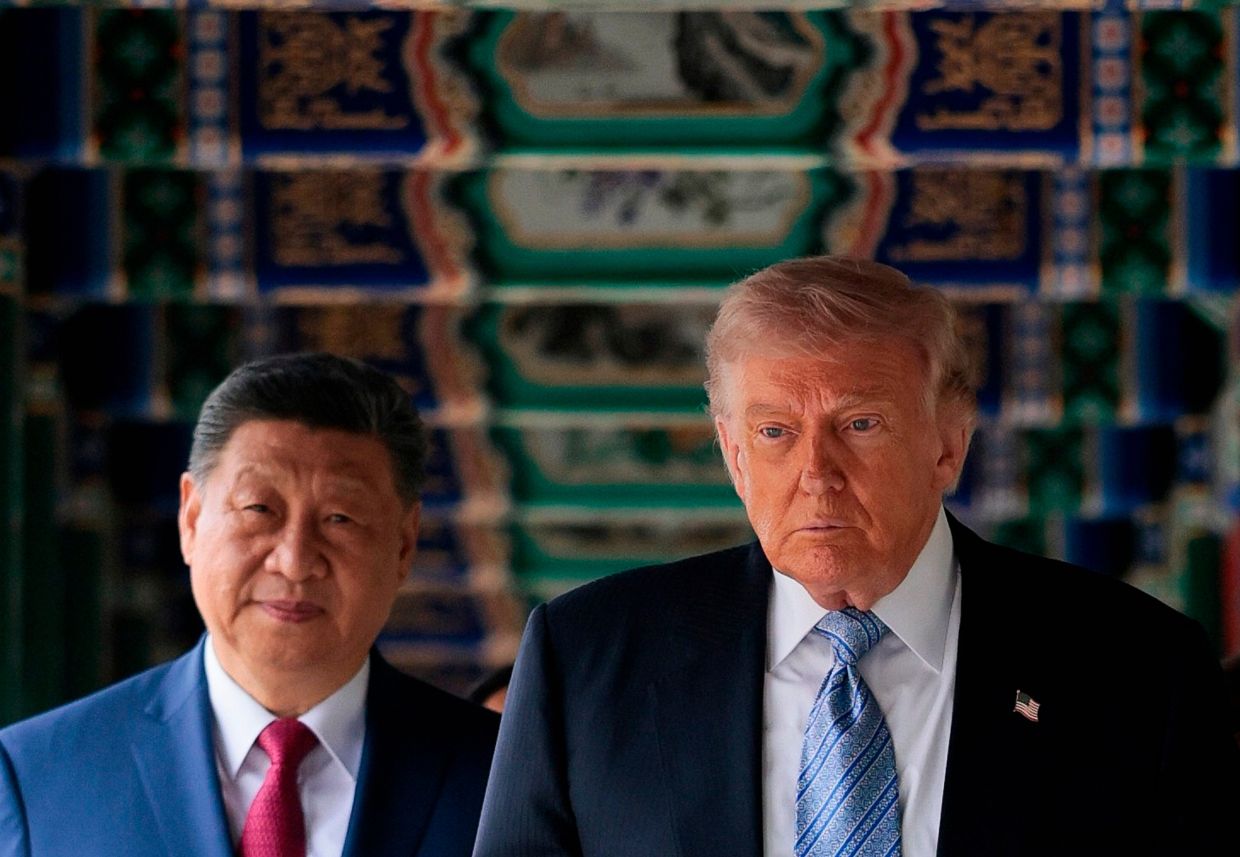
The Trump administration is displaying starkly contradictory approaches to China policy, simultaneously levelling serious accusations against Beijing while maintaining diplomatic preparations for a high-level visit from Chinese leader Xi Jinping scheduled for September 24. This oscillation between confrontation and engagement reveals the unpredictable nature of Trump's China strategy, creating uncertainty for regional observers including Malaysia and other Southeast Asian nations who navigate between Washington and Beijing interests.
Reports that China has supplied weapons to Iran through Pakistan—a deal reportedly valued between US$60 million and US$70 million with aircraft transporting materiel from western China through Pakistani airspace—have triggered mixed responses from the American administration. When asked about the allegations, Trump indicated he would find such activity "surprising" given prior assurances. He stated that Xi had assured him personally of non-involvement in Iran supply chains, yet simultaneously signalled his displeasure by noting he would be "quite disappointed" if those commitments proved false. This phrasing suggests Trump is attempting to balance his stated trust in the Chinese leader with acknowledgement of the serious implications if the reports prove accurate.
Beijing has categorically denied the weapons supply allegations, with the Chinese foreign ministry characterising the claims as "untrue and not factual at all". This represents a familiar pattern in their diplomatic exchanges, as China had previously rejected comparable accusations of supplying weapons to Iran ahead of Trump's May visit to Beijing. The Chinese government has reaffirmed its commitment to de-escalation and conflict resolution, positioning itself as a responsible actor despite American scepticism. Such denials carry particular weight given the broader context of US-China tensions, where verification of military supply chains remains difficult and contested.
Trump's latest China criticism extends beyond weapons trafficking allegations. Just hours before his measured response to the Iran supplies report, Trump launched an extensive attack on social media targeting Anthony Fauci, the long-serving US health official. Trump renewed his controversial claim that COVID-19 originated from a laboratory in Wuhan, accusing Fauci of consistently prioritising protection of China over scientific accuracy. The president stated categorically: "I said from the beginning that the virus came from the Wuhan Laboratory in China. Fauci strongly disagreed, always trying to protect China." This rhetorical strategy conflates pandemic origins with broader geopolitical competition, weaponising scientific debate for political purposes.
The scientific community maintains that natural spillover from animal populations remains the most probable explanation for COVID-19's emergence, though the possibility of a laboratory incident has gained wider consideration in recent years. Trump's sustained promotion of the Wuhan laboratory theory represents a political positioning rather than scientific consensus-building. For Malaysian readers and Southeast Asian policymakers, this demonstrates how domestic American political battles increasingly incorporate China criticism, potentially influencing bilateral relations and regional stability calculations regardless of factual substantiation.
Trump's approach to Chinese conduct in the Middle East further illustrates his contradictory messaging. Last week, he claimed that China and Russia were not "participating" in Iran-related activities, stating that Xi had promised during their May Beijing meeting that China would provide no assistance to Iran under any circumstances. Trump emphasised his confidence in this commitment, declaring: "Considering our relationship, I take him at his word." Yet immediately thereafter, he issued a pointed warning that any Chinese involvement would be "very bad for them" and contrary to their interests. This formulation combines expressions of personal trust with implicit threats, creating ambiguity about the administration's actual assessment of Chinese reliability.
The contradictions intensify when examining the broader sequence of administration positions. Just twelve days before Trump's reassuring statements about Chinese non-involvement in Iran affairs, he had delivered a prime-time address accusing Beijing of orchestrating "the largest compromise of election data in history". During that speech, Trump claimed China had unlawfully obtained 220 million American voter records and declassified documents purporting to support this allegation. He characterised the situation as an "unprecedented election security nightmare", language suggesting existential threat to American democratic institutions. Such rhetoric typically precedes comprehensive sanctions regimes and punitive trade measures.
However, the Trump administration has implemented no new sanctions, trade penalties, or formal diplomatic consequences targeting China following these sensational election interference allegations. Instead of retaliatory measures, American officials have continued routine planning for Xi's September state visit. This absence of concrete action following such severe accusations raises questions about whether Trump genuinely believes the election interference claims or whether the announcements served primarily domestic political purposes. For regional observers, this inconsistency undermines confidence in American commitment to confronting perceived Chinese misconduct through sustained policy responses.
This pattern of fierce public rhetoric unmatched by corresponding policy action has become the defining characteristic of Trump's China approach. The administration simultaneously maintains that China represents a fundamental threat to American security and democratic integrity while preserving diplomatic channels and scheduling high-level visits. Malaysian and Southeast Asian policymakers must contend with this unpredictability when calibrating their own China engagement strategies, uncertain whether American accusations reflect genuine policy intentions or performative positioning for domestic audiences.
The September visit from Xi presents a critical test of Trump's actual China policy orientation. If the trip proceeds without significant incident or last-minute cancellation, it would suggest that Trump's public accusations of weapons trafficking and election interference carry lower priority than maintaining strategic communication channels with Beijing. Conversely, any dramatic developments immediately preceding the visit could signal that Trump's rhetoric translates into substantive diplomatic consequences. Regional nations with critical interests in maintaining stable US-China relations must prepare for both scenarios while monitoring Trump's increasingly volatile and contradictory signalling.
For Southeast Asian governments including Malaysia, Trump's mixed China strategy creates both risks and opportunities. The unpredictability could precipitate unexpected escalations affecting regional security and economics, while also providing diplomatic space for countries to advance independent interests. Understanding that Trump's public statements may not reliably predict actual policy helps regional leaders avoid overreacting to inflammatory rhetoric while remaining alert to genuine shifts in American strategic posture toward the region and China.

