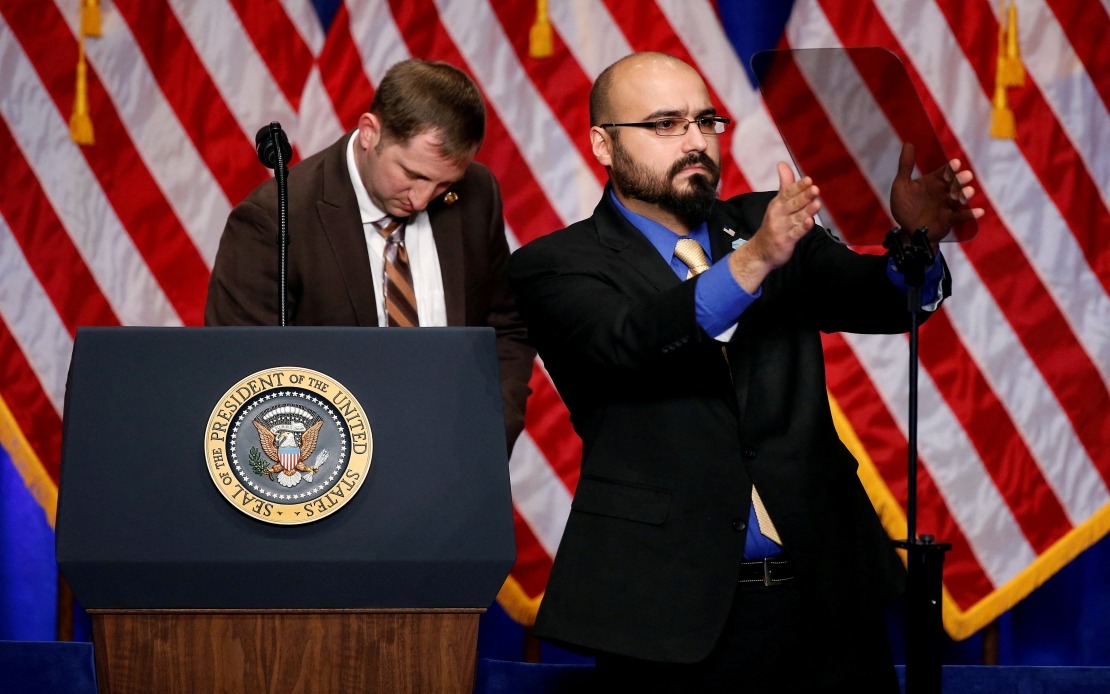
The White House has suspended a senior staff member responsible for operating President Donald Trump's teleprompter following an investigation into his alleged participation in a betting scheme centred on the president's public addresses. The unnamed operator, who has held the position since 2016, was placed on unpaid leave this week as authorities scrutinise claims that he exploited advance knowledge of Trump's speeches to place wagers on a prediction markets platform.
White House press secretary Karoline Leavitt characterised the matter as troubling during a briefing on Thursday, stating that President Trump had been fully briefed on the development. Her framing of the incident as "deeply unfortunate and frankly a disgrace" signals the severity with which the administration is treating what amounts to a breach of trust at the highest levels of the executive branch. The suspension represents a rare display of accountability within a White House often criticised for maintaining loose ethical standards.
According to reporting by broadcaster ABC, the operator allegedly utilised confidential information about the content and timing of Trump's speeches to generate winnings exceeding $100,000 on Kalshi, a digital platform specialising in prediction markets. These markets allow participants to wager on the outcomes of real-world events, creating a financial incentive structure that can tempt individuals with non-public information. The platform operates within a regulatory grey area in the United States, though it has gained prominence among traders seeking exposure to political and economic events.
The mechanism of the alleged scheme underscores vulnerabilities in how sensitive information circulates within presidential operations. Teleprompter operators occupy a unique vantage point, typically receiving speeches hours or days before public delivery, which positions them with material non-public information. The operator's ability to translate that advantage into substantial financial gain suggests minimal oversight of staff trading activities and potentially weak internal controls governing the handling of advance presidential statements.
Kalshi's legal team, including head of enforcement Robert DeNault, acknowledged the platform's role in identifying and reporting the suspicious trading activity. In a public statement posted on the social media platform X, DeNault emphasised that Kalshi had "promptly" detected irregularities in the trades, initiated an investigation, and escalated findings to the Commodity Futures Trading Commission, the federal agency responsible for regulating derivatives and prediction markets in the United States. This disclosure indicates that prediction markets platforms maintain monitoring systems designed to catch exactly this type of insider trading activity.
The referral to the CFTC represents the natural progression of regulatory protocol, shifting responsibility from the private sector to government enforcement bodies equipped to investigate and potentially prosecute violations of securities and commodities laws. The CFTC has broad authority to penalise individuals who exploit material non-public information for trading purposes, even within the relatively nascent prediction markets ecosystem. The commission's involvement suggests the scope of scrutiny extends beyond internal White House accountability to federal law enforcement.
For Malaysian and Southeast Asian observers, this incident illuminates broader governance challenges facing established democracies navigating digital-age challenges. The United States, despite possessing sophisticated regulatory frameworks, continues to encounter scenarios where technological advancement outpaces institutional safeguards. Prediction markets, an increasingly globalised phenomenon, operate across borders with limited harmonisation of rules, presenting risks that extend beyond individual jurisdictions. Financial platforms accessible from Malaysia and throughout the region may harbour similar vulnerabilities if oversight mechanisms remain fragmented or inadequately resourced.
The case also demonstrates the particular risks posed by asymmetric information access in high-stakes political environments. Presidential administrations worldwide employ hundreds of staff members with varying levels of clearance to sensitive planning and communications. The temptation to exploit such positioning for personal financial gain represents a recurring challenge, particularly as digital trading platforms lower the barriers to entry for speculative wagering. The normalisation of prediction markets has coincided with their integration into political discourse, creating unprecedented opportunities for misconduct.
Internally, the incident places pressure on the White House to reinforce ethical training and implement trading restrictions for staff with access to non-public information. Standard practice in financial services firms involves prohibiting employees and their immediate family members from trading in securities or commodities where they possess material non-public information. The White House has historically maintained looser standards around such restrictions, though this episode may catalyse the adoption of more formal protocols.
The suspension and investigation also intersect with broader questions about political integrity and public trust in governmental institutions. Citizens expect those entrusted with proximity to power to exercise restraint and prioritise public service over personal enrichment. When individuals convert their position into direct financial advantage through information asymmetries, public confidence in institutional fairness erodes. The White House's swift action—by placing the operator on leave—signals an effort to contain reputational damage, though critics will argue that accountability requires more substantial consequences once investigations conclude.
Regulatory responses to this incident will likely influence how platforms and enforcement agencies approach prediction markets going forward. As these markets mature and attract mainstream participation, coordination between private technology firms and government regulators will become increasingly critical. For the Malaysian financial services sector and regional regulators, the case illustrates why international cooperation on platform governance remains essential as betting and prediction markets expand across Asia.
The unfolding investigation will determine whether the operator acted alone or received assistance, whether Kalshi's monitoring systems functioned adequately, and what legislative or regulatory reforms might prevent similar schemes. The outcome will set precedent for how insider trading allegations are handled in the emerging prediction markets space, a domain that lacks the deep institutional history and enforcement experience of traditional equity and commodities markets. Until authorities conclude their examination, the incident remains emblematic of governance vulnerabilities that transcend national borders in an interconnected digital economy.

