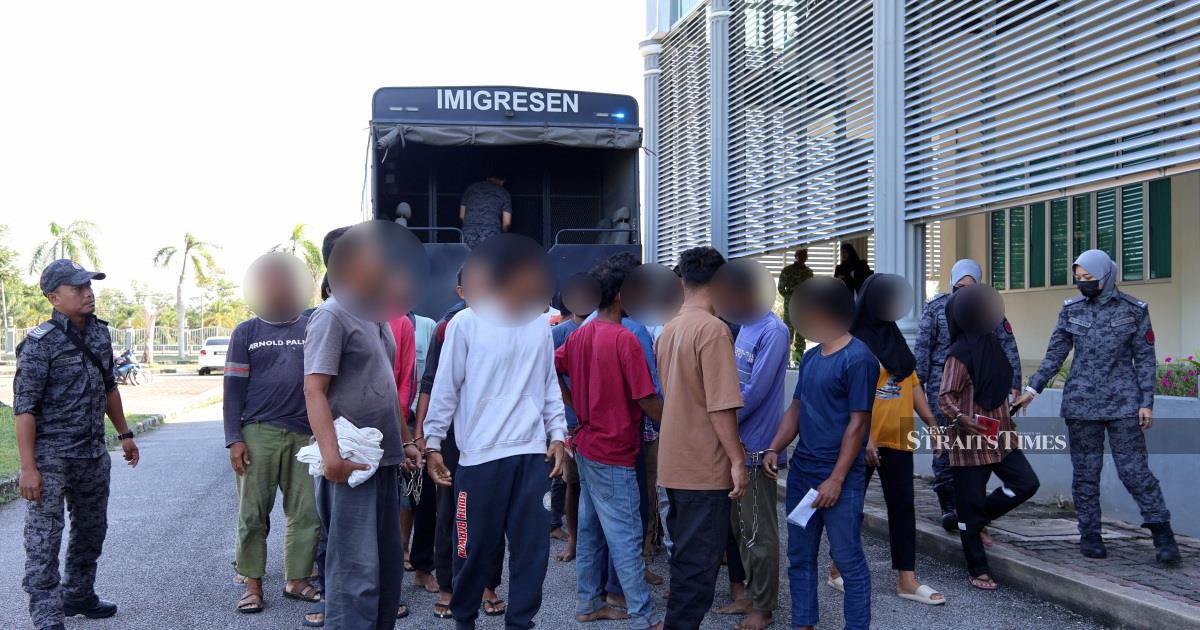
The Sessions Court in Pasir Mas delivered a significant ruling against undocumented migrants, imposing financial penalties on 29 individuals who entered the country illegally or breached immigration regulations. Convicted on charges stemming from illegal entry, overstaying beyond permitted timeframes, and fraudulent use of travel documents, the defendants were fined between RM1,000 and RM10,000 following their guilty pleas.
The case reflects an ongoing challenge in Malaysia's immigration enforcement, particularly in northern border states where irregular movement across land boundaries remains prevalent. Kelantan, where Pasir Mas is located, sits near the Thailand-Malaysia frontier, making it a strategic focus for immigration authorities combating cross-border human smuggling networks and undocumented worker trafficking.
The varied penalty amounts—ranging from a minimum of RM1,000 to a maximum of RM10,000—indicate that the court considered individual circumstances during sentencing. Factors likely influencing the differential fines include the severity of violations, duration of illegal stay, employment status, nationality, and prior offence history. Individuals convicted solely of illegal entry may have received lighter sentences than those charged with multiple or aggravated violations, reflecting Malaysia's tiered approach to immigration sentencing.
Misuse of travel documents represents a particularly serious concern for Malaysian authorities, as forged or fraudulently obtained passes facilitate not only illegal residence but also enable individuals to access employment, healthcare, and social services meant exclusively for documented migrants and citizens. The inclusion of this charge in the prosecution underscores law enforcement's focus on dismantling document falsification schemes that feed irregular migration networks throughout Southeast Asia.
The court proceedings in Pasir Mas exemplify Malaysia's continued judicial response to immigration violations as criminal matters rather than civil infractions. By prosecuting offenders through the criminal justice system and imposing custodial alternatives through financial penalties, the government aims to establish both specific and general deterrence against future illegal border crossings and regulatory breaches. The fines collected contribute to government revenue while theoretically discouraging repeat offences and word-of-mouth encouragement within migrant communities.
Kelantan's position as an entry and transit point for irregular migrants from Thailand, Bangladesh, Myanmar, and Indonesia makes immigration enforcement a persistent operational priority. The state's porous borders, combined with limited ground resources relative to the territory's size, create structural challenges for border control agencies. Periodic enforcement operations and court convictions like this one serve as visible demonstrations of regulatory capacity, though critics argue that such interventions address symptoms rather than underlying push-pull factors driving irregular migration.
The composition of the 29 convicted individuals—their nationalities, employment sectors, and family circumstances—remains undisclosed in the available court records, limiting deeper analysis of migration patterns. However, previous enforcement data suggests that the majority of apprehended undocumented migrants in Malaysia originate from neighbouring ASEAN states, particularly those experiencing economic hardship, political instability, or resource scarcity. Many enter seeking temporary employment in construction, agriculture, hospitality, and domestic work sectors where wage premiums relative to their home countries create powerful economic incentives.
The prevalence of overstaying charges among the 29 convicted individuals points toward a secondary enforcement challenge: tracking and locating migrants who initially enter legally on temporary visitor passes but then remain after expiration. Immigration monitoring systems, though increasingly digitalised, face practical constraints in a country hosting approximately 4 million documented foreign workers alongside millions of undocumented residents. Overstaying often occurs when employment prospects improve, family members arrive informally, or the costs of departing and returning exceed available resources.
Regional cooperation mechanisms, including ASEAN agreements on labour mobility and periodic bilateral enforcement coordination between Malaysia and Thailand, have achieved limited success in reducing undocumented migration flows. The economic disparities between Malaysia and its poorer neighbours remain substantial enough to sustain persistent migration pressures regardless of enforcement intensity. Complementary policies addressing employment demand for migrant workers, streamlining legal recruitment processes, and improving conditions in origin countries would address root causes more effectively than criminal prosecution alone.
The fines imposed by the Sessions Court serve immediate legal objectives but raise longer-term policy questions. Many convicted migrants lack resources to pay penalties, resulting in default sentences or extended detention. Alternative justice approaches—including skills training, employment assistance, or supervised return to origin countries with post-return support—might achieve compliance objectives while reducing recidivism and reintegration costs. Malaysia's approach remains fundamentally punitive, reflecting broader regional trends treating irregular migration as a security matter requiring strict deterrence.

