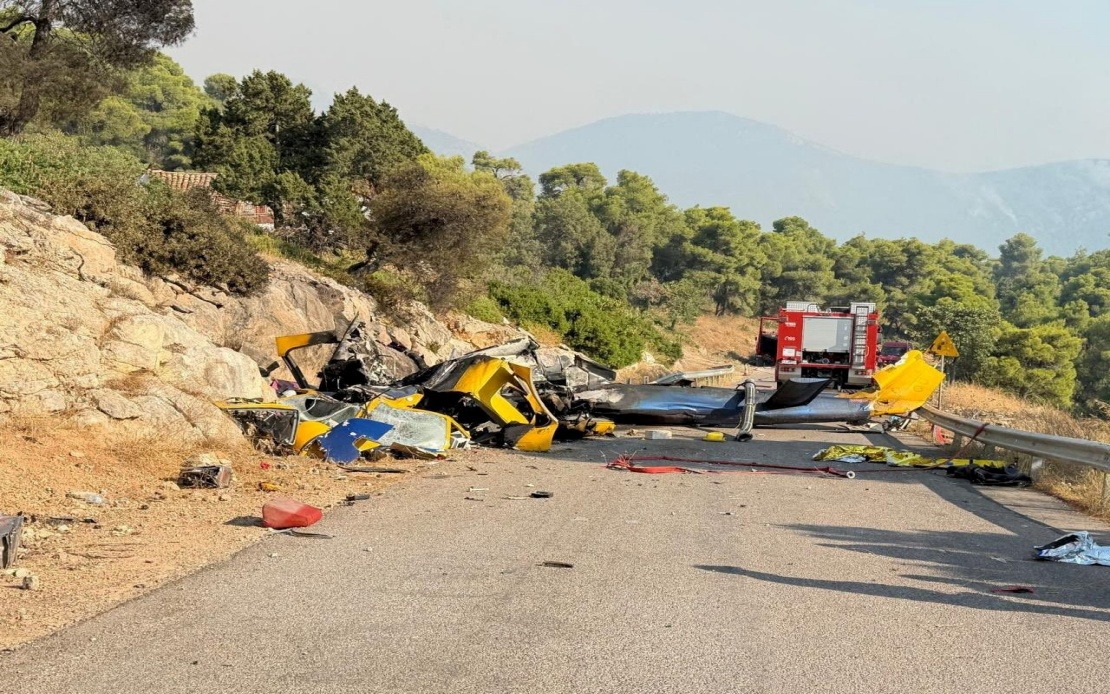
A tragic collision between two firefighting helicopters has claimed two lives during an active wildfire response operation in Greece. The incident occurred on Sunday in western Attica as the two Bell helicopters were conducting aerial firefighting missions against a significant wildfire sweeping through the region. Fire Service spokesperson Vassilis Vathrakogiannis confirmed at a press briefing that a Danish pilot and a Greek firefighting coordinator were killed in the accident, while a British pilot and another Greek firefighting coordinator managed to survive, though one sustained injuries.
The two helicopters, each crewed by two personnel, struck each other in mid-air while performing coordinated water-dropping and fire suppression activities. The impact sent both aircraft plummeting toward the ground near the coastal settlement of Psatha in western Attica. Emergency responders immediately mobilised search and rescue teams to the crash site, launching a comprehensive operation to locate survivors and recover the aircraft wreckage. The rapid deployment of rescue personnel was crucial in reaching the surviving crew members and providing immediate medical assistance to the injured coordinator.
Greek authorities have committed to a full investigation into the collision, though the exact sequence of events and technical factors leading to the mid-air impact remain under examination. Preliminary indications suggest communication challenges, spatial awareness limitations, or timing coordination issues may have played a role, but officials have cautioned against drawing premature conclusions. The investigation will examine aircraft maintenance records, weather conditions at the time of the accident, flight protocols in use, and communication systems between the helicopter crews.
The two Bell helicopters were leased specifically to augment Greece's firefighting capacity during the intense wildfire season. These rented assets represent a common practice across southern European nations that face seasonal spikes in large-scale wildfires requiring additional aerial resources beyond their permanent fleets. The loss of one helicopter significantly impacts available aerial firefighting capability at a critical moment, potentially hampering response efforts to ongoing blazes across the region.
The collision underscores the inherent operational risks facing helicopter crews conducting low-altitude firefighting missions in challenging conditions. Pilots must navigate complex terrain, maintain proximity to flames and smoke, and coordinate closely with other aircraft—all while managing unpredictable wind patterns and limited visibility. The fatigue factor during sustained firefighting campaigns also contributes to operational hazards, as crews work extended hours across multiple sorties during peak fire seasons.
Greece continues confronting an overwhelming wildfire crisis exacerbated by punishing heat waves, drought conditions, and strong winds that have stretched emergency services and firefighting resources to their limits. The broader landscape across Attica and Boeotia remains under threat from multiple active blazes that have consumed thousands of hectares and displaced communities. These environmental pressures create the circumstances under which accidents become more likely, as personnel and equipment operate at maximum capacity with minimal margin for error.
The deaths of the Danish and Greek crew members represent the human cost of wildfire response operations that rarely capture widespread attention despite their inherent dangers. International cooperation in firefighting support—evidenced by the Danish pilot's presence—demonstrates the cross-border nature of European wildfire response, where nations routinely deploy personnel and resources to assist neighbours facing critical situations. Such arrangements, while essential for managing large-scale disasters, introduce additional coordination complexities that require meticulous protocols.
For Southeast Asian readers, this tragedy offers sobering perspective on the risks inherent in aerial wildfire suppression across tropical and subtropical regions. Malaysia, Indonesia, and neighbouring countries periodically face transboundary haze and large wildfires requiring helicopter-based firefighting responses. The Greek incident illustrates why rigorous safety standards, pilot training protocols, and communication systems are non-negotiable investments, even when budgetary pressures incentivise cost-cutting through rented equipment and compressed operational schedules.
The surviving British pilot and injured Greek firefighting coordinator remain under medical observation, with their recovery prospects under close monitoring. Their survival, whilst fortunate, represents a reminder that outcomes in such incidents often depend on factors including aircraft design, crash impact dynamics, and response time—elements that justify substantial preventive investments in operational safety systems rather than reactive post-incident improvements.
Greek authorities have intensified their commitment to reviewing helicopter coordination procedures and safety protocols governing aerial firefighting missions. These reviews will likely inform updated guidelines addressing altitude separation, communication procedures, and real-time position tracking technologies. As climate change intensifies wildfire risks across the Mediterranean basin and beyond, incorporating lessons from accidents like this Sunday's collision becomes essential for protecting the personnel who volunteer to combat these ever-escalating natural disasters.

