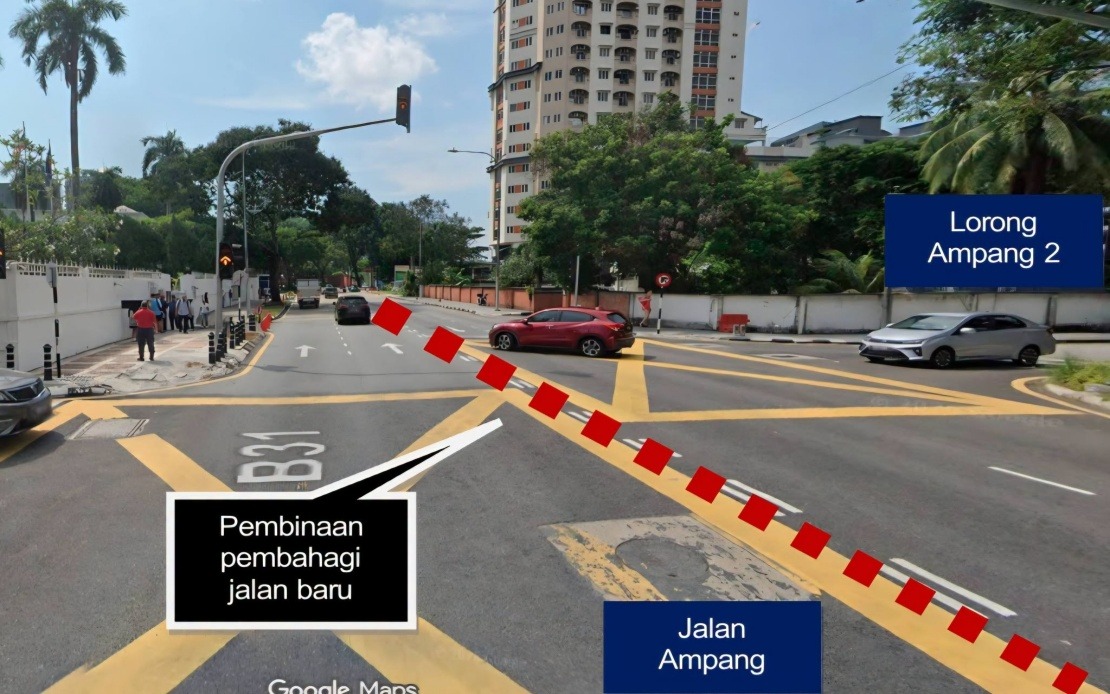
Kuala Lumpur commuters face significant changes to their daily commute as the city council moves forward with a substantial infrastructure initiative. Starting today, the traffic light intersection in front of the Royal Thai Embassy and the intersection at Lorong Ampang 2 on Jalan Ampang will be permanently closed, marking the beginning of a transformative upgrade project that will reshape one of the city's major arterial routes.
Kuala Lumpur City Hall (DBKL) announced that this closure forms a critical component of the broader 3.2-kilometre Jalan Ampang upgrade initiative. The project spans from the Jalan Tun Razak intersection extending to the Middle Ring Road 2 (MRR2), covering a substantial stretch of one of the city's busiest corridors that serves as a vital link between the city centre and the eastern suburbs.
The motivation behind this comprehensive undertaking extends beyond simple maintenance. DBKL officials emphasise that the upgrade project represents a strategic initiative designed to address multiple transportation challenges simultaneously. By reimagining the road's infrastructure, planners aim to create a more efficient network that reduces congestion, enhances user safety, and facilitates smoother traffic movement along this critical corridor that millions of motorists traverse monthly.
The physical transformation will be substantial. The project encompasses the construction of proper road dividers that will prevent dangerous crossing manoeuvres and reduce traffic weaving—a major contributor to accidents and congestion. Equally important are the planned improvements to pedestrian infrastructure, including wider and more secure walkways that will make the corridor safer for those on foot. Enhanced street lighting will address safety concerns during evening hours, a consideration often overlooked in traffic improvement plans.
The rationale for closing these particular intersections reflects sophisticated traffic engineering principles. By eliminating the traffic light intersections and constructing the road dividers, traffic engineers expect to substantially reduce the conflicts that arise when vehicles attempt to weave across lanes before reaching junction points. These weaving patterns typically create bottlenecks and accidents, particularly during peak hours when pressure on the road system intensifies. The closure should theoretically eliminate these conflict points entirely.
The upgrade will introduce a two-way four-lane configuration along the stretch, representing a significant change from the current road geometry. This reconfiguration aims to provide more dedicated space for traffic movement in both directions, theoretically reducing the compression and merging chaos that characterises the current arrangement. For regular users of Jalan Ampang, this represents a fundamental change to how they navigate this corridor.
Understanding the impact of such disruptions, DBKL has thoughtfully designated alternative routes to minimise inconvenience during the transition period. Motorists heading towards Ampang who would normally exit at the closed intersections can execute U-turns at Jalan Tun Razak to access the Ampang direction. Those travelling citybound have been directed to make U-turns at Jalan Ampang Hilir, ensuring that the closure does not completely disrupt traffic patterns but rather redirects vehicles through viable alternatives.
The project represents an important test case for urban infrastructure development in Kuala Lumpur. As a densely populated city grappling with increasing motorisation rates, the capital faces constant pressure to improve road networks without simply expanding capacity—an approach that often proves unsustainable. This project's focus on safety, pedestrian amenities, and operational efficiency rather than mere widening suggests a more sophisticated approach to traffic management that Malaysian planners are increasingly adopting.
For businesses along Jalan Ampang, particularly those near the Royal Thai Embassy area, the construction period may present temporary challenges regarding accessibility, though DBKL's clear communication about alternative routes should help mitigate concerns. Long-term, improved traffic flow should enhance the attractiveness of the corridor for commercial and residential development.
The closure underscores broader infrastructure development patterns across Malaysia's capital region. Multiple major road projects are proceeding simultaneously—the Middle Ring Road extensions, various public transport initiatives, and these localised improvements all aim to address the systemic congestion that has become increasingly problematic. The success of the Jalan Ampang project will likely influence future decisions about similar road upgrades across the metropolitan area.
Motorists are advised to familiarise themselves with the new traffic sign arrangements and alternative routes before attempting to navigate the affected area. The temporary inconvenience of rerouting is intended to yield substantial long-term benefits through reduced congestion, fewer accidents, and improved safety for all road users. DBKL emphasises that cooperation from the public in following the designated routes and new traffic arrangements remains essential for minimising disruption during this important urban development initiative.

