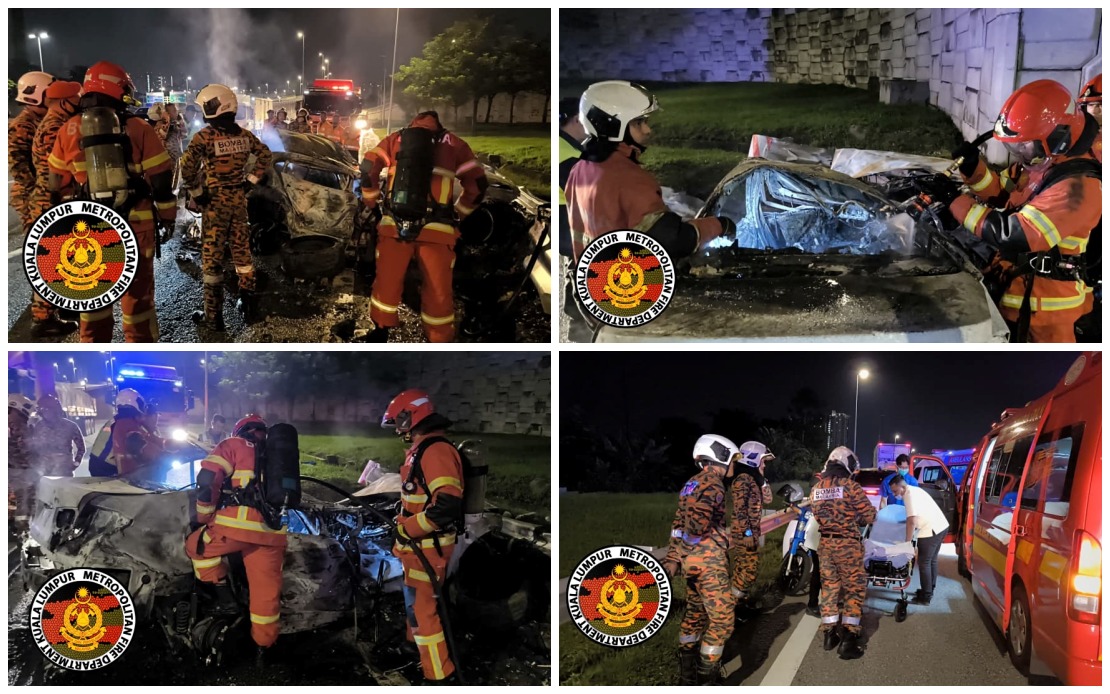
A tragic accident on the Duta-Ulu Kelang Expressway in Kuala Lumpur claimed the lives of two university students on Thursday morning when their BMW sedan lost control and erupted into flames. The collision occurred at the Jalan Kuching exit ramp, leaving investigators to piece together the chain of events that led to the fatal outcome. A third passenger, a 20-year-old Singaporean male student, escaped with only minor injuries and has been receiving treatment at Kuala Lumpur Hospital.
According to Kuala Lumpur Traffic Investigation and Enforcement Department chief ACP Mohd Zamzuri Mohd Isa, preliminary findings indicate that the BMW 328i Sport was moving in the direction of Selayang from Jalan Duta when speed became a critical factor. The officer stated that the vehicle appeared to be travelling significantly faster than safe limits for the roadway conditions, leading the driver to lose command of the car. The subsequent loss of control sent the vehicle into a skid that terminated in a violent collision with the left-side barrier, with the impact causing the fuel system to ignite and engulf the vehicle in flames.
The two casualties were identified as Malaysian nationals pursuing higher education. The driver, a 22-year-old student enrolled at Queensland University of Technology in Australia, was operating the vehicle at the time of the crash. The front passenger, aged 21, was a student at Sunway University in Malaysia's Klang Valley region. Both occupants were pronounced dead at the scene, with authorities believing they became trapped within the burning wreckage and could not escape the rapidly spreading fire. Their identification will proceed through DNA analysis due to the severe nature of the injuries sustained in the blaze.
The survival of the third passenger provides a glimmer of tragedy's randomness. The Singaporean student, who was 20 years old, sustained injuries that medical personnel classified as minor, suggesting he may have been positioned away from the point of greatest impact or benefited from the vehicle's safety features. His ability to escape the vehicle and receive prompt emergency treatment contrasts sharply with the fate of his companions, raising questions about the configuration of the seating arrangement and the precise mechanics of the crash.
The incident has triggered a comprehensive investigation that extends beyond the immediate crash scene. Police officers are meticulously examining CCTV footage from cameras positioned along the expressway to reconstruct the vehicle's movement in the moments leading up to the collision. Statements are being collected from the surviving passenger, who may provide eyewitness accounts of the driver's behaviour, road conditions, and any mechanical issues that could have contributed to the accident. The case is being pursued under Section 41(1) of the Road Transport Act 1987, which governs serious road traffic offences.
For families and friends of the two deceased students, the tragedy represents an immense personal loss during what should have been years of academic achievement and professional development. The victims were young men with evident ambition, with one pursuing engineering or technology studies in Australia while the other was engaged in higher education in Malaysia. Their deaths underscore the fragility of life and the potentially catastrophic consequences of speeding on high-speed expressways, particularly during early morning hours when traffic visibility and driver alertness may be compromised.
The DUKE expressway, which connects northern Kuala Lumpur with areas in Selangor, regularly carries substantial volumes of traffic including students, professionals, and commercial vehicles. The route has been the site of previous accidents, and road safety advocates have periodically raised concerns about the speed capabilities of vehicles on the expressway and the effectiveness of current enforcement measures. This incident will likely reignite discussions about speed limiting technology, improved barrier systems, and the adequacy of current road safety protocols on Malaysia's major expressways.
Authoritarian investigations continue at the crash site, with officers examining the physical evidence left by the collision and the resulting fire. The vehicle's final resting position, tyre marks, and debris patterns provide forensic clues that may indicate the exact speed at which the BMW was travelling and confirm whether external factors such as mechanical failure played any role. Investigators are also requesting that members of the public who witnessed the accident or were travelling nearby to submit any dashcam footage, as such video evidence could be instrumental in establishing a complete and accurate account of the incident.
The police have made a direct appeal to drivers and residents who were in the vicinity of the Jalan Kuching exit ramp at the time of the early morning collision. Those with relevant information are encouraged to contact the Traffic Police Station located at Jalan Tun H.S. Lee or any nearby police station. Such public cooperation is vital to traffic investigation units, as eyewitness accounts and video evidence often provide details that are not evident from official forensic analysis alone and can help prevent similar tragedies.
This fatality serves as a stark reminder to Malaysian motorists of the critical importance of adhering to speed limits and driving with appropriate caution, particularly on expressways where high speeds can magnify the consequences of even minor errors in judgment. The loss of two young lives—one with ties to Australia and one based in Malaysia—underscores how road accidents do not respect borders or educational status. As investigations continue and the families grieve, the broader community faces uncomfortable questions about whether current measures are sufficient to protect the growing number of young people using Malaysia's expressway network.

