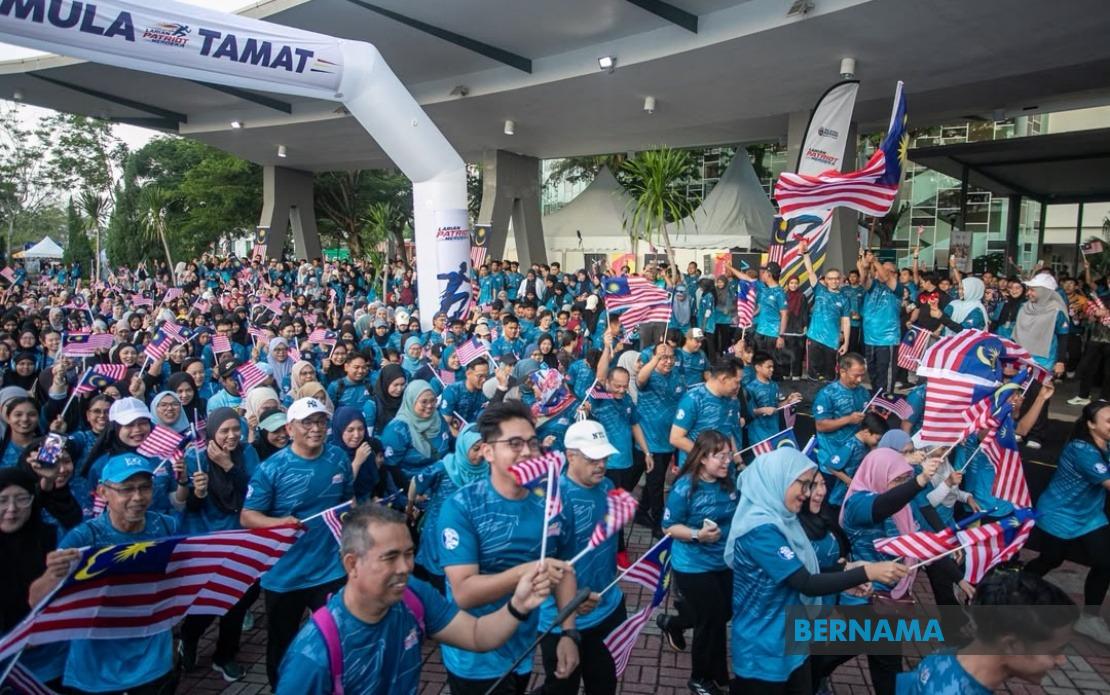
An early morning convergence of nearly 2,000 residents filled the grounds of the Sultan Azlan Shah Ministry of Health Training Institute in Ipoh on Friday, transforming the location into a vibrant celebration of national pride. The participants—ranging from young children to seniors, many arriving with families in tow—assembled as dawn broke to participate in the Patriot Merdeka Run, a community event designed to kindle patriotic spirit while promoting wellness across all demographic groups. The turnout reflected widespread engagement with Malaysia's efforts to commemorate its 2026 National Month and the accompanying Fly the Jalur Gemilang Campaign, signalling public appetite for collective celebrations of national identity.
The event commenced with an energetic mass aerobics session that set an uplifting tone for the gathering. As participants stretched and moved in unison, a palpable sense of community cohesion emerged—the kind that transcends the typical confines of exercise routines and speaks to deeper civic connections. Following this shared physical activity, attendees assembled to raise and wave the Malaysian flag in synchronized fashion, a symbolic gesture intended to underscore the nation's foundational principles of unity and patriotism. The sight of so many flags rippling in the morning breeze created a visual testament to the event's central message.
At 7.30 am, Datuk Abdul Halim Hamzah, the Communications Ministry's secretary-general, officially initiated the 2.5-kilometre fun run by firing the starting signal. Along the entire route, the Jalur Gemilang was prominently positioned, serving as both a decorative element and a constant visual reminder of the nationalist theme. The decision to mark the course with flags represented an intentional design choice to weave patriotic messaging throughout the physical experience, ensuring participants would maintain their connection to the event's larger purpose throughout the morning.
The scenes along the route captured the multifaceted nature of the gathering. Parents tenderly guided their youngest participants, many of whom were experiencing such communal nationalist activities for perhaps the first time in their lives. Simultaneously, runners and walkers had dressed themselves and their families in creative ensembles incorporating the red, white, and blue hues of the national flag, demonstrating thoughtful engagement with the occasion. The participants' genuine enthusiasm—expressed through cheers and encouragement exchanged between strangers—created an atmosphere that extended well beyond mere bureaucratic ceremony, instead fostering authentic interpersonal warmth and shared purpose.
Organisers deliberately positioned the Patriot Merdeka Run as a vehicle for achieving dual objectives. The immediate goal was to promote physical wellness and active lifestyles among Malaysian communities. Yet equally important was the underlying mission to embed patriotic consciousness within the experience of collective participation. By structuring the event to welcome participants regardless of age, fitness level, or social background, the organisers ensured that patriotism would not appear as an exclusive or rarefied concept, but rather as something accessible and welcoming to ordinary Malaysians engaging in everyday activities.
This particular event represents one in a broader constellation of programmes scheduled to commemorate the dual occasion of National Day and Malaysia Day in 2026. By launching these celebrations nine months in advance, the government appears intent on building sustained momentum and public engagement rather than confining festivities to a single commemorative moment. The Patriot Merdeka Run functions as an opening gambit in this extended campaign, establishing the thematic tone and demonstrating public receptiveness to nationalist programming.
The organisers harbour strategic ambitions regarding the long-term impact of such initiatives. Their stated hope involves establishing and sustaining programming that will nurture national unity over extended periods while simultaneously deepening public understanding of what independence genuinely signifies. Rather than treating independence as a historical fact consigned to textbooks, the emphasis falls on animate, embodied experiences that allow Malaysians to feel and express their national consciousness through direct participation. This pedagogical approach suggests recognition that abstract patriotism requires reinforcement through repeated, meaningful community experiences.
The event's timing proved significant, occurring on the morning before Prime Minister Datuk Seri Anwar Ibrahim was scheduled to formally launch the broader 2026 National Month and Malaysia Day celebrations at 10 am the same day. This sequencing positioned the grassroots community gathering as a prelude to high-level governmental ceremony, suggesting an integrated strategy where bottom-up civic engagement complements top-down institutional recognition. The general population's enthusiastic participation in the morning run would provide organisational momentum and demonstrable public support for the prime minister's afternoon launch event.
For Malaysian communities, particularly in Perak where Ipoh is situated, the Patriot Merdeka Run offered a tangible mechanism for expressing national affiliation in an era when such expressions sometimes feel muted or instrumentalised. The diverse representation—spanning economic backgrounds, ages, ethnic groups, and family structures—underscores the inclusive vision underpinning the 2026 celebrations. As Malaysia continues navigating complex questions about national identity and social cohesion, communal events of this nature provide periodic opportunities for citizens to collectively reaffirm shared foundational commitments, offering a counterpoint to divisive rhetoric and fractious debates that frequently dominate the national discourse.

