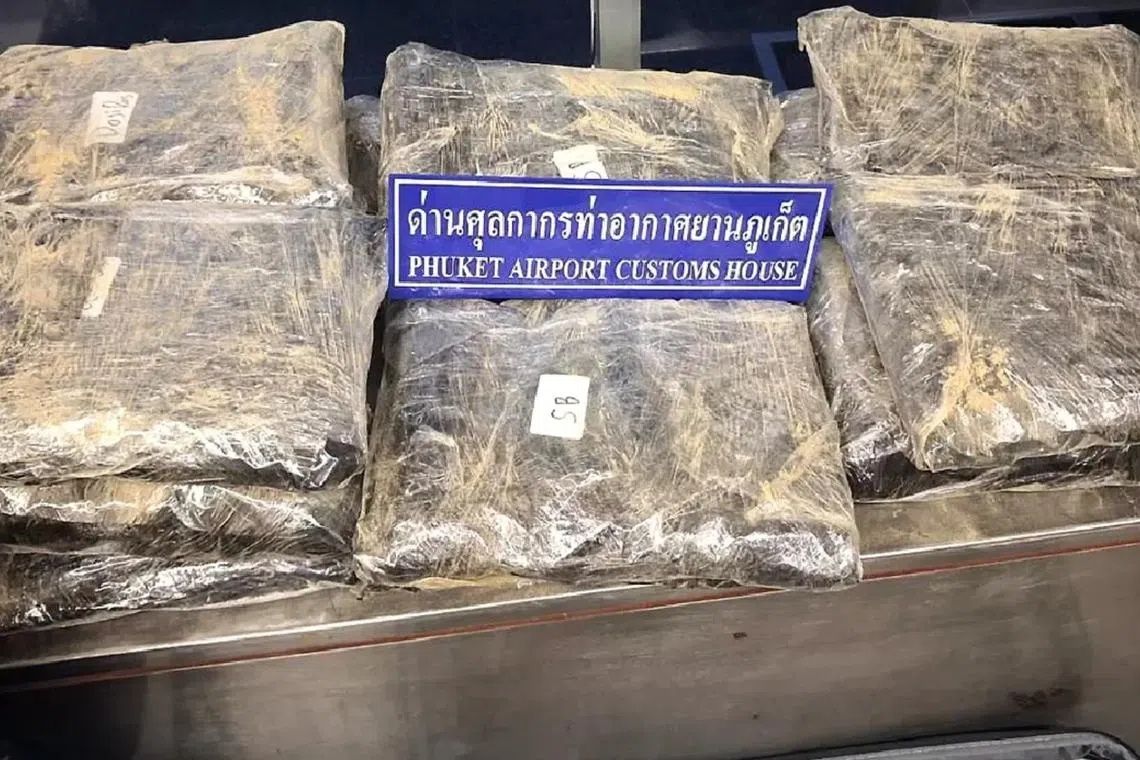
Thailand's customs enforcement intensified its grip on drug trafficking this week when officers at Phuket International Airport intercepted two separate smuggling attempts within hours of each other. The crackdown, which unfolded in the international departures terminal on Thursday, July 9, underscores the kingdom's commitment to stamping out illegal narcotics exports despite recent policy shifts that have loosened restrictions on cannabis cultivation and medical use domestically.
The first incident occurred at approximately 11am when customs officers working alongside Sakhu Police Station personnel conducted a routine inspection of a black Pierre Cardin suitcase. The luggage belonged to 18-year-old Filipino national Levannah Chelsea Guzman, who was preparing to depart Thailand. Inside, officers discovered 14 vacuum-sealed packages carefully arranged to avoid detection. These packages contained cannabis flowers with a combined weight of 14.5kg, a substantial quantity that immediately triggered formal charges against the young traveller.
Upon questioning, Guzman cooperated with authorities and acknowledged ownership of both the suitcase and its contents. Her admission, however, did not ease her legal predicament. She faced multiple charges stemming from attempted exportation of goods without completing mandatory customs procedures—a violation under Thailand's Customs Act BE 2560 (2017). Beyond the customs breach, prosecutors also filed charges under the Narcotics Code and the Protection and Promotion of Traditional Thai Medicine Wisdom Act BE 2542 (1999). Additional charges referenced the Public Health Ministry's 2025 notification classifying cannabis as a controlled herb, reflecting Thailand's nuanced regulatory approach to the substance.
The afternoon brought a second apprehension that revealed an even larger cache. At approximately 1pm, customs officers grew suspicious of a green Swish Navy wheeled suitcase belonging to Penpitcha Phutsiang, a Thai national. When opened, the examination uncovered 16 vacuum-sealed packages containing cannabis flowers totalling 17.6kg—a significantly larger shipment than the first seizure. Phutsiang similarly admitted to owning the suitcase and its contents, and faced an identical array of charges before being transferred to Sakhu Police Station for formal processing and investigation.
These arrests illuminate a peculiar contradiction within Thailand's current drug policy landscape. While the government has become increasingly permissive toward cannabis cultivation for medical and research purposes—a progressive stance relative to regional neighbours—authorities remain uncompromising in their approach to international smuggling. The simultaneous seizures underscore official determination to prevent the country from becoming a transit point for narcotics bound for markets with stricter prohibitions. The volume seized in a single day suggests that trafficking organisations view Thailand as an accessible sourcing point, particularly as domestic legal restrictions ease.
For Malaysian observers, these developments carry significant implications. Thailand's porous borders and relatively accessible cannabis supply chains pose indirect risks to the region, particularly as international criminal networks adapt to shifting legal frameworks. Malaysia maintains some of Southeast Asia's harshest narcotics penalties, including potential capital punishment for trafficking large quantities. The Phuket arrests demonstrate that neighbouring countries' enforcement priorities differ markedly from Malaysia's uncompromising stance, potentially creating enforcement gaps that sophisticated smugglers might exploit.
The timing of these apprehensions reflects broader enforcement efforts that appear to be accelerating. According to the customs authority's statement, Phuket Airport has implemented heightened screening measures specifically targeting outbound passengers suspected of attempting narcotics smuggling. Officers have intensified inspections of luggage across all departure terminals, indicating sustained operational focus rather than isolated incidents. This systematic approach suggests intelligence-driven targeting, where customs personnel may be flagging suspicious travel patterns or working from advance tip-offs about specific shipments.
The case details reveal something about contemporary smuggling methodologies. Both accused individuals selected wheeled suitcases and employed vacuum-sealing technology to compress and conceal their contraband—standard tradecraft designed to minimise detection by standard airport screening. The relatively young age of the Filipino suspect may indicate how trafficking organisations recruit couriers, often targeting individuals with limited criminal records and personal motivation rooted in economic desperation rather than organized crime credentials. A 18-year-old traveller likely presented fewer red flags to standard profiling than an established smuggler would.
What remains unclear from available reports is whether these individuals were operating independently or as part of a coordinated network. The simultaneous timing and comparable scale of their shipments—14.5kg and 17.6kg—suggests possible coordination, though authorities have not disclosed whether cross-examination revealed connections between the accused. If linked, the seizure represents disruption of a more substantial operation than isolated amateur smuggling would indicate. The location of destination markets and intended buyers remains undisclosed, leaving questions about whether cannabis was destined for specific regional markets or dispersed through opportunistic networks.
The legislative framework applied to these cases reflects Thailand's evolving position on cannabis within a broader drug enforcement ecosystem. Rather than treating cannabis as categorically equivalent to heroin or methamphetamine, the 2025 notifications acknowledge medical and traditional use applications while criminalising unauthorised cultivation, possession above specified thresholds, and international trafficking. This graduated approach contrasts sharply with Southeast Asian neighbours' largely prohibitionist stances, creating potential friction between nations' enforcement priorities and treaty obligations.
As Malaysia and other regional governments navigate their own cannabis policy considerations, the Phuket case study offers practical enforcement lessons. The integration of customs and police authority, systematic screening protocols, and rapid follow-up investigation demonstrate operational competence that other agencies might emulate. Simultaneously, the dual seizure suggests that demand-side pressures—presumably from markets with severe cannabis scarcity and high street prices—continue driving substantial smuggling risk despite tightened border monitoring.
Authorities have transferred both accused to Sakhu Police Station, where investigation will proceed toward formal prosecution. Both face similar charge schedules and comparable legal jeopardy. The outcome of their cases will likely establish precedential guidance for subsequent cannabis trafficking prosecutions as Thailand develops jurisprudence around the 2025 regulatory changes. For regional travellers and law enforcement agencies, the message is unambiguous: despite Thailand's liberalisation of domestic cannabis policy, unauthorised exportation remains seriously criminalised and actively prosecuted.

