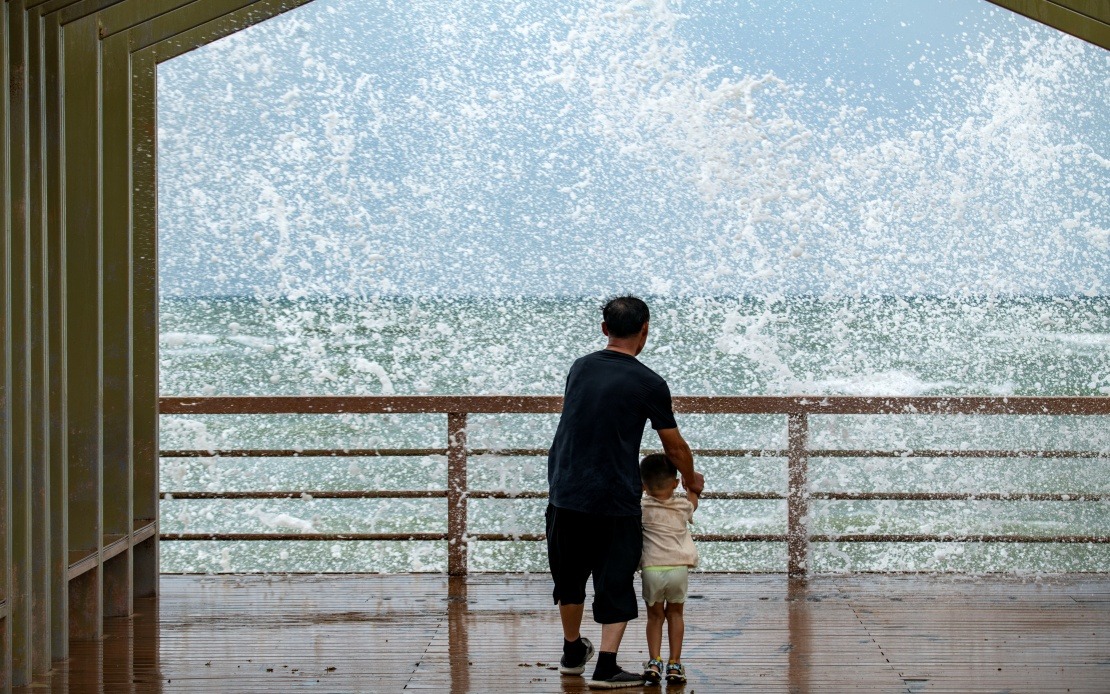
Typhoon Maysak, marking the tenth tropical cyclone to develop in the western Pacific this year, made landfall along the coast of Hainan Province in southern China on Friday evening, unleashing significant disruption across the island's transport infrastructure and forcing authorities to implement precautionary measures affecting education and public services. The storm touched down at approximately 6.20 pm local time in Yelin Township within Lingshui Li Autonomous County, carrying maximum sustained winds near its centre of 23 metres per second, according to data released by the Hainan provincial meteorological bureau.
The arrival of Maysak triggered immediate and comprehensive disruptions to transport connectivity throughout Hainan and beyond. All rail services operating to and from the island were suspended entirely for both Friday and Saturday as authorities prioritised passenger safety during the storm's passage. Sanya Phoenix International Airport, one of the island's busiest aviation hubs, halted all flight operations beginning at 5 pm on Friday, leaving hundreds of travellers stranded and forcing airlines to reschedule services indefinitely. The suspension of ferry services across the Qiongzhou Strait—a crucial waterway linking Hainan to the Chinese mainland and carrying both passenger and commercial traffic—commenced at 2 am that same day, with officials projecting the closure would persist for between one and two days depending on how quickly weather conditions improved.
Beyond transport networks, the typhoon prompted authorities in several municipalities to implement protective closures of educational institutions. Schools and child-care facilities across Sanya and Ledong Li Autonomous County shut their doors as a precaution, ensuring that younger residents remained sheltered indoors during the most dangerous phase of the storm. Such measures reflect standard emergency protocols in typhoon-prone regions, where wind speeds and associated flooding pose genuine hazards to outdoor movement and infrastructure integrity.
Meteorological forecasts predicted that Maysak would track in a northwesterly direction after making landfall, traversing through several populated counties including Baoting, Wuzhishan, Baisha, and Danzhou before eventually moving into the Beibu Gulf, a shallow maritime basin bordering Hainan to the west. This projected path indicated the storm would maintain significant intensity as it crossed the island, potentially bringing heavy rainfall and gusty winds to inland communities that might otherwise have expected lighter impacts from a weakening tropical cyclone.
For Malaysian and broader Southeast Asian readers, the Hainan disruptions carry several implications worth considering. The region represents a crucial economic hub within China's development strategy, and any interruption to transport networks—whether aviation, maritime, or rail—cascades across regional supply chains and trade flows that Southeast Asian businesses depend upon. Tourism connections linking Malaysia to popular Hainan destinations would face immediate cancellation, affecting holiday plans and hospitality sector revenues on both sides of the exchange.
The scale of transport suspension also underscores the vulnerability of island economies to tropical weather systems, a reality Southeast Asian nations understand intimately. Malaysia's own eastern coastline faces similar typhoon and monsoon hazards during certain seasons, and observing how Chinese authorities manage large-scale disruptions offers valuable lessons in emergency coordination and public communication. The decision to suspend all rail and ferry services demonstrates a preference for comprehensive precaution rather than selective closures—an approach that prioritises safety over economic continuity.
Typhoon Maysak's classification as the tenth storm of the year raises questions about seasonal intensity patterns and whether increasing ocean temperatures are generating more frequent tropical cyclones across the western Pacific. Climate scientists and meteorological agencies throughout Southeast Asia monitor such trends carefully, as any shift toward more intense or frequent storms would reshape coastal development planning, infrastructure investment, and disaster preparedness budgets across the region.
The economic impact of such disruptions extends beyond immediate transport cancellations. Manufacturing facilities dependent on just-in-time supply chains experience production delays; agricultural products destined for export markets face spoilage during extended transport halts; and workers stranded away from home incur unexpected accommodation costs. For businesses operating across Southeast Asia and southern China, these interruptions translate into tangible financial losses and competitive disadvantages.
As climate patterns continue to evolve, tropical cyclone management has become increasingly sophisticated across East and Southeast Asia. Real-time meteorological monitoring, early warning systems, and coordinated evacuation protocols represent advances that have substantially reduced fatality rates compared to historical storms. Nevertheless, economic disruptions remain inevitable when storms of Maysak's intensity strike populated regions, highlighting the persistent challenge of balancing development ambitions with environmental vulnerability.

