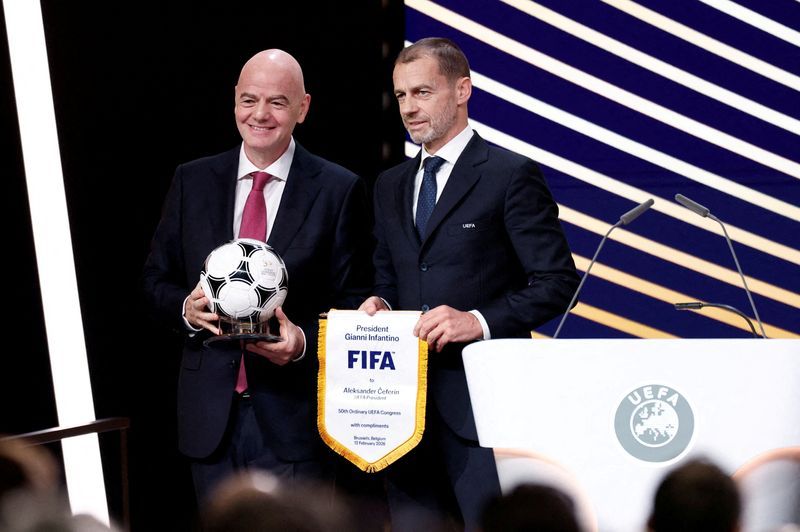
UEFA has escalated its dispute with FIFA President Gianni Infantino by requesting access to documents and testimony from FIFA's Florida-based subsidiaries through a U.S. federal court, setting the stage for formal criminal charges in Switzerland. The move represents a dramatic escalation in football governance tensions that erupted in late July when Infantino's controversial FIFA Forward Enterprise proposal threatened to trigger a European boycott of international competitions, including the World Cup.
The European confederation's legal strategy centres on allegations of mismanagement under Swiss law, specifically Article 158 of the Swiss Criminal Code. UEFA contends that Infantino developed the FIFA Forward Enterprise plan—which would have transferred commercial rights for men's and women's World Cups and the Club World Cup to a newly created subsidiary—entirely outside FIFA's established governance structures. According to UEFA's court filing, this year-long process excluded FIFA's 211 member associations, regional confederations, and even FIFA's own Council, the organisation's primary decision-making body.
The FIFA Forward Enterprise proposal represented an attempt to unlock value from world football's most valuable commercial assets. Potential investors, led by Thrive Eternal (an investment vehicle controlled by Joshua Kushner and affiliated with Thrive Capital), were prepared to inject $4.2 billion into the venture, which UEFA's analysis suggests valued FIFA's commercial rights at approximately $20 billion. However, European football's governing body has questioned the commercial logic underlying the entire transaction, noting that FIFA currently maintains billions of dollars in reserves—funds that technically belong to member associations rather than the organisation's executive leadership.
UEFA's core complaint focuses on procedural irregularities and the circumvention of established governance protocols. The confederation alleges that FIFA staff members internally reported feeling "deceived" by the secretive process, with FIFA Secretary General Mattias Grafstrom reportedly excluded from drafting the proposal. This exclusion of senior administrative figures from a transaction potentially affecting FIFA's most significant revenue streams underscores what UEFA characterises as a fundamental breach of institutional trust. The confederation argues that FIFA's Council possesses sole authority under the organisation's statutes to determine how commercial rights are promoted and monetised.
The valuation methodology employed for the transaction further inflames UEFA's concerns. The $20 billion valuation assigned to FIFA Forward Enterprise was never subjected to open market testing or independent professional valuation, according to UEFA's legal submission. Instead, a pre-selected investor group was effectively offered a permanent financial stake in FIFA's commercial operations at a price that UEFA believes significantly understates their actual value. This approach contrasts sharply with standard practice for major asset transactions, where competitive bidding processes typically ensure fair pricing and genuine market discovery.
The broader Southeast Asian context makes this governance crisis particularly significant for regional football development. FIFA's development funding, which the FFE proposal was ostensibly designed to expand, directly supports football infrastructure, training programmes, and competitive opportunities across Asia. Any restructuring of FIFA's financial mechanisms carries implications for how development resources are allocated regionally and whether such allocations remain subject to transparent, consultative processes that respect member confederation input.
Despite the aggressive legal posturing, UEFA has provisionally suspended plans to withdraw European national teams from FIFA competitions after receiving written assurances on July 30 that the FIFA Forward Enterprise project was "irrevocably and permanently withdrawn." This tactical retreat allowed the U-20 Women's World Cup in Poland to proceed as scheduled and prevented the immediate international disruption that a European boycott would have triggered. However, UEFA's leadership made clear that this suspension represents a temporary pause rather than a resolution of underlying governance tensions.
Infantino, who plans to seek a fourth term as FIFA President in March 2027, has framed the abandoned proposal as a well-intentioned initiative designed to expand global football development funding. He initially described FIFA Forward Enterprise as a "golden opportunity" while emphasising that implementation would have required majority support from FIFA's member associations and approval from the Council—claims that directly contradict UEFA's allegations that the proposal was developed in secret without such consultation. Infantino's characterisation of the initiative as merely a proposal rather than a predetermined transaction reflects fundamentally divergent interpretations of governance legitimacy within world football's institutional structures.
Geopolitical dimensions of this governance conflict have become increasingly apparent. While UEFA's 55 member associations unanimously opposed the FIFA Forward Enterprise plan, other confederations have maintained support for Infantino's leadership. The African confederation and South American confederation have continued backing Infantino, whilst the Saudi Arabian Football Federation explicitly endorsed his leadership on August 27, stating support for "continued efforts of FIFA President Gianni Infantino and FIFA's leadership to restore unity across the football family."
UEFA has signalled its intention to mount a sustained institutional challenge to Infantino's leadership authority. The confederation stated that its members unanimously mandated pursuit of "every available institutional, political and legal avenue" to secure governance reforms and restore limitations on presidential power. Should Infantino proceed with his 2027 re-election bid, UEFA has committed to mobilising partner confederations to present member associations with "a credible alternative" candidate committed to structural reform.
The confederation has additionally demanded that FIFA commission "a genuinely independent external review" of the FIFA Forward Enterprise proposal, explicitly rejecting the possibility that internal FIFA investigations could satisfy the football community's demand for accountability. This stance reflects broader governance anxiety about concentrations of executive authority within FIFA and the adequacy of existing internal oversight mechanisms to constrain presidential discretion.
As legal proceedings unfold in Switzerland and potentially before U.S. courts, the FIFA Forward Enterprise episode has exposed fundamental fault lines in world football's governance architecture. The dispute transcends the specific transaction, instead raising systemic questions about how FIFA's most consequential decisions are made, who participates in decision-making processes, and what mechanisms exist to ensure that FIFA's commercial resources—ultimately derived from global football's competitive ecosystem—serve the sport's broader development objectives rather than narrow executive or investor interests.

