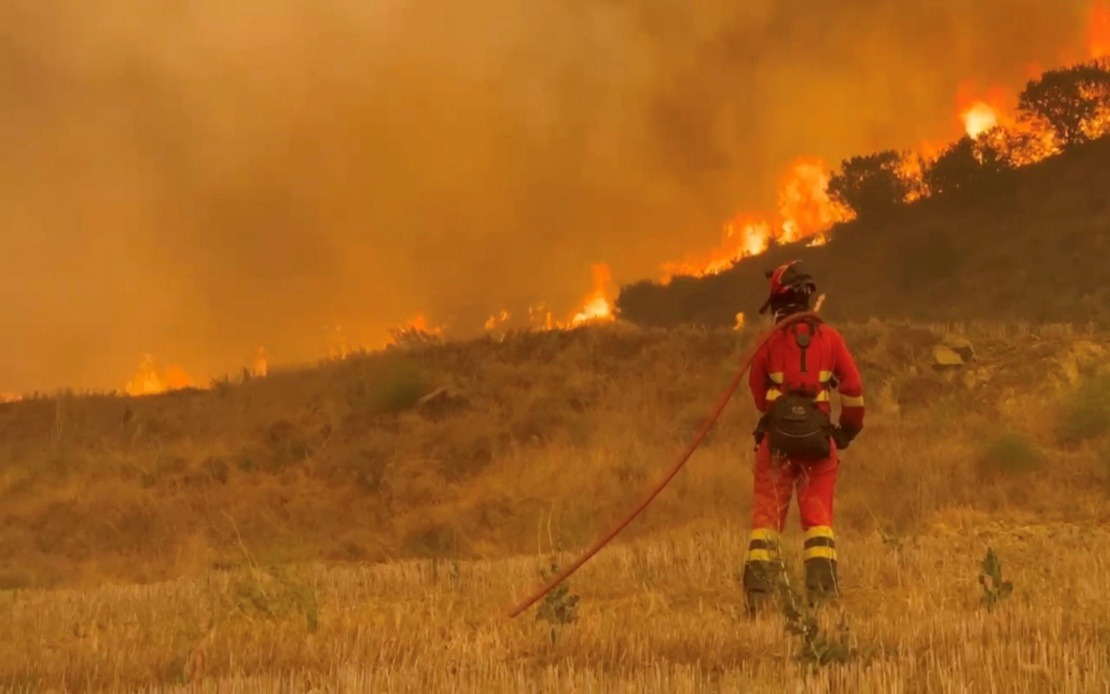
Britain's government is escalating its response to an intensifying environmental crisis, with senior ministers gathering for an emergency Cobra meeting on Wednesday to coordinate efforts against record heat, spreading wildfires and severe drought conditions affecting multiple sectors. The convening of such a high-level crisis committee underscores the scale of the challenge now facing the country, with the unusual combination of overlapping weather emergencies straining public services, agricultural output and emergency response capabilities across the nation.
Andy Burnham, a senior government figure, will preside over the emergency session as officials grapple with the cascading impacts of prolonged extreme temperatures. The meeting acknowledges that firefighters battling major blazes, farming communities facing devastating conditions and NHS staff already stretched thin by routine demands are all contending with unprecedented pressures directly attributable to the weather crisis. The decision to convene Cobra—the government's top-level emergency committee—signals recognition that conventional administrative responses may prove insufficient for the scope of the challenge ahead.
The immediate trigger for Wednesday's emergency gathering involves a significant wildfire currently consuming the New Forest in Hampshire, a sprawling protected landscape in southern England. Simultaneously, meteorological authorities expanded drought designations on Monday, placing additional regions across England under official drought status, compounding existing water stress conditions already declared across Wales and roughly half of England following months of exceptionally low rainfall and sustained elevated temperatures. This geographic expansion of drought zones carries serious implications for water availability, agricultural productivity and long-term environmental health across much of the country.
The UK's meteorological authority, the Met Office, has issued a rarely-invoked amber extreme heat warning for Thursday, signalling that conditions are expected to reach dangerous levels. More remarkably, the same agency announced on Tuesday that Britain now appears positioned to record its hottest summer in history when measured by average temperature across the season. This trajectory represents a stark departure from historical norms and reflects the broader pattern of climate-related weather extremes increasingly affecting Northern European nations previously considered less vulnerable to such phenomena compared to Mediterranean regions.
The temporal context of the crisis deepens its significance for policymakers and the public alike. A drought declaration across Wales materialised on July 30 as mounting evidence of water system stress accumulated, while England's drought proclamation followed recognition of record-low rainfall throughout the preceding weeks combined with relentless high temperatures that have drained reservoirs and groundwater sources. These sequential declarations across the UK's constituent nations underscore the geographic breadth of the environmental challenge, affecting both urban water supplies and rural agricultural viability.
The health toll from the preceding months has proven substantial and alarming. The UK Health Security Agency disclosed that Britain recorded 2,877 excess deaths during the heat waves that swept the nation in May and June, representing nearly a doubling of the 1,504 excess deaths tallied during the summer of 2025. These figures, while technical in presentation, represent thousands of individuals whose mortality risk was heightened by extreme heat conditions, highlighting the direct relationship between weather extremes and public health outcomes, particularly among vulnerable elderly populations and those with pre-existing health conditions.
Green Party leadership has used the crisis as a platform for advocating systemic policy shifts on energy and climate matters. Zack Polanski, the party's leader, articulated demands that extended beyond immediate crisis management to encompass fundamental policy reorientation. His statement—"We cannot negotiate with the science"—reframed the emergency as a moment requiring decisive action aligned with scientific understanding rather than incremental adjustments. The specific policy proposals he advanced included taxation mechanisms targeting fossil fuel corporations to finance wildfire suppression capabilities, development of community-level cooling infrastructure, implementation of maximum workplace temperature thresholds to protect worker safety, and a moratorium on new hydrocarbon extraction authorisation in the North Sea energy sector.
The interconnected nature of these crises—heat, fire, and water scarcity—creates a complex governance challenge that transcends traditional sectoral boundaries. Firefighting operations require sustained resource commitment under dangerous conditions; agricultural communities face potential crop failure and livestock losses; water utilities confront competing demands from household consumers, commercial users and environmental conservation needs; and health services must prepare for surge demand from heat-related illnesses and exacerbated chronic conditions. The emergency meeting represents an attempt to achieve coordinated response across these fragmented domains.
For Malaysia and Southeast Asia, the UK's experience offers instructive parallels and warnings. While tropical nations have historically adapted to heat and intense rainfall, the concurrent occurrence of severe drought with extreme temperatures represents a novel combination that challenges conventional adaptive strategies. The UK's struggle to mobilise emergency responses, manage excess mortality and maintain essential services during weather extremes demonstrates that developed nations with sophisticated infrastructure and resources nonetheless face significant vulnerabilities when climatic patterns shift beyond historical experience. The health data particularly resonates, as vulnerable populations in tropical regions with limited air conditioning access and less robust health systems may face proportionally greater mortality risks from similar temperature excursions.
The British government's reliance on high-level emergency coordination mechanisms suggests that departmental fragmentation and routine administrative processes cannot adequately address the velocity and scale of climate-related impacts. This has implications for emergency preparedness thinking across developed and developing nations alike, indicating that institutional structures and decision-making frameworks designed for more stable climatic conditions may require fundamental redesign. The question of whether emergency mobilisation during crises proves sufficient, or whether permanent institutional adaptation becomes necessary, remains unresolved even as the UK confronts its most serious weather emergency in recent memory.

