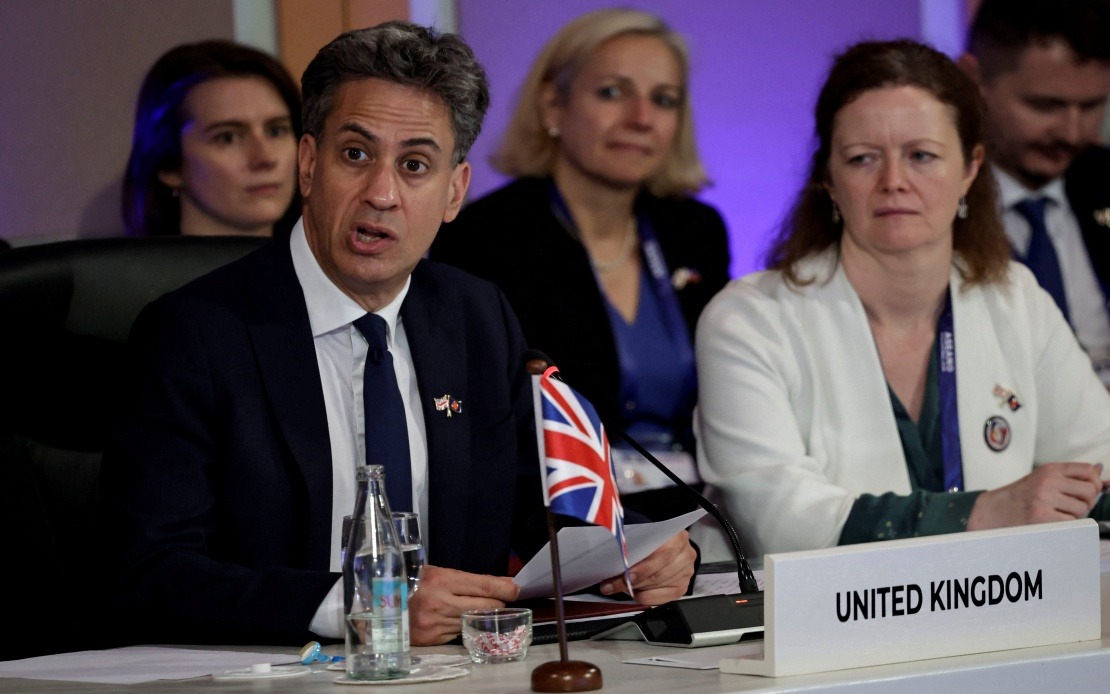
Ed Miliband, in his debut journey across the English Channel as the United Kingdom's foreign secretary, is embarking on a diplomatic mission centred on rebuilding and reinforcing relationships with key European partners. His inaugural continental tour will take him to France and Spain on Wednesday, marking a significant statement of intent from the newly installed British government about its desire to reset the relationship with the European Union following years of post-Brexit tensions and diminished engagement.
The timing of Miliband's journey carries particular weight, as both France and Spain are currently grappling with catastrophic wildfire emergencies that have upended the lives of hundreds of thousands of residents. The scale of the displacement crisis is staggering, with approximately 330,000 people forced to evacuate their homes across the two countries as fires have ravaged communities and consumed vast stretches of countryside. Against this backdrop of national crisis, Miliband's solidarity mission underscores Britain's readiness to stand with its European neighbours during their moment of acute vulnerability.
Miliband intends to weave the environmental catastrophe into a broader narrative about the existential threat posed by climate change, positioning the devastating wildfires not as isolated incidents but as symptoms of a planetary crisis that demands coordinated, sustained international action. By linking the immediate human suffering on the ground to the longer-term question of climate transformation, he aims to elevate the conversation beyond expressions of sympathy to substantive commitments to collective environmental stewardship. This framing carries particular significance for Southeast Asian nations like Malaysia, which face similar wildfire threats during dry seasons and understand intimately the transboundary nature of environmental degradation.
In Paris, Miliband will sit down with French Foreign Minister Jean-Noel Barrot to navigate several interconnected strategic challenges facing Europe. High on the agenda will be discussions about fortifying Europe's security architecture, a conversation rendered increasingly urgent by Russia's ongoing war in Ukraine and the need to ensure sustained international support for Kyiv. The two ministers will also explore how Britain and France can collaborate on securing greater stability in West Asia, a region where both nations retain significant diplomatic and strategic interests. Additionally, migration policy—an issue that has dominated European political discourse and often strained Franco-British relations—will be part of their talks.
The migration dimension of Miliband's visit carries particular relevance for Malaysia and other nations in the region that have emerged as transit points and destinations for displaced persons. The cross-border movement of people, whether driven by conflict, economic hardship, or climate displacement, represents a challenge that requires coordinated responses rather than isolated national approaches. Britain's willingness to engage with France on migration solutions signals a potential shift towards multilateral problem-solving on an issue that has previously divided European capitals.
Following his Paris engagement, Miliband will travel southward to Madrid for discussions with Spanish Foreign Minister José Manuel Albares. These conversations will address the Gibraltar question, a historical thorn in UK-Spanish relations that has remained contentious despite efforts at resolution. The UK-EU Gibraltar treaty represents an attempt to establish new frameworks governing the disputed territory following Britain's exit from the European Union, and Miliband's visit provides an opportunity to take the temperature on this sensitive issue and explore pathways towards lasting resolution. Beyond Gibraltar, the two ministers will delve into bilateral security cooperation, an area where Spain's geographic position and strategic importance in Atlantic and Mediterranean affairs make it an essential partner.
The elevation of security cooperation between Britain and Spain reflects broader strategic reorientation within Europe, where the continent faces mounting external pressures and internal challenges. Spain's role as a gateway between Europe and North Africa, combined with its military capabilities and intelligence assets, positions it as a crucial ally in addressing transnational security threats ranging from terrorism to organised crime to migration flows. For Malaysian observers, Spain's experience managing security challenges across diverse geographic and demographic contexts offers comparative lessons relevant to Southeast Asian security architectures.
Climate change, identified as a central preoccupation in both the Paris and Madrid legs of Miliband's journey, represents perhaps the most universally pressing concern transcending traditional geopolitical boundaries. The decision to foregrounding environmental catastrophe within a high-level diplomatic visit signals that Britain's newly installed government treats climate action not as an ancillary policy concern but as central to its entire foreign policy framework. This positioning aligns Britain with European consensus on climate urgency while simultaneously offering a potential platform for deepening engagement with non-European partners who share these concerns.
Miliband's inaugural European tour can be understood as a deliberate recalibration of British foreign policy priorities following years of focus on post-Brexit domestic adjustment and transatlantic relations. By beginning his tenure with a focused engagement on the continent, he signals that Britain seeks to overcome the polarisation and estrangement that characterised the Brexit period and move towards a more balanced, constructive relationship with its nearest neighbours. The substantive issues under discussion—Ukraine, migration, security, climate, Gibraltar—represent the accumulated complexities of contemporary European geopolitics, requiring sophisticated diplomatic engagement rather than posturing.
For Malaysia and Southeast Asia more broadly, the significance of Miliband's mission lies partly in what it reveals about Britain's strategic intentions in a period of profound global uncertainty. A Britain that remains actively engaged with European security architecture and committed to multilateral climate action is likely to remain a significant actor in Indo-Pacific affairs, where both security and environmental challenges demand sustained international attention. The success or failure of Miliband's attempts to strengthen British-European relations will reverberate across multiple regions and shape the architecture of international cooperation in the years ahead.

