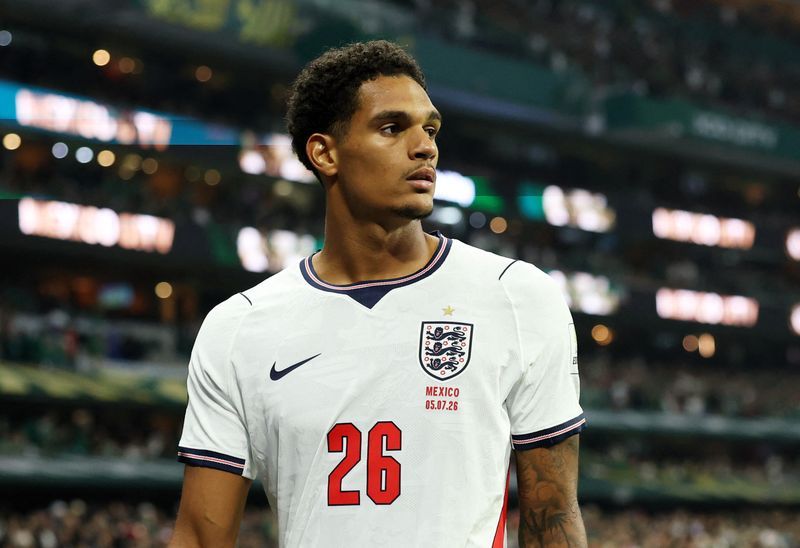
The row surrounding disciplinary decisions at the World Cup has escalated dramatically as British parliamentarians intervene on behalf of England defender Jarell Quansah, seeking the same suspension reprieve granted to American striker Folarin Balogun just days earlier. The escalation underscores mounting concern across multiple European football authorities that FIFA's handling of these cases may not be transparent or uniformly applied, potentially undermining confidence in one of world sport's most consequential regulatory processes.
Quansah received a red card during England's dramatic 3-2 victory over Mexico at Azteca Stadium on Sunday, triggering an automatic one-match ban that would sideline him from the quarter-final clash against Norway scheduled for Saturday in Miami. The automatic suspension would normally be incontestable under FIFA regulations, yet the preceding week's decision to defer Balogun's punishment has emboldened British MPs to argue that precedent now demands equal treatment. Labour backbenchers Noah Law and Melanie Onn submitted separate formal letters to FIFA President Gianni Infantino requesting that Quansah's ban be postponed until after the tournament concludes, mirroring the exceptional arrangement afforded to the American player.
The controversy stems from extraordinary political involvement that has no parallel in recent World Cup history. United States President Donald Trump publicly acknowledged contacting Infantino directly to intervene in Balogun's case, an admission that immediately thrust World Cup discipline into the realm of international diplomacy and high-level political pressure. Although Infantino subsequently stated that FIFA's independent judicial bodies would make all disciplinary decisions without external influence, the very fact of presidential intervention created an appearance of impropriety that has since metastasised into a broader credibility crisis for the governing body's impartiality.
Law articulated the philosophical crux of the challenge in his correspondence, acknowledging that Quansah's red card was properly issued under the laws of the game but contending that deferring the suspension until after the World Cup's conclusion would accord with precedent and fairness. His argument hinges on a straightforward principle of equal application: if one player suspended under identical circumstances can receive an exemption, denying the same consideration to another player places FIFA in an untenable position of apparent discrimination. Onn expanded this reasoning by emphasising that allowing such inconsistency would fundamentally compromise FIFA's disciplinary credibility, creating a system where outcomes depend not on objective rules but on factors external to the game itself.
The intervention represents the first formal attempt by political figures to leverage the Balogun decision as a binding precedent for other players, transforming what FIFA characterises as a one-off judicial determination into what could become a template for future appeals. This shift carries significant implications for how the world's football governing body operates under public scrutiny. If FIFA declines to apply similar reasoning to Quansah, officials will face accusations of political selectivity; if they grant the request, they effectively establish a framework where suspension deferrals become available for players whose home nations mobilise diplomatic resources. Neither outcome preserves FIFA's stated independence.
Caroline Dinenage, chairing the House of Commons Culture, Media and Sport Committee, escalated parliamentary pressure by formally demanding that FIFA urgently clarify the grounds for its Balogun decision and address suggestions of political interference. Her statement reflected broader anxiety among legislative bodies that football's foundational rules—ostensibly the same for all competitors—might be subject to manipulation based on which nation can exert the greatest political leverage. Dinenage framed the issue not as a technical dispute but as a threat to sport's moral legitimacy, warning that inconsistent application of regulations undermines the meaning and integrity of competition itself.
The English Football Association is reportedly considering its options regarding a potential appeal, according to sources familiar with the matter, indicating that official football authorities are now examining whether formal challenge mechanisms might succeed where they previously seemed exhausted by automatic suspension rules. This exploration suggests growing confidence that the Balogun precedent has substantively altered the regulatory landscape, even though FIFA itself has declined to confirm whether it would evaluate Quansah's case under the same Article 27 provision that governed the American striker's exemption. The silence from FIFA headquarters only deepens suspicions about the decision-making process.
For Malaysian and Southeast Asian observers, this controversy illuminates a persistent tension in global sports governance: the framework of supposedly neutral, universally applied rules frequently encounters pressure from powerful political actors seeking advantages for their nations. The incident demonstrates how political will and diplomatic resources can potentially circumvent established procedures, raising questions about whether smaller football-playing nations can expect equal treatment when their players face discipline. The pattern suggests that access to high-level political channels may increasingly determine outcomes that ostensibly derive from objective application of the laws of the game.
England's path to the quarter-finals has already been marked by controversy and drama, and this disciplinary dispute threatens to overshadow genuine sporting achievement. The team's victory over Mexico, though inspiring in its own right, has become entangled with questions about whether football operates as a transparent, rules-based system or as a domain where political pressure and diplomatic channels determine crucial outcomes. If FIFA grants Quansah's suspension reprieve, it validates the notion that sufficient political pressure can override established procedures; if it refuses, it opens itself to accusations of selective application and politically motivated inconsistency.
The coming days will reveal whether FIFA possesses the institutional confidence to maintain consistent disciplinary standards irrespective of political pressure, or whether the governing body has fundamentally shifted toward a model where outcomes depend on which nations can mobilise presidential phone calls and parliamentary committees. This moment transcends the immediate question of two players' World Cup participation, touching instead on whether international sport can sustain public confidence in systems that purport to be neutral while operating in an increasingly politicised environment. For football authorities worldwide, the precedent being established carries consequences extending far beyond this tournament.

