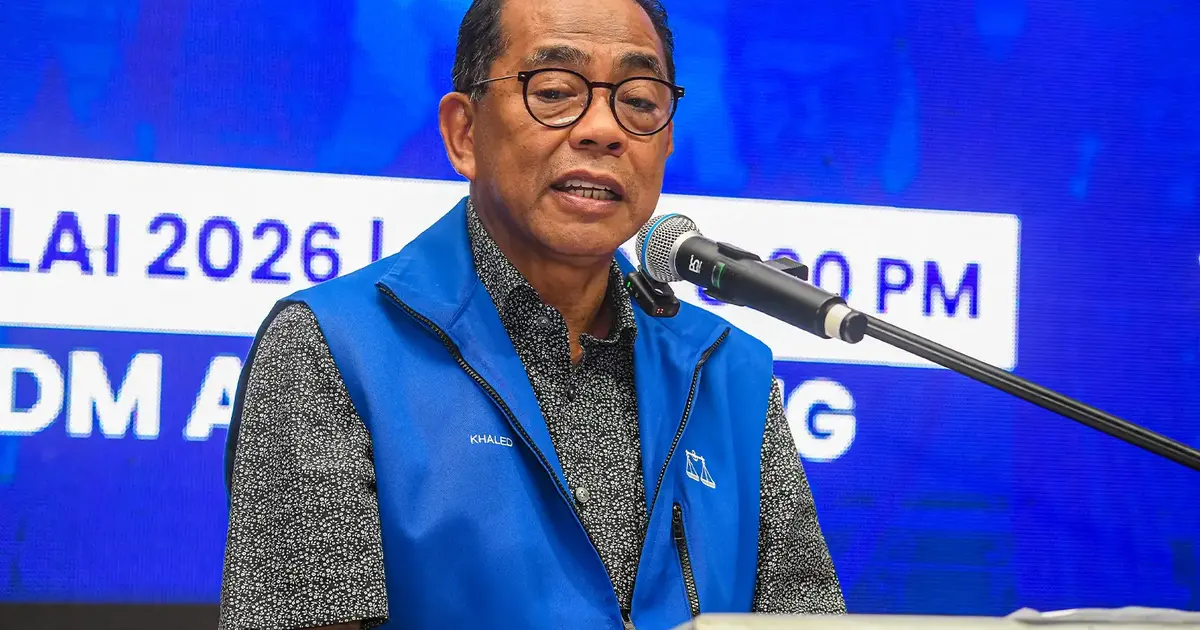
Umno vice-president Khaled Nordin has intensified calls for voters in Negeri Sembilan to deliver a decisive rejection of Bersatu, drawing a pointed comparison to the party's electoral collapse in neighbouring Johor and making a broader case that the faction must be thoroughly routed before the next general election.
Khaled's intervention reflects deepening anxieties within Umno about Bersatu's residual political strength and its continued presence in parliament, even after suffering severe setbacks in recent state contests. The Umno heavyweight has framed the Negeri Sembilan electoral cycle as a critical opportunity to diminish Bersatu's parliamentary representation and eliminate what he characterises as a destabilising force within Malaysian politics.
Bersatu's implosion in Johor during the 2023 state election served as a watershed moment for Malaysian politics. The party, which had dominated federal office under former Prime Minister Mahathir Mohamad and subsequently under Muhyiddin Yassin, was almost entirely wiped out at the ballot box. Johor voters decisively rejected Bersatu-aligned candidates across constituencies, delivering a stark message about the coalition's waning appeal in the southern state. This result prompted immediate reassessments within Umno regarding whether similar rejection patterns could be engineered in other strongholds.
Khaled's strategic emphasis on Negeri Sembilan appears calculated to build momentum for a broader anti-Bersatu narrative heading into the sixteenth general election. By invoking Johor's example, he is attempting to normalize the concept of comprehensive Bersatu defeat and position such outcomes as both achievable and necessary for Malaysia's political stability. The rhetoric suggests Umno sees value in framing Bersatu not merely as an electoral rival, but as a threat requiring systematic containment.
For Malaysian voters observing these partisan manoeuvres, Khaled's messaging highlights the deeper fragmentation that has characterised Malay-Muslim dominated politics since Pakatan Harapan's 2018 breakthrough. The formation and evolution of Bersatu represented a significant rupture within the traditional Umno-led order, and even though the party has struggled to maintain electoral competitiveness, its mere existence continues to generate controversy among rival factions competing for the same demographic base.
Negeri Sembilan holds particular significance within this competitive landscape. As a relatively moderate and electorally unpredictable state, it offers neither Umno nor Bersatu guaranteed dominance. The state's political trajectory since 2020 has seen shifting coalitions and uncertain electoral patterns, making it difficult for any single party to claim ascendancy. Khaled's intervention suggests Umno strategists believe that sustained mobilisation against Bersatu could alter Negeri Sembilan's electoral arithmetic before the national contest.
The timing of Khaled's remarks reflects the ongoing jockeying within Malaysian politics as parties position themselves for what many analysts expect will be a competitive general election campaign. Bersatu, despite its setbacks, continues to hold parliamentary seats and maintains organisational presence in multiple states. From Umno's perspective, allowing Bersatu to retain or expand its legislative foothold represents an unacceptable outcome that could complicate post-election coalition mathematics.
Analysts have observed that Bersatu's political durability partly stems from its retention of constituencies where it performed reasonably despite losing overall state contests. The party's residual parliamentary presence means that even after decisive defeats in state elections, it retains negotiating power and institutional platforms. Khaled's appeal for a more thorough rejection reflects Umno's determination to foreclose even this limited space for Bersatu manoeuvre.
The broader context involves Malaysia's evolving coalition politics, where traditional party hierarchies have fractured significantly. Umno, historically the dominant Malay nationalist force, faces competition not only from Bersatu but also from PAS and other players vying for Malay-Muslim support. In this crowded landscape, Khaled's explicit messaging against Bersatu signals that Umno views the party's elimination as strategically preferable to a scenario where multiple rivals share limited electoral space and post-election bargaining leverage.
For Southeast Asian observers, Malaysia's internal partisan struggles reflect broader regional patterns of political fragmentation and coalition instability. The collapse and persistence of Bersatu demonstrates how dominant parties can fracture when factional disputes overwhelm institutional loyalty, yet also how splinter factions can survive despite electoral punishment if they retain organisational capacity and parliamentary representation.
The appeal for Negeri Sembilan voters to emulate Johor's rejection of Bersatu underscores the high stakes that Malaysian political actors perceive in state and federal contests. While electoral outcomes ultimately rest with voters, the intensity of Khaled's campaigning illustrates how seriously Umno takes the possibility that Bersatu might otherwise persist as a complicating factor in Malaysia's political future.

