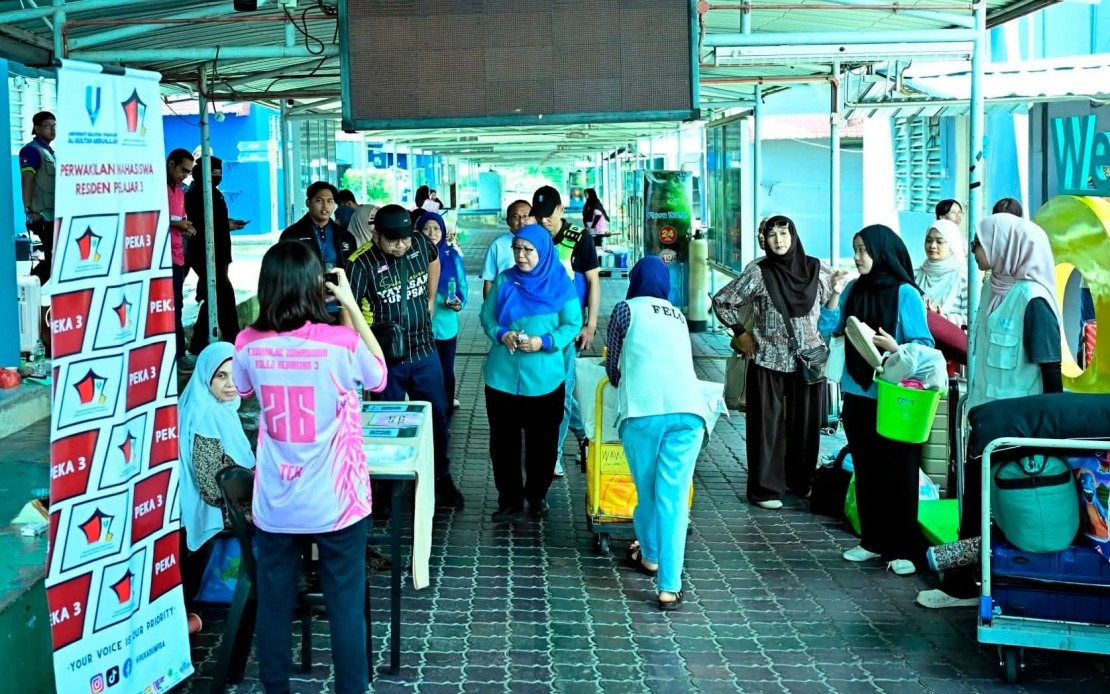
Universiti Malaysia Pahang Al-Sultan Abdullah (UMPSA) has pledged sustained investment in programmes designed to remove financial barriers for disadvantaged students, with vice-chancellor Prof Dr Yatimah Alias emphasizing that equitable access to higher education remains central to the institution's mission. The commitment comes as the university registers its largest cohort of new diploma intake since inception, signalling both institutional expansion and a deliberate focus on broadening participation across socioeconomic strata.
Yatimah outlined a multi-layered approach to student welfare during registration day in Kuantan, describing the university's strategy as encompassing not merely financial disbursement but comprehensive academic and pastoral support. By framing these interventions as essential infrastructure rather than charity, the vice-chancellor positioned equity as foundational to UMPSA's educational philosophy rather than peripheral. This rhetorical framing carries particular weight in Malaysia's higher education landscape, where access disparities based on family income remain a documented challenge across both public and private institutions.
Tangible evidence of this commitment materialized through immediate disbursements to enrolled students. Twenty students received full scholarships covering tuition fees alongside monthly allowances—a package that substantially reduces the financial pressure on recipients throughout their academic careers. Beyond these larger awards, UMPSA Foundation channeled RM1,000 Early Education Incentive payments to additional students identified as facing economic hardship. While individual sums vary, the dual-track approach suggests institutional recognition that financial need operates across a spectrum rather than as a binary condition.
The 1,045 new diploma students registering for the 2026/2027 session represent the highest single intake in UMPSA's operational history, a milestone reflecting both demographic demand and institutional capacity expansion. For underprivileged cohorts, enrollment growth at this magnitude carries practical implications—larger pools of beneficiaries, competitive scholarship allocations, and increased pressure on support services. Universities across Southeast Asia have grappled with this tension: expanding access while maintaining quality of individualized support. UMPSA's public commitment to financial assistance alongside record intake suggests the institution views this as an investable challenge rather than a constraint.
Contextualized within Malaysia's broader educational narrative, UMPSA's prioritization of disadvantaged student welfare addresses a persistent policy concern. Tertiary education access remains unequally distributed across income quintiles despite government initiatives, with first-generation university students facing particular vulnerability to dropout. By embedding support mechanisms into standard operations rather than treating them as supplementary, UMPSA signals institutional alignment with national aspirations around inclusive growth and meritocratic mobility. This positioning is especially relevant given the university's location in Pahang, a state where rural and semi-urban populations may encounter greater obstacles accessing university-level education.
The vice-chancellor's engagement with students during registration—beyond ceremonial appearance—suggests organizational culture prioritizing stakeholder visibility. Such interactions serve practical purposes: they enable direct understanding of student circumstances and emerging support needs. They also carry symbolic weight, communicating that senior leadership considers student welfare sufficiently important to warrant personal attention rather than delegation. In Malaysian institutional contexts, where hierarchical dynamics often structure organizational communication, such gestures carry disproportionate messaging significance.
Financial assistance, while critical, represents only one dimension of support that underprivileged students require. UMPSA's stated commitment to academic support and unspecified "various initiatives" suggests recognition of barriers beyond tuition costs—inadequate secondary preparation, family obligations competing with study time, and psychological adjustment challenges common among first-generation cohorts. The specificity of scholarship details contrasts with vaguer language around academic support, a linguistic pattern common in institutional communications but potentially masking uneven implementation. Transparency regarding the scope and utilization of these supplementary programmes would strengthen the university's credibility on equity commitments.
Regional context amplifies UMPSA's initiative significance. Across Southeast Asia, higher education expansion has proceeded rapidly, yet equity outcomes have lagged enrollment growth. Malaysia's position as a relatively developed economy with established tertiary infrastructure positions it to model inclusive expansion practices. UMPSA's record intake combined with documented support commitments offers a case study relevant to peer institutions navigating similar demographic and policy pressures. Should the university sustain and transparently report on outcomes for disadvantaged cohorts, it contributes valuable evidence regarding scalable equity interventions.
The UMPSA Foundation's role in funding early education incentives warrants attention as an institutional innovation. Foundation-funded initiatives can provide flexibility absent in government-constrained budgets, enabling rapid response to identified needs and experimental programming. However, foundation dependence also introduces sustainability questions—as endowments fluctuate or philanthropic priorities shift, commitments made through such mechanisms may face volatility. Universities committed to equitable access must ensure that welfare initiatives rest on stable funding architectures rather than contingent on external fundraising success.
Looking forward, UMPSA faces the challenge of translating enrolment success into graduation outcomes and post-tertiary opportunity realization for disadvantaged cohorts. Scholarship provision and initial financial support must connect to career pathways, internship access, and professional networks that historically advantage privileged graduates. The most inclusive universities become those that address not merely entry barriers but the full student lifecycle, including labour market transition. UMPSA's expansion initiatives, if coupled with employment support and industry partnership development, could transform institutional practice in ways extending far beyond immediate scholarship recipients.

