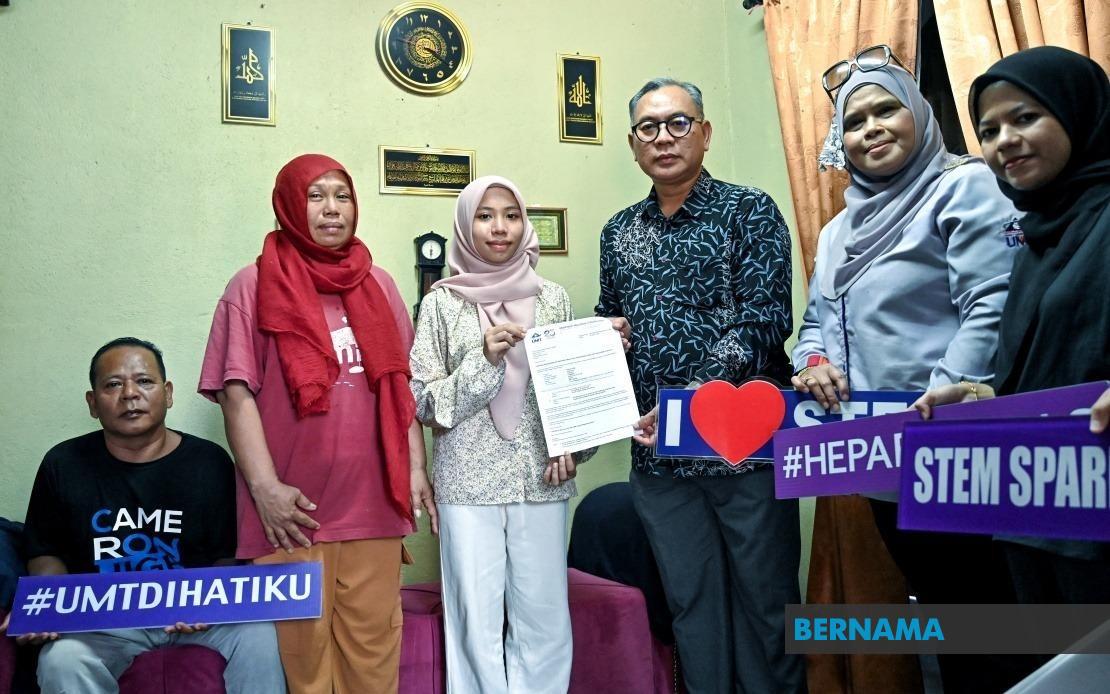
When Nurul Amira Abdul Hamid received her university acceptance letter, it initially brought despair rather than celebration. The 18-year-old from Parit Jawa in Perak faced an impasse that would have ended her educational aspirations before they began: her family lacked the means to pay registration and tuition fees for her chosen programme. She had already begun working at a retail store earning RM1,300 monthly to help her parents manage household expenses, a sacrifice that seemed to signal the end of her academic journey. Her circumstances reflected a broader challenge across Malaysia, where talented students from underprivileged backgrounds often abandon higher education despite their capabilities, unable to bridge the gap between qualification and affordability.
Intervention from Universiti Malaysia Terengganu proved transformative for Nurul Amira's future. The institution identified her situation and stepped beyond typical administrative processes to become an active partner in her educational access. UMT secured the Al-Ikhlas Scholarship worth RM500 for the teenager and coordinated additional financial support to address registration costs and ongoing expenses. The university went further by arranging transportation for her to visit campus when her family could not afford such trips, and structured a living assistance package throughout her studies. These interventions eliminated barriers that typically force capable students to choose employment over education, recognising that financial constraints often mask genuine academic potential.
Nurul Amira's background underscores the economic realities facing many Malaysian families. Her father, Abdul Hamid Othman, was managing serious health complications that reduced the household's earning capacity, while her mother, Asmah Che Ros, worked as a housewife. As the youngest of three siblings, Nurul Amira bore the psychological weight of contributing financially at an age when her peers were preparing for university entrance. Her SPM results—three As—demonstrated that her earlier work stint was not reflective of academic ability but rather necessity. The decision to seek direct assistance from UMT marked a crucial turning point, requiring courage to articulate vulnerability and resourcefulness to identify where support might exist.
The pathway Nurul Amira is now pursuing represents one of Malaysia's critical talent pipelines. Her enrolment in the one-year STEM Foundation programme followed by a Bachelor's degree in Science with specialisation in Nautical Science and Maritime Transportation positions her within an industry sector increasingly central to Malaysia's economic strategy. Maritime industries span shipping, port management, naval architecture, and ocean resource development—fields where Malaysia's geographical position and economic ambitions create significant demand. By ensuring that capable students like Nurul Amira access these pathways regardless of household income, universities address both social mobility and national skills gaps simultaneously.
UMT's approach reflects a philosophical shift in how research universities view their broader societal role. Vice-Chancellor Prof Dr Mohd Zamri Ibrahim articulated an institutional commitment beyond standard student services, emphasising that the university takes responsibility for actively reaching out to students and families facing financial difficulties. Rather than waiting for students to navigate complex application processes for assistance, UMT implemented a proactive engagement model where university staff meet families, assess genuine need, and craft customised support packages. This approach acknowledges that financial barriers often prevent students from even submitting applications for aid, meaning passive assistance systems systematically miss those most in need.
The scale of UMT's intervention suggests this is not an isolated case of benevolence but part of systematic institutional programming. The vice-chancellor indicated that more than ten students from underprivileged families received assistance during the current academic year through similar mechanisms. This figure suggests UMT has embedded financial inclusion into its recruitment and retention strategy, allocating resources and staff capacity to identify and support vulnerable students. The commitment to provide living assistance throughout students' academic careers demonstrates understanding that financial hardship is not merely about tuition fees but encompasses accommodation, meals, transportation, and study materials that collectively determine whether students can maintain focus on their education.
For Malaysian higher education broadly, Nurul Amira's experience illuminates both achievements and persistent gaps. Malaysia's university system has expanded dramatically, with dozens of public and private institutions offering diverse programmes. However, access remains stratified by family income in ways that waste human capital and reinforce inequality. Students who would excel in tertiary education sometimes never enrol because the initial financial burden appears insurmountable, or they dropout when unexpected expenses create crisis. Universities that adopt proactive intervention models demonstrate that removing these barriers is both feasible and beneficial, creating pathways for talented individuals regardless of household economic status.
The importance of this intervention extends beyond individual benefit to regional economic implications. Southeast Asia faces intensifying global competition for talent and investment in strategic sectors including maritime industries, technology, and advanced manufacturing. Countries that fail to develop the full spectrum of their human capital—allowing talented individuals to remain underemployed or unemployed due to financial constraints—cede competitive advantage to nations with more inclusive educational systems. When a Malaysian university actively removes barriers to access for capable students, it strengthens the region's capacity to build knowledge-intensive industries and sustain economic advancement.
Nurul Amira's transition from retail employment to STEM foundation studies also reflects important demographic patterns within Malaysian education. Women constitute increasing proportions of university enrollees and frequently outperform male counterparts academically, yet women from lower-income households face compounded barriers including family expectations and financial vulnerability. By supporting female students like Nurul Amira in technical and maritime fields traditionally male-dominated, universities expand the talent pools available to sectors experiencing skills shortages. The investment in her success today becomes measurable value in her future contributions as a qualified maritime professional serving Malaysia's shipping and ocean industries.
Moving forward, the sustainability question becomes whether UMT's model can scale and inspire replication across Malaysia's higher education sector. Resource constraints mean universities cannot eliminate all financial barriers, yet strategic interventions targeting high-potential students from underprivileged backgrounds generate significant returns in student retention, graduation rates, and employment outcomes. Other institutions facing similar demographic challenges—regions with concentrations of lower-income families, areas experiencing industrial transition—might study and adapt UMT's approach. The combination of active outreach, rapid assessment, customised support packages, and ongoing living assistance creates a replicable framework demonstrating that financial inclusion enhances rather than detracts from institutional excellence.
Nurul Amira's immediate future involves rigorous STEM foundation study followed by advanced undergraduate coursework in maritime science and transportation. Longer term, she represents a growing cohort of Malaysian women entering technical professions previously associated with male dominance, bringing diverse perspectives to engineering and maritime sectors. Her success story, enabled by institutional decision-making at UMT, documents how universities function simultaneously as educational providers and social mobility engines. The teenager who nearly declined her university place due to poverty is now positioned to complete credentials unlocking professional careers in expanding maritime industries, transforming her family's economic trajectory while strengthening Malaysia's capacity to address skills gaps in strategic sectors.

