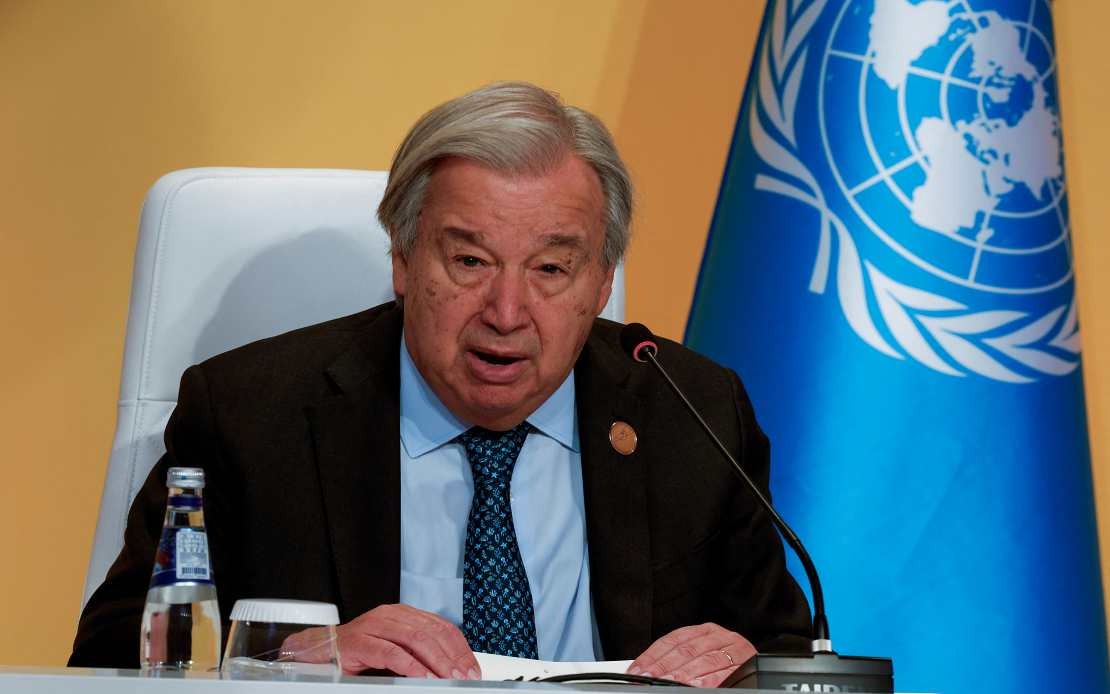
The United Nations' top official has sounded an urgent alarm over the deteriorating security situation unfolding across the Persian Gulf, warning that continued military escalation threatens far-reaching consequences for regional stability and global economic interests. In a statement released on Sunday, UN Secretary-General Antonio Guterres articulated his deep concern regarding a series of recent hostile incidents, encompassing Iranian attacks on commercial shipping in the Strait of Hormuz, retaliatory American military strikes against Iranian targets, and Iranian missile strikes directed at neighbouring countries. The escalating cycle of tit-for-tat military actions has prompted the international community to intensify diplomatic pressure on the conflicting parties to step back from the brink of broader hostilities.
The secretary-general's intervention reflects growing international anxiety that the current trajectory of regional tensions could spiral into open conflict with catastrophic ramifications. Speaking through his spokesperson Stephane Dujarric, Guterres emphasised that a return to full-scale military hostilities would inflict severe damage not only on the civilian populations living throughout the Middle East but would also destabilise the international order and inflict substantial harm on the global economy. This assessment underscores a fundamental reality for trading nations worldwide: disruptions to shipping in the Strait of Hormuz, one of the world's most critical energy chokepoints, would trigger immediate spikes in oil prices and supply chain disruptions affecting economies from Asia to Europe.
For Malaysia and other Southeast Asian nations heavily dependent on stable energy supplies and global trade flows, the implications of a major Gulf conflict are particularly acute. The region's manufacturing sectors, petrochemical industries, and maritime logistics networks all rely on predictable access to Middle Eastern energy resources and uninterrupted shipping lanes. A significant escalation in Gulf tensions would translate into higher energy costs that would permeate through Malaysian supply chains, potentially dampening economic growth and competitiveness in export-oriented sectors. The Malaysian government and regional associations have long prioritised the maintenance of freedom of navigation through critical international waterways, making the Strait of Hormuz situation directly relevant to Southeast Asian strategic and economic interests.
Guterres has made an explicit call on both Iran and the United States to exercise maximum restraint and abandon further provocative military actions. The secretary-general's statement emphasises the urgent necessity for immediate de-escalatory measures, signalling that the current moment represents a critical juncture where diplomatic intervention could still prevent catastrophic outcomes. This plea for restraint carries particular weight given the UN's limited enforcement mechanisms and the reality that both Iran and the United States possess significant military capabilities and regional influence. The international community's ability to influence outcomes in the Gulf has proven repeatedly constrained when either major power is determined to pursue confrontational policies.
Crucially, Guterres has reiterated the international community's fundamental interest in maintaining and restoring full freedom of navigation through the Strait of Hormuz. This principle transcends the immediate Iran-United States dispute and touches upon foundational norms of international maritime law and commerce. Approximately one-third of global liquefied natural gas and roughly one-quarter of traded oil passes through the strait annually, making unrestricted passage essential for global energy security. Any blockade, attempted closure, or sustained militarisation of the waterway would represent a direct threat to international commerce and the economic wellbeing of nations far beyond the immediate region.
The UN chief has specifically urged Iran and the United States to resume direct negotiations and pursue diplomatic channels for addressing their outstanding disagreements. This emphasis on dialogue reflects the international consensus that military solutions to the bilateral tensions between Washington and Tehran have proven counterproductive and dangerous. Previous cycles of military escalation have consistently failed to resolve the underlying issues driving Iranian-American hostility, instead generating new grievances and expanding the scope of conflict. The diplomatic route offers the only viable pathway toward addressing the substantive disputes regarding nuclear programmes, sanctions, regional proxies, and spheres of influence that have defined the relationship between the two nations.
The current escalation must be understood within the context of broader regional instability across the Middle East. The Syria conflict, the Yemen humanitarian catastrophe, the Israeli-Palestinian tensions, and various proxy conflicts have created a combustible environment where any Iran-United States confrontation risks triggering cascading regional consequences. Additional actors including Saudi Arabia, the United Arab Emirates, Iraq, and various non-state armed groups possess their own interests and military capabilities that could become mobilised in response to a major escalation between Iran and America. This web of intersecting conflicts and alliances means that de-escalation efforts must succeed quickly before the situation metastasises into a broader regional conflagration.
The secretary-general's invocation of catastrophic consequences carries implicit recognition of the humanitarian dimension underlying the current crisis. Beyond economic disruptions and geopolitical complications, an expanded Gulf conflict would generate mass civilian casualties, refugee movements, and humanitarian emergencies that would overwhelm regional and international capacity to respond effectively. The existing humanitarian crises throughout the Middle East have already strained international resources; a major new conflict would intensify these emergencies geometrically. Malaysia's humanitarian and development communities would likely face demands for increased participation in refugee assistance and reconstruction efforts in the aftermath of such a conflict.
The timing of the secretary-general's statement reflects the international community's assessment that immediate intervention remains necessary to prevent further deterioration. Diplomatic channels between the major powers appear strained, and direct communication mechanisms have proven inadequate for managing the current tension. The UN, despite its institutional limitations, serves as the primary forum where all nations can articulate their positions and where international consensus regarding fundamental principles like freedom of navigation can be reinforced. The secretary-general's statement therefore represents both an appeal for restraint and a reaffirmation of international legal norms that should govern behaviour in shared spaces like the Strait of Hormuz.

