The women's draw heading into the US Open presents a rare competitive landscape, with defending champion Aryna Sabalenka struggling to repeat her dominance and second seed Elena Rybakina sidelined by injury concerns—a combination that has substantially widened the field of plausible winners when play begins on Sunday at Flushing Meadows.
Sabalenka's campaign to achieve a third consecutive US Open title faces formidable headwinds after a disappointing second half of the season undermined her credentials. The Belarusian has failed to reach a final since capturing the Australian Open and Miami Open earlier this year, and her vulnerability has become increasingly apparent in recent weeks. According to ESPN's Mary Joe Fernandez, a former world number four, Sabalenka has struggled to close out crucial matches and squandered significant leads in several tournaments—a troubling pattern for someone seeking to join an exclusive historical club. Success would make her only the third woman in the Open Era to achieve three consecutive crowns at the venue, following Margaret Court's era and Serena Williams' remarkable run between 2012 and 2014.
Rybakina's unexpected withdrawal from Cincinnati following a leg injury has cast further uncertainty over the top half of the seeding. The Kazakhstani player's physical setback arrives at precisely the wrong moment, arriving just days before one of tennis's most demanding fortnight competitions. Her absence from the final in Cincinnati represents a significant blow to her US Open preparations, leaving questions about her fitness and readiness to contend through multiple rounds on hard courts.
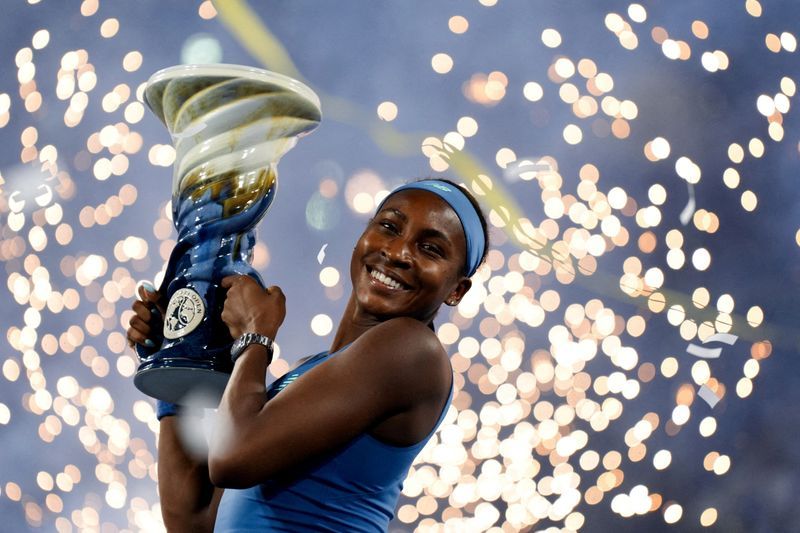
The door these circumstances have opened has swung wide for Coco Gauff, the 2023 champion who has rediscovered her championship form at exactly the right moment. The American has orchestrated a remarkable turnaround in her game, particularly in her serve—an element that drew considerable criticism during her career—which has become a genuine asset rather than a liability. Her performance in Toronto, where she reached the semifinals, and her triumphant run in Cincinnati, where she claimed her first title of the year, demonstrate the consistency and confidence she is carrying into New York. Gauff benefits tremendously from the partisan home crowd at Flushing Meadows, where American tennis fans provide vocal and energetic support. Fernandez noted that among all contenders, Gauff is currently playing the most convincing tennis, a significant endorsement heading into the main draw.
Gauff is not alone in her American representation. Jessica Pegula, ranked fourth, will shoulder expectations as the US women have conspicuously failed to reach any Grand Slam final during the first three major championships of 2024—a drought that has intensified the pressure on American representatives to restore national success at these events. The combination of Gauff's restored form and Pegula's consistent ranking places substantial responsibility on their shoulders to reverse this trend.
Iga Swiatek represents another formidable candidate to claim the crown. The Polish champion, a six-time major winner, has arrested her season-long struggles with a powerful statement by capturing the Toronto title just weeks before the US Open. Her resurgence carries particular significance given the intense criticism she faced within Polish media and public discourse. Swiatek herself acknowledged that her journey through 2024 had been complicated by impatience and premature expectations, admitting that she sometimes pursued victories when her game was not yet ready. However, her timing appears fortuitous as she arrives in New York with restored confidence and upward trajectory.
Swiatek's campaign has been marked by disappointment at the major championships, with her deepest run this year reaching only the quarterfinals across the first three Grand Slams. The Toronto victory represents her breakthrough moment, suggesting that the hard court season has finally unlocked the consistency and aggressive shot-making that characterise her most dominant performances. At number eight in the rankings, she enters as a challenger rather than favourite, but her current momentum cannot be dismissed.
The competitive landscape extends well beyond these headline contenders. Russian teenager Mirra Andreeva has already announced her arrival at the elite level by winning her maiden major title at Roland Garros earlier this year, demonstrating the precocious talent emerging in women's tennis. Czech player Linda Noskova claimed her own significant breakthrough at Wimbledon just weeks ago, suggesting that multiple emerging talents could capitalize on any stumbles by established players. Most intriguingly, Alexandra Eala of the Philippines has captured attention by defeating both Naomi Osaka and Jessica Pegula to win the prestigious WTA 500 tournament in Washington DC this month—a result that stunned observers and established the Filipino player as a name to watch.
Naomi Osaka, twice a US Open champion in 2018 and 2020, remains relevant despite her extended absence from competition due to maternity leave in 2023. Her return to relative form, highlighted by a runner-up finish at Bad Homburg in June and her semifinal appearance at last year's US Open following her comeback, suggests that New York's enthusiastic crowd and hard court conditions could reignite her championship credentials. The American-adopted Japanese player commands fervent support in New York, and any successful run would provide compelling narrative given her comeback arc.
The breadth of potential winners reflects genuine parity in women's tennis at this moment. ESPN commentator Patrick McEnroe observed that while the tournament cannot be characterised as entirely wide open, somewhere between six and eight players possess legitimate chances to lift the trophy. This represents a substantial expansion from the typical scenario where top-ranked players dominate outcomes. The combination of injuries, inconsistent form among champions, and the emergence of multiple contenders has created conditions where experience, momentum, and crowd support could prove decisive factors. For Malaysian and Southeast Asian tennis followers, the emergence of Eala as a significant player represents regional relevance in a sport increasingly dominated by European and North American players. The US Open women's draw that commences this Sunday will determine whether these forecasts prove accurate or whether additional surprises await.

