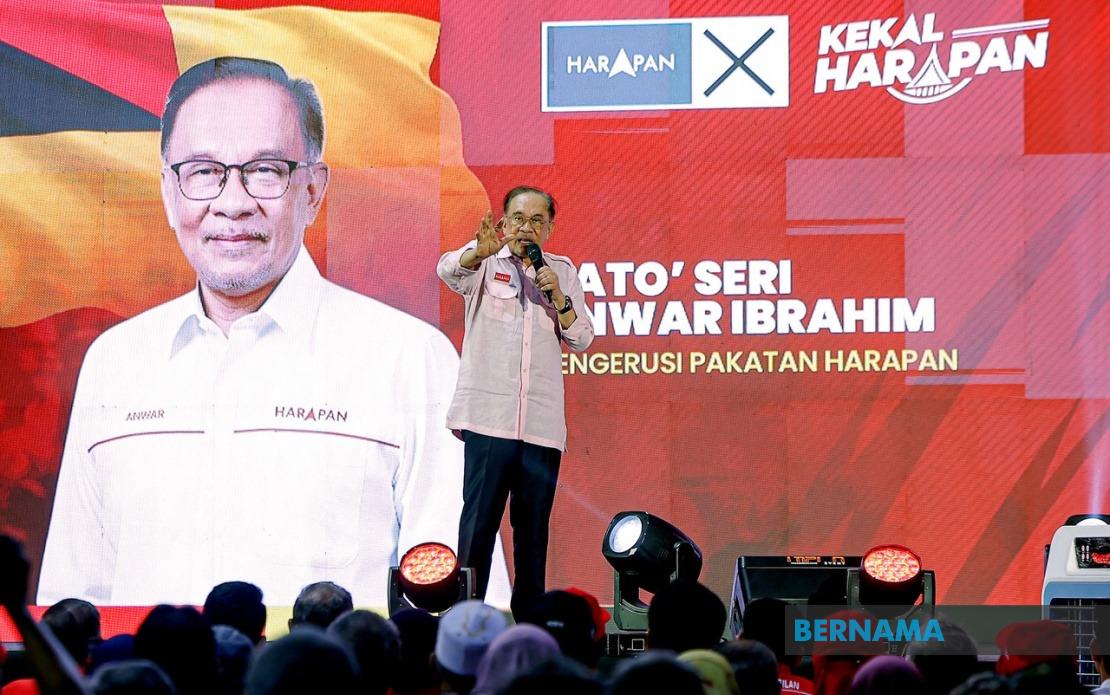
Prime Minister Datuk Seri Anwar Ibrahim has moved to reassure the nation about the solidity of the federal administration, declaring that the Unity Government maintains unwavering stability and strength despite political dynamics playing out across the states. Speaking in Seremban on July 22, he sought to distance concerns about any fractures within the coalition that governs at the national level, emphasising that this cohesion is essential for maintaining Malaysia's economic trajectory and international investor confidence.
The administration's chief underscored the distinction between what unfolds at the grassroots political arena and what transpires in the corridors of federal power. While acknowledging that individual states may experience their own electoral pressures and organisational challenges, Anwar stressed that these developments have not translated into substantive threats to the national government's operational continuity. This separation of concerns reflects a deliberate strategy by the coalition to compartmentalise competitive positioning without allowing it to destabilise the mechanisms of federal governance.
According to the Prime Minister, the collaborative framework within the Unity Government remains demonstrably functional. He pointed to the regular and orderly convening of Cabinet meetings as tangible evidence of this working relationship, noting that ministerial gatherings are proceeding smoothly and without disruption despite the competing organisational interests of coalition partners. The execution of these regular governmental forums suggests that institutional discipline and shared commitment to national administration are holding firm.
Anwar highlighted recent Cabinet sessions attended by key figures including Agriculture and Food Security Minister Datuk Seri Mohamad Sabu, Transport Minister Anthony Loke, and Deputy Prime Minister Datuk Seri Dr Ahmad Zahid Hamidi, alongside other senior leaders. The mention of these high-profile participants underscores the continued engagement of major coalition parties in federal decision-making processes. The fact that the Prime Minister specifically referenced these gatherings indicates an intention to signal normalcy and functional governance to both domestic and international audiences.
The Prime Minister's reassurance carries particular significance given the Malaysian political context, where coalition governments have historically faced scrutiny regarding their durability. The statement appears calibrated to address investor concerns and market sentiment, recognising that economic confidence depends partly on perceptions of political stability. Malaysia's track record of relying on foreign direct investment for growth means that any suggestion of governmental instability could prompt capital flight or deter new investment commitments.
Anwar's emphasis on economic growth and investor confidence reflects an understanding that the federal government's primary obligation during a period of stated stability is to maintain the conditions under which business can flourish. The framing suggests that preventing economic disruption has become a central rallying point for coalition unity, even when individual parties pursue distinct electoral strategies at the state level.
The acknowledgment that state-level competition exists represents a candid recognition of the coalition's internal tensions. Malaysia's federal structure means that state governments serve as important power bases and testing grounds for political parties. The willingness to compete for state-level control while maintaining federal cooperation is not unusual in Malaysian politics, yet it does create inherent contradictions that require careful management. By explicitly stating that state-level issues remain compartmentalised, Anwar seeks to prevent spillover effects that could undermine federal governance.
The Prime Minister's invocation of hope that stability will persist "after the elections" hints at forthcoming electoral contests, likely at the state level. This forward-looking statement suggests awareness that electoral outcomes could potentially shift the balance of forces within the coalition. The use of "Insha'Allah" adds a rhetorical layer that appeals to shared values while simultaneously acknowledging that political stability depends on factors beyond governmental control.
The broader implication of Anwar's statement is that maintaining federal-level unity remains a strategic priority for the current government configuration. This reflects the reality that Malaysia's complex multi-party system requires intentional coalition management, and that the preservation of working relationships at the federal level is treated as a prerequisite for economic performance. For Malaysian stakeholders and regional observers, the message being conveyed is one of continuity and institutional resilience, even as the country navigates the ordinary turbulence of competitive democratic politics at various governance levels.

