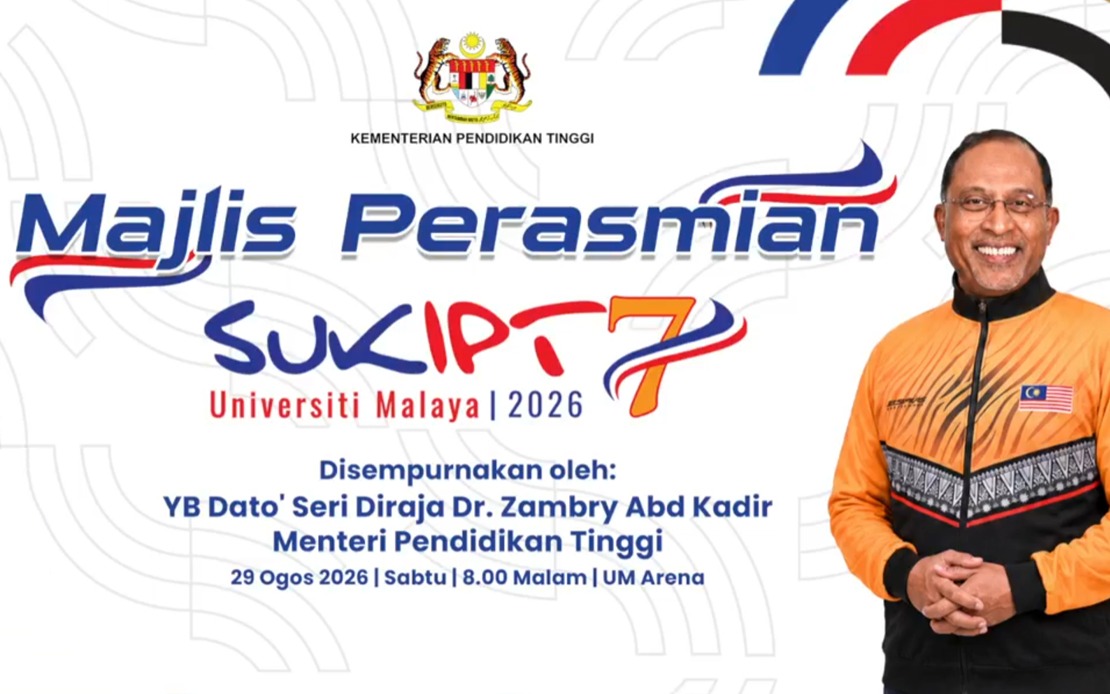
The achievements of Malaysia's university athletes on the international stage underscore a critical truth: higher education institutions have become crucial incubators for developing world-class sporting talent capable of competing and winning on the global arena. Speaking at the opening of the Higher Education Institution Games (SUKIPT) 2026 held at Universiti Malaya Arena, Higher Education Minister Datuk Seri Dr Zambry Abdul Kadir emphasised that the success of IPT athletes in recent major competitions validates the strategic importance of nurturing sports excellence within the university system.
The minister pointed to several standout achievements that exemplify this potential. Muhammad Erry Hidayat from Universiti Putra Malaysia captured gold in men's 79-kilogramme weightlifting at Glasgow 2026, while his teammate Muhammad Aniq Kasdan from Universiti Teknologi MARA secured gold in the men's 60kg category. These performances represent not merely individual triumphs but evidence of systematic excellence developing within Malaysian universities. Beyond weightlifting, Amir Daniel Abdul Majid from Universiti Sains Malaysia made history by becoming the first Malaysian judoka to claim Commonwealth Games gold in his sport, a breakthrough achievement that signals deepening competitive strength in traditionally underrepresented disciplines.
The Commonwealth Games medals are particularly significant for Malaysia's sporting narrative. Amirul Daniel Abdul Rahim from Universiti Malaya contributed bronze in lawn bowls, adding to the medal tally and demonstrating that excellence spans multiple sports rather than concentrating in narrow specialisations. These successes occurring simultaneously across different universities and disciplines suggest that the infrastructure and coaching frameworks supporting university athletics have matured considerably. For Malaysian policymakers and sports administrators, this pattern validates continued investment in institutional sports development as a pathway toward sustained national competitiveness.
Domestically, IPT athletes have equally impressed through record-breaking performances at the Malaysia Games. Omar Osman from Politeknik Sultan Ibrahim set standards in the 400-metre event, while Muhammad Fadwah from UiTM and Danish Iftikhar Muhammad Rosli from Universiti Pendidikan Sultan Idris both shattered existing records in sprint events. The duo's achievements in the 200-metre and 4x100-metre relay particularly merit attention, as relay records typically demand not just individual talent but cohesive team preparation and technical refinement—qualities that well-organised university systems can cultivate systematically. These records signal that Malaysian university athletes are not merely participating competitively but actively pushing the boundaries of what the nation has previously achieved in track athletics.
The scale of SUKIPT 2026 itself reflects the comprehensive nature of university sports development in Malaysia. The biennial championship, now in its seventh edition, assembled 64 contingents representing 20 public universities, 42 private higher education institutions, a polytechnic, and a community college. With 8,244 athletes and officials competing across 30 different sports, the event creates a competitive ecosystem substantial enough to identify talent, test training methodologies, and expose emerging athletes to high-level competition. This breadth differs markedly from narrower sporting calendars and provides Malaysian university students opportunities to compete consistently at elevated standards.
Financial incentives embedded within SUKIPT's structure further reinforce performance-focused culture. The games awarded 227 gold medals alongside cash prizes of RM3,000 each for individual Sportsman and Sportswoman of the Games, RM7,000 for best male and female teams, and RM20,000 for athletes breaking national records. These incentive structures, while modest compared to professional sporting scholarships elsewhere, signal institutional commitment to recognising and rewarding excellence. The specific emphasis on national record-breaking—offering the largest financial reward—suggests a deliberate policy orientation toward pushing competitive boundaries rather than merely celebrating participation.
For Southeast Asia regionally, Malaysia's university sports model offers instructive lessons about alternative pathways for talent development. Whereas some countries rely primarily on dedicated sports academies and government-funded systems separate from higher education, Malaysia's integration of elite athletics within university frameworks creates synergies. University athletes simultaneously pursue academic credentials while developing sporting excellence, potentially creating more well-rounded individuals and reducing opportunity costs associated with career specialisation in sport. This integration also distributes talent identification across multiple campuses and sporting traditions, reducing concentrations of resources that might create bottlenecks elsewhere.
The success pattern reflects institutional maturation within Malaysian universities themselves. Campuses like UPM, UiTM, USM, and UM have clearly developed competitive infrastructure—coaching expertise, training facilities, athlete support services—sophisticated enough to produce international medallists. This suggests that over recent years, these institutions have successfully recruited or developed coaching talent, invested in sporting facilities, and created administrative systems permitting athletes to balance study with training demands. Such institutional development requires sustained commitment and is not easily replicated, giving Malaysian universities competitive advantages within regional university sports competitions.
However, scaling these achievements into consistent national sporting success at non-university levels remains a distinct challenge. While university athletes have delivered Commonwealth medals, Malaysia's overall performance in major international competitions such as the Olympics and Asian Games reflects broader systemic constraints. The gap between university-level achievement and sustained professional-level success suggests that post-university career pathways for athletes require attention. Supporting athletes' transition from university competition into professional or semi-professional contexts, whether through sports science institutes, government funding mechanisms, or private sector sponsorships, will determine whether university excellence translates into lasting national advantage.
Dr Zambry's emphasis on university sports serving as a "breeding ground for quality talent" and creating "a face that dares to challenge records" reflects strategic thinking about Malaysia's sporting future. Rather than viewing universities primarily as academic institutions with sports as peripheral activities, this framing positions athletic development as integral to institutional identity and national capacity-building. For Malaysian readers, this signals a deliberate policy direction attempting to harness the resources, infrastructure, and young talent pools within higher education toward enhancing national sporting competitiveness. Whether this approach ultimately generates Olympic medallists or sustainable sporting excellence across multiple disciplines depends on how effectively achievements at SUKIPT and Commonwealth competitions translate into systemic national sporting improvements beyond university campuses.

