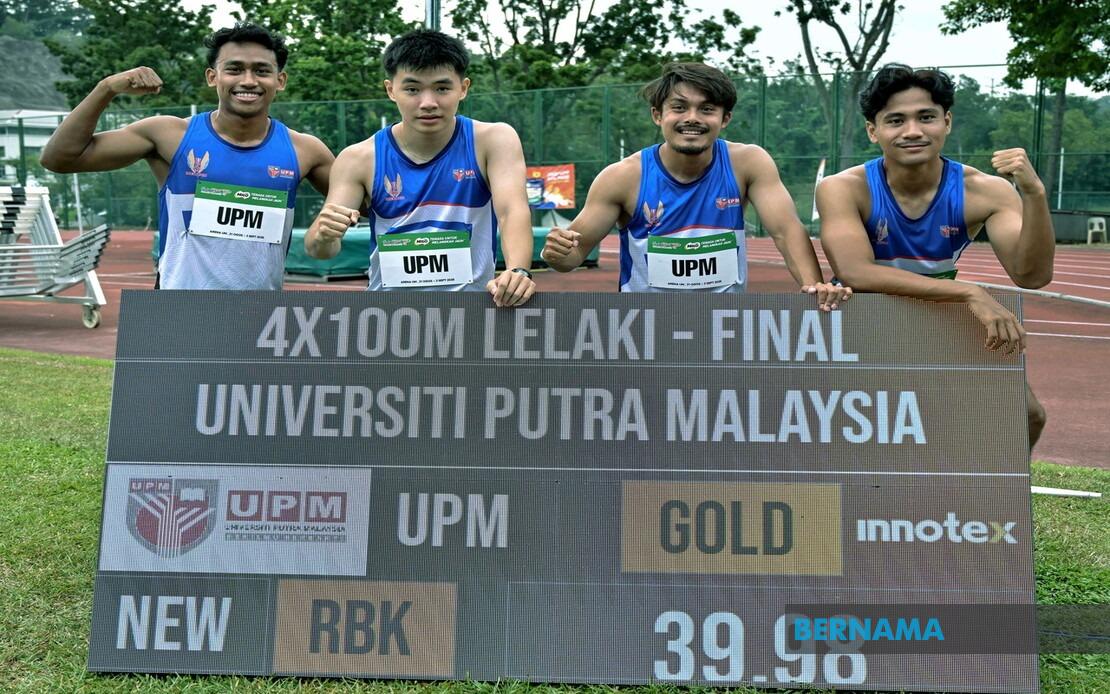
Universiti Putra Malaysia's men's 4x100-meter relay team delivered a watershed moment for the institution's athletics programme on August 31 at the 2026 Higher Education Institutions Sports Games (SUKIPT), storming to gold with a time of 39.98 seconds. The achievement obliterated the previous championships benchmark of 40.98 seconds, cementing UPM's continued dominance in sprint relay events whilst signalling a smooth transition to the next generation of competitors.
The significance of UPM's triumph extends beyond the medal podium. For a university programme navigating the delicate challenge of maintaining excellence whilst rebuilding with untested talent, breaking the games record sends a powerful message about institutional depth and coaching quality. The victory validates the strategic decision to field a quartet composed almost entirely of first-time SUKIPT participants, a gamble that paid dividends when their collective efforts surpassed the benchmark set by previous championship-winning configurations.
Aliff Iman Mohd Fahimi, UPM's senior runner and the team's figurehead, was competing at SUKIPT for what he described as his final appearance. His presence in the anchor position carried symbolic weight—a seasoned performer, visibly marked by six months of injury-enforced absence, returning to ensure continuity with UPM's storied relay heritage. The athlete's wristbands bearing the inscriptions 'Papa' and 'Mama' underscored the personal significance of his comeback, transforming what could have been a routine race into a farewell marked by substance. Aliff Iman's role transcended the physical act of receiving the baton; he functioned as a bridge connecting the legacy of previous stars with the potential of incoming talent.
During the post-race reflection at UM Arena, Universiti Malaya, Aliff Iman articulated the philosophical dimensions of the performance. He characterised the gold medal not merely as a victory but as a renewal for UPM's relay programme—a deliberate passing of the torch to athletes experiencing the pressure and atmosphere of SUKIPT for the first time. This framing acknowledges the particular anxiety that accompanies debut appearances at high-profile championships, yet the team's performance suggested that nervousness never manifested into hesitation when it mattered most. The runner emphasised that his responsibility extended beyond personal achievement; he carried the burden of ensuring that established reputations from athletes like Jonathan Nyepa and Zulfiqar Ismail, both previous champions associated with UPM, would be sustained rather than diminished.
The quartet's strategy rested on granular knowledge of individual capability. Rather than aiming vaguely for competitive times, Aliff Iman revealed that the team had identified specific targets based on each member's personal records. Understanding that three of his teammates possessed average 100-meter times clustering around 10.4 to 10.5 seconds, the senior runner calculated that maintaining such individual performance would necessarily produce a sub-40-second relay time. This data-driven approach transformed the record-breaking effort from a stroke of fortune into the predictable outcome of competent execution by athletes operating within their demonstrated capacity.
Reeve Kua, one of the younger members of the winning quartet, provided candid testimony to the various obstacles overcome en route to the podium. Competing whilst recovering from severe fever represented a notable test of physical resilience; Kua's matter-of-fact account of self-medicating with Panadol the previous evening before racing the following day illustrates the pragmatic determination that characterises collegiate-level athletics in Malaysia. His relief that pain did not accompany his efforts suggests the fine margins between participation and withdrawal at this competitive level, where athletes routinely navigate illness, fatigue, and injury to honour their team commitments.
The final runner, Ahmad Amir Aiman Mohd Kamaruddin, functioned as the decisive link in UPM's relay chain, positioned to convert the baton exchange and his teammates' collective effort into championship gold. His willingness to anchor the team with confidence in those who preceded him reflected the squad cohesion necessary for successful relay racing. Unlike individual sprint events where performance depends solely on personal capacity, the 4x100-meter format demands psychological trust; receiving the baton represents an act of faith in the previous runners' execution. Ahmad Amir's apparent composure in this role suggests coaching staff successfully cultivated the relational dynamics necessary for such trust to flourish.
Universiti Pendidikan Sultan Idris (UPSI) secured the silver medal position with 40.16 seconds, a respectable performance strengthened by the presence of national-level runner Danish Iftikhar Muhammad Roslee in their lineup. UPSI's competitive showing indicates that the gap separating the championship-winning performance from the runner-up remains slim, with merely 0.18 seconds differentiating the two institutions. Malaysian Polytechnics completed the podium with a time of 41.75 seconds, reflecting the broader competitive landscape of university-level athletics in Malaysia where several institutions maintain serious relay programmes.
The implications of UPM's record extend to the broader architecture of Malaysian university athletics. SUKIPT functions as a pipeline institution, identifying talent that frequently transitions into national representative teams and international competition. When a university successfully combines veteran leadership with promising junior athletes while simultaneously surpassing established benchmarks, it signals effective institutional planning at both the coaching and administrative levels. UPM's achievement thus constitutes evidence that the university has navigated the generational transition challenge—a common pitfall for athletic programmes that struggle to replace departing stars.
For Malaysian observers following university sports, the 2026 SUKIPT relay result carries broader significance within Southeast Asian university athletics. Regional competitions increasingly feature Malaysian university teams competing against counterparts from Thailand, Indonesia, and other neighbouring countries, rendering institutional strength within the domestic context relevant to international standing. UPM's record-setting performance enhances the university's credibility when fielding teams at regional forums, potentially attracting stronger competition and elevating overall standards.
The record's longevity will test UPM's capacity to maintain the momentum established by Aliff Iman's final campaign. Future relay squads will shoulder the expectation of matching or surpassing 39.98 seconds, potentially establishing new institutional culture norms around acceptable performance levels. Whether the benchmark becomes a floor upon which subsequent teams build, or represents a peak unlikely to be repeated, will become apparent only as the athletics programme progresses through subsequent SUKIPT editions.

