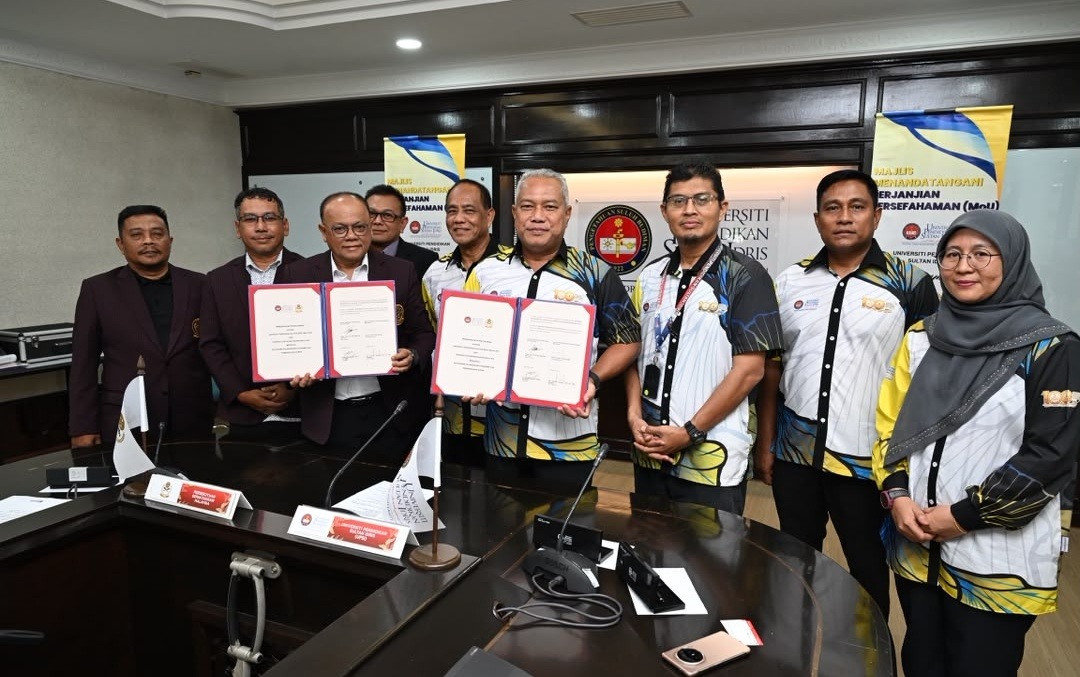
Universiti Pendidikan Sultan Idris (UPSI) has formalized a strategic partnership with the Malaysian Sepaktakraw Federation (PSM) aimed at reshaping how elite athletes balance academic pursuits with competitive sporting commitments. The Memorandum of Understanding, inked at UPSI's Sultan Abdul Jalil Shah Campus in Tanjong Malim, represents a deliberate effort to integrate higher education with national sports development—a model that Southeast Asian universities are increasingly adopting to retain talent and strengthen institutional relevance.
The three-year agreement encompasses three interconnected pillars: creating structured educational pathways for sepak takraw athletes at various academic levels, establishing a dedicated national training centre, and facilitating knowledge exchange in sports science, coaching methodology, and technical officiating. This layered approach distinguishes the partnership from purely sponsorship-based arrangements, positioning UPSI as an active stakeholder in athlete development rather than a passive institutional backdrop.
Prof Datuk Dr Md Amin Md Taff, UPSI's Vice-Chancellor, articulated the university's philosophical stance by framing the collaboration as integral to Malaysia's broader human capital agenda. Rather than treating sporting excellence and academic achievement as competing priorities, the framework explicitly accommodates training schedules and competition calendars within flexible degree structures. This accommodation recognizes a fundamental reality overlooked by many educational institutions: elite athletes require institutional support systems, not merely admission rights, to succeed in both domains simultaneously.
The university has committed to deploying its existing expertise across multiple technical domains. UPSI's sports science facilities and personnel will contribute to biomechanical analysis, sports psychology, injury prevention, and recovery protocols—areas where Malaysian sepak takraw could gain competitive advantage against regional rivals in Southeast Asia. Additionally, the university will facilitate coaching education and official certification programs, addressing a chronic skills gap in the sport's administrative infrastructure.
From PSM's perspective, the partnership solves a persistent recruitment and retention problem. Tengku Zaihan Che Ku Abdul Rahman, the federation's Vice-President, emphasized that national and state-level athletes, including those from Malaysian Sports Schools and State Sports Schools, will now access a formalized educational pathway without sacrificing competitive development. This is strategically significant because it removes a false choice that has historically driven talented players abroad or into early retirement from the sport.
The broader implications for Malaysian sports governance warrant consideration. This MoU potentially establishes a replicable template for collaboration between national sports bodies and tertiary institutions across other disciplines. If successful, the model could attract international benchmarking, particularly from neighbouring ASEAN nations facing similar athlete retention challenges. Thailand, Indonesia, and Vietnam have invested heavily in sports facilities and international competition, yet struggle to institutionalize athlete education at comparable levels.
Sepak takraw itself occupies a unique position in Southeast Asian sport. As an indigenous discipline with deep cultural roots, it commands significant grassroots participation and regional competition through the Southeast Asian Games and international tournaments. However, the sport struggles with professionalization challenges, inconsistent international visibility, and limited commercial viability compared to football or badminton. Educational integration through university partnerships potentially addresses these systemic weaknesses by professionalizing pathways and attracting sustained institutional investment.
The partnership's emphasis on talent identification and development through Malaysian Sports Schools and State Sports Schools indicates a deliberate pipeline approach. By engaging athletes at secondary level, UPSI and PSM can influence long-term player trajectories, ensuring that promising competitors understand education as integral to career sustainability rather than a parallel obligation to be managed minimally.
The agreement's three-year term with mutual extension provisions creates a natural review mechanism. This structure allows both institutions to assess concrete outcomes—athlete progression, coaching certifications awarded, research outputs, training centre utilization—before deepening commitment through the proposed Memorandum of Agreement. For Malaysian readers familiar with past sports initiatives that generated significant announcements but modest implementation, this staged approach offers modest reassurance regarding genuine follow-through.
PSM's aspiration that this model become a reference point for other national sports bodies reflects broader recognition that Malaysia's competitive position in regional sports depends partly on institutional innovation. Badminton's success, for instance, stems significantly from professional infrastructure and sustained institutional support. Replicating those conditions across lesser-resourced sports requires exactly this type of strategic alignment between educational and sporting organizations.
For student-athletes, the partnership creates tangible benefits beyond rhetorical commitment. Flexible scheduling, specialist coaching, access to sports science expertise, and peer support from other elite competitors creates an ecosystem where dual achievement becomes feasible. This particularly matters for athletes pursuing technical or scientific fields where academic rigor demands substantial time investment alongside competitive training.
The collaboration also addresses Malaysia's regional competitiveness in sepak takraw specifically. Southeast Asian dominance in the sport requires continuous technical innovation, particularly as Thailand and Indonesia strengthen their national programs. By mobilizing university research capacity and coaching expertise, UPSI's involvement could facilitate the technical advancement necessary to maintain Malaysia's traditional strength in this distinctly Southeast Asian discipline.
Ultimately, this partnership reflects a mature understanding that national sports development cannot rely solely on federation resources or government funding allocated episodically. By anchoring athlete development within educational institutions, Malaysia creates sustainable infrastructure less vulnerable to political shifts or budgetary fluctuations. Whether this collaboration translates into demonstrable athlete success and institutional innovation will determine whether it becomes a model for Southeast Asian sports governance.

