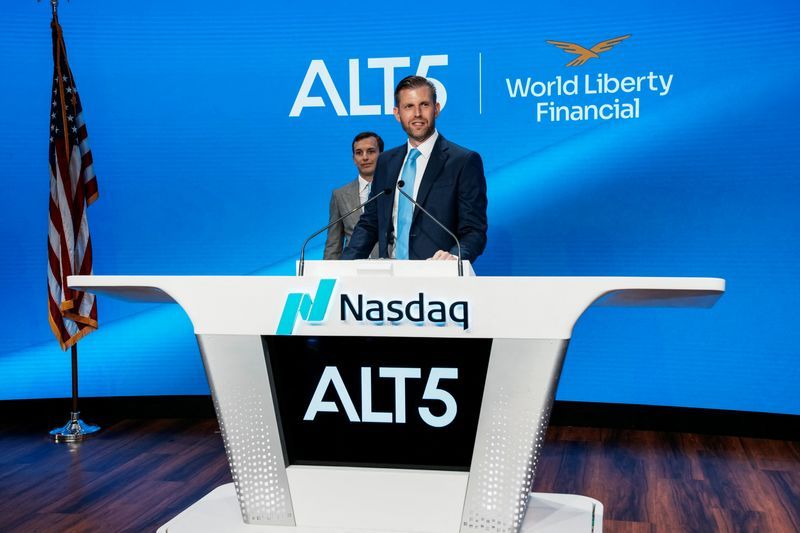
The Office of the Comptroller of the Currency has conditionally approved a banking charter application for World Liberty Trust Company, marking a significant regulatory milestone for the cryptocurrency venture founded by President Donald Trump and his family. The decision, communicated through a published letter, grants preliminary approval for the national trust charter that the company had sought since January, effectively enabling an expansion of its stablecoin operations under federal banking supervision.
This approval represents a watershed moment in the Trump administration's approach to cryptocurrency regulation. The conditional charter does not immediately allow traditional banking functions such as deposit-taking or lending, but it does grant World Liberty the authority to manage and hold customer assets, process payments more efficiently, and directly issue its USD1 stablecoin—currently the fourth-largest digital currency by market capitalisation at approximately US$4 billion. Previously, these functions were managed through partnerships, notably with BitGo, which handled custody and reserve management responsibilities.
The regulatory action reflects a broader thaw in attitudes toward crypto enterprises within the current US administration. Comptroller Jonathan Gould, appointed to the Office of the Comptroller of the Currency by Trump last year, has similarly granted preliminary approvals to other cryptocurrency firms including Ripple and Circle seeking equivalent national trust charters. The crypto industry has strategically leveraged this receptive regulatory environment, recognising that such charters enable companies to serve institutional clients more effectively by providing comprehensive asset servicing under a unified federal framework covering all 50 states.
World Liberty Financial welcomed the conditional approval, with Zach Witkoff, serving as president and chairman of World Liberty Trust, characterising the development as a pivotal achievement in the company's trajectory. Witkoff emphasised that the national trust bank structure would consolidate USD1 issuance, custody, and reserve administration under Office of the Comptroller of the Currency supervision, subject to the same regulatory standards applied to traditional banking institutions for generations. The company's statement reflected confidence in regulatory oversight and commitment to ongoing federal scrutiny.
However, the conditional approval comes with substantial requirements that World Liberty must satisfy before final charter status. The company must maintain at least US$20 million in capital reserves, notify regulators of any significant changes to its business strategy, and employ a qualified individual to oversee internal audit functions. These conditions represent standard precautions employed by banking regulators to ensure institutional stability and compliance with federal banking principles.
The approval process itself generated considerable controversy and scrutiny regarding foreign investment in the venture. The Office of the Comptroller of the Currency received and published comments expressing concern about non-US investors holding stakes in World Liberty Financial. In response, the regulator noted that such foreign investors would not qualify as principal shareholders and disclosed that several international investors, including Eric Trump serving as president of a Trump-family investment entity, had submitted passivity agreements committing to non-interference in the bank's operations or governance decisions.
These international investment dimensions had previously attracted legislative attention. In February, two Democratic members of the US Senate Banking Committee urged the Treasury secretary to examine potential national security implications stemming from a reported US$500 million equity purchase linked to the United Arab Emirates' national security adviser. Such scrutiny underscores the complex intersection of financial regulation, national security concerns, and political sensitivities surrounding cryptocurrency ventures backed by the sitting president.
World Liberty Financial's leadership structure reveals deep interconnections with Trump's longstanding political circle. The Witkoff family, particularly Zach Witkoff and his father Steve Witkoff—who serves as Trump's special diplomatic envoy—co-founded the venture alongside the president and his three sons in late 2024. Robert Witkoff, Steve's brother and a former insurance executive, is proposed as a director, while Scott Alper, president of the Witkoff family's real estate operations, similarly holds a directorial position. This concentrated network of family and personal relationships within the company's governance structure has amplified questions about potential conflicts of interest.
Democrats have consistently objected to the charter approval on grounds of institutional conflict of interest, arguing that a sitting president maintaining financial interests in a major financial services company raises fundamental governance concerns. During a February congressional hearing, Democratic lawmakers pressed Comptroller Gould to disclose the company's complete, unredacted application materials, noting that the publicly released version omitted crucial details regarding capital structure and operational plans. The Office of the Comptroller of the Currency responded by asserting that Gould and staff had adhered to statutory duties and ethical obligations throughout the application review process, which involved career civil servants rather than political appointees.
From a Southeast Asian perspective, World Liberty Financial's regulatory success carries broader implications for cryptocurrency adoption and blockchain finance across the region. If the venture succeeds in establishing itself as a stable, institutional-grade stablecoin provider, it could influence how other Asian nations approach regulating domestic or regional cryptocurrency platforms. Malaysia, Singapore, and other regional financial centres monitor US regulatory developments closely when formulating their own digital asset strategies. The precedent of a sitting president's family-backed crypto enterprise receiving federal banking approval represents an unprecedented regulatory development globally.
The USD1 stablecoin itself has demonstrated rapid market penetration since its March 2025 announcement, suggesting substantial investor appetite for blockchain-based financial instruments. By June 2026, the Trump family had accumulated approximately US$50 million in earnings from USD1 operations alone, while World Liberty Financial channelled more than US$1.6 billion to Trump and his family as of April. These figures demonstrate the commercial viability of the venture and the substantial financial incentives motivating its establishment and expansion.
World Liberty Financial's stated mission—democratising financial access and circumventing traditional banking systems characterised as unnecessarily restrictive—resonates with cryptocurrency advocates across Southeast Asia, where banking access remains uneven and regulatory frameworks remain in development. The company's framing of blockchain-based finance as an alternative to incumbent banking structures appeals to underbanked populations and young, tech-savvy demographics prominent in the region. However, the venture's deep ties to Trump family interests and its unprecedented regulatory status as a president's financial enterprise create distinctive governance questions that extend beyond typical cryptocurrency regulatory analysis.
The ultimate success or failure of World Liberty Financial will establish important precedents for future applications from crypto enterprises seeking federal banking charters. If the company successfully navigates final approval and operates without major compliance failures or scandals, it may encourage additional applications from the broader cryptocurrency industry seeking equivalent regulatory status. Conversely, any significant operational difficulties, regulatory violations, or reputational challenges could prompt a recalibration of the Office of the Comptroller of the Currency's approach to future crypto banking applications, potentially affecting comparable ventures throughout Asia-Pacific regions seeking to model themselves on successful American examples.

