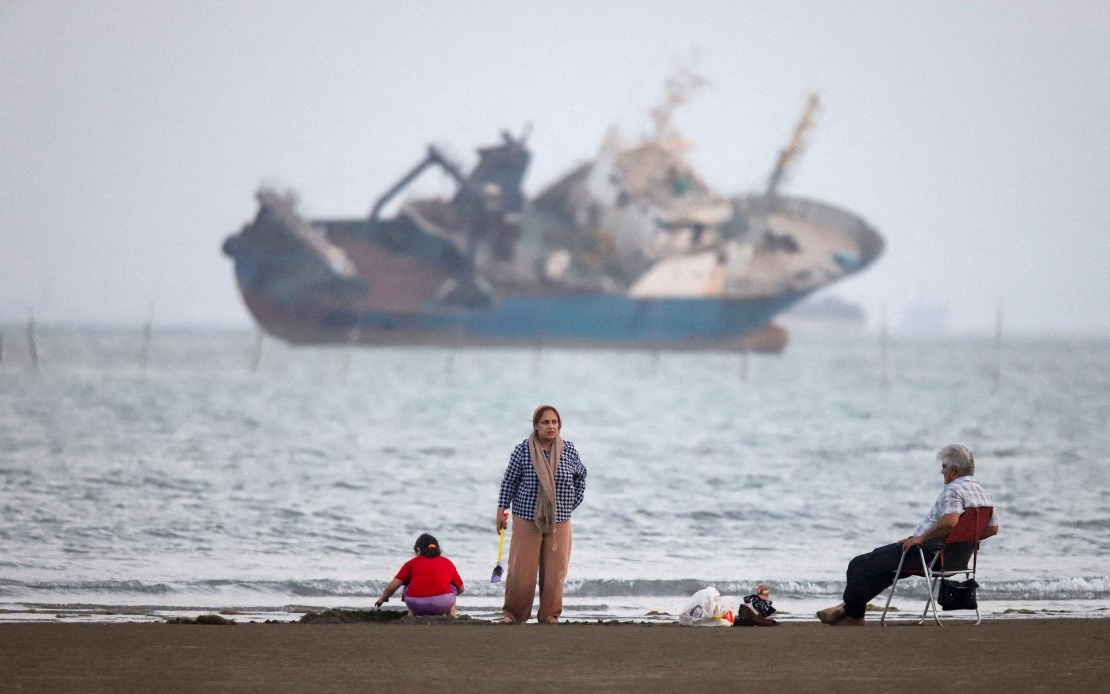
The United States has escalated its economic pressure on Iran by imposing a fresh round of sanctions targeting an alleged network of financial intermediaries and officials with ties to Tehran's highest levels of power. The Treasury Department's action, announced on Friday, follows a period of heightened tensions in the Strait of Hormuz, a strategically vital waterway through which roughly one-fifth of global crude oil passes annually. The timing of these sanctions underscores Washington's determination to maintain pressure on Iran's financial system while responding to what it characterises as destabilising maritime activity.
At the heart of the sanctions package is Ali Ansari, a figure the US Treasury Department identifies as operating in close proximity to Mojtaba Khamenei, son of Iran's Supreme Leader Ayatollah Khamenei, and the Islamic Revolutionary Guard Corps, the country's most powerful military institution. The designation of Ansari represents a direct challenge to Iran's innermost political circles, signalling that Washington views him as a significant node in networks that funnel resources to entities the US considers threatening. This targeting of individuals near the top of Iran's hierarchy reflects a strategic shift toward dismantling the financial infrastructure that supports decision-makers rather than merely sanctioning lower-level operatives.
Beyond individual designations, the Treasury Department's Office of Foreign Assets Control identified multiple unlicensed exchange houses operating from Tehran and Shiraz for inclusion on the Specially Designated Nationals List. These entities—the Mohammad Darbani and Partners Exchange, the Mohsen Khandan and Partners Exchange, and the Lavasani and Partners Exchange—function as informal financial conduits outside the regulated banking system. The targeting of such shadow finance operations reflects international concern about Iran's ability to circumvent traditional sanctions by channelling transactions through unregulated channels that obscure the origin and ultimate destination of funds.
The sanctions package also reached across borders to encompass Smart Global Limited, a holding company registered in Saint Kitts and Nevis, a small Caribbean nation that has emerged as a jurisdiction of choice for entities seeking to mask beneficial ownership. The inclusion of this company signals that Washington is willing to pursue Iranian-linked financial architecture wherever it is incorporated, highlighting the extraterritorial reach of US economic sanctions. This approach places Caribbean financial centres and others under closer scrutiny regarding their potential role in facilitating transactions for sanctioned jurisdictions.
For Southeast Asian observers, the implications are considerable. The Strait of Hormuz's importance to regional supply chains and energy security means that tensions affecting this waterway have direct consequences for Malaysian, Singaporean, and other regional economies. Prolonged disruptions to shipping in this corridor would elevate transportation costs and insurance premiums across Asia's vital import and export routes. Malaysia, as a major trading nation and energy consumer, remains vulnerable to any sustained interruption of the petroleum flows that transit this strategic passage.
Iran's immediate response through Foreign Minister Seyed Abbas Araghchi indicates that diplomatic channels remain fractured. Araghchi's assertion on social media that Iran has honoured its commitments while accusing the US Treasury Secretary of violating provisions of an unspecified Memorandum of Understanding suggests an underlying dispute over interpretations of previous agreements. His emphasis on mutual compliance points to a deeper grievance within Iran's government regarding what Tehran perceives as unilateral American action unmoored from negotiated frameworks.
The designation process itself reflects a broader American strategy of targeting financial networks rather than attempting direct military or kinetic responses to maritime incidents. By concentrating on the money flows that sustain Iran's security apparatus and leadership networks, Washington seeks to impose costs without escalating to direct military confrontation. This approach has become the preferred tool of US administrations seeking to respond to Iranian actions while avoiding the unpredictable consequences of open conflict in a region already marked by significant geopolitical tensions.
The shadow banking and exchange house designations deserve particular attention because they reveal how Iran has adapted to decades of sanctions by developing parallel financial infrastructure. These informal networks, often operating within family business structures or through trusted intermediaries, have become increasingly sophisticated at disguising transactions and moving value across borders. By targeting specific exchange houses by name, the US aims to disrupt these established patterns and force Iranian economic actors to seek alternative arrangements, each shift creating friction and raising transaction costs.
For Malaysian policymakers and businesses, the escalating sanctions regime reinforces the need for heightened due diligence in financial and trade relationships involving Iran or Iranian-linked entities. Compliance departments must remain vigilant regarding the constantly expanding list of designated individuals and organisations. The targeting of Caribbean-registered entities also serves as a reminder that jurisdictional arbitrage—the practice of using offshore locations to obscure ownership and control—has become a central focus of US enforcement efforts.
The incident illustrates the persistent vulnerability of global commerce to geopolitical disruptions in critical chokepoints. The Strait of Hormuz lacks meaningful alternatives for large-scale energy transport, making it impossible for trading nations to simply reroute commerce around the area. This concentration risk means that even localised tensions can create cascading effects throughout global supply chains. For Malaysia's maritime industry and shipping sector, such instability represents both challenge and opportunity—challenge in navigating unpredictable operating conditions, and opportunity in positioning itself as a reliable alternative regional hub for transshipment and related services.
The sanctions announcement also underscores the limitations of unilateral American economic action absent broader international coordination. While US designation authority is extensive, the effectiveness of these measures depends partly on compliance by other major economic players. Asian nations, including Malaysia, maintain more complex relationships with Iran than do Western countries, creating potential gaps in enforcement. Whether regional governments will voluntarily align their financial regulation with US sanctions designations remains an open question with significant trade implications.
Looking forward, the trajectory of US-Iran confrontation appears set to continue along this path of targeted financial sanctions punctuated by maritime incidents and diplomatic protests. Neither side shows signs of genuine de-escalation, suggesting that the Strait of Hormuz will remain a zone of tension for the foreseeable future. Regional economies must adapt their risk management frameworks accordingly, building resilience into supply chains and exploring diversification strategies that reduce dependence on uninterrupted passage through this vulnerable waterway.

