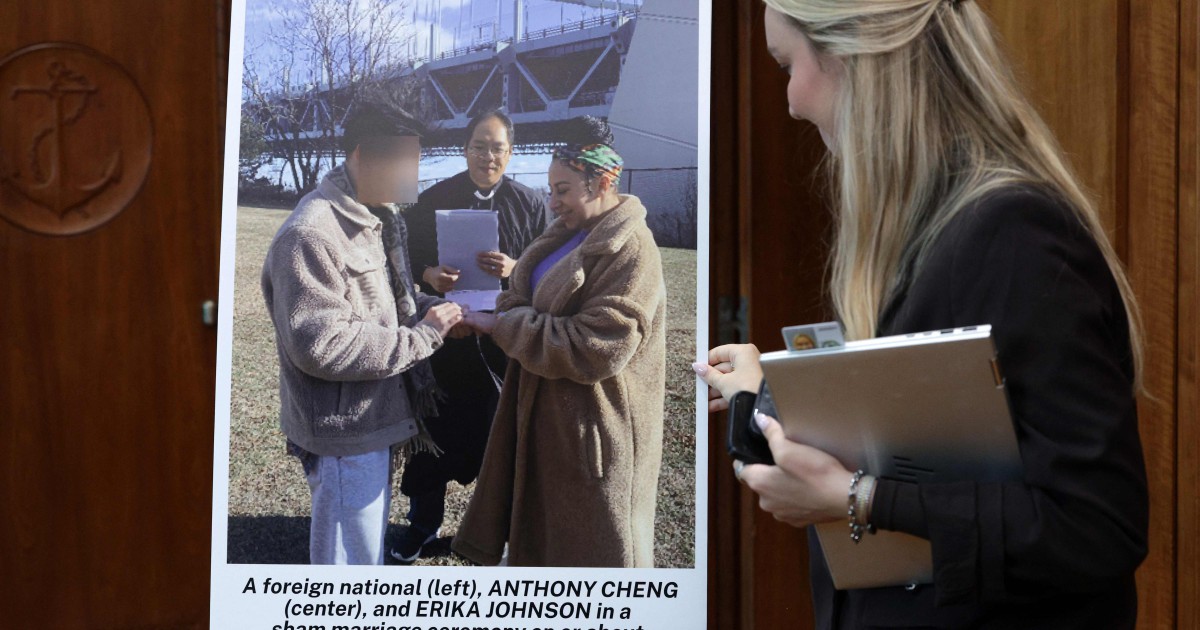
The United States Justice Department has brought charges against 11 individuals accused of orchestrating an extensive fraudulent marriage scheme spanning more than a decade, according to filings in federal court. The operation is alleged to have facilitated approximately 1,000 sham marriages, predominantly involving Chinese nationals who sought to circumvent normal immigration procedures and establish legal residency in America.
This prosecution underscores the persistence of document fraud and marriage-based immigration schemes that continue to challenge US border security and immigration enforcement. The scale of the alleged conspiracy—involving roughly 1,000 fraudulent unions across ten years—reveals the systematic nature of the enterprise and suggests a well-organised criminal network rather than isolated incidents of immigration fraud. Such schemes represent a calculated exploitation of family-based immigration pathways, which remain a cornerstone of American immigration policy despite mounting vulnerabilities.
The timing of these charges arrives amid heightened scrutiny of immigration practices under new policy directives. The Trump administration has signalled renewed focus on immigration enforcement, including measures addressing what officials characterise as "birth tourism" and other unauthorised entry methods. This prosecution reflects broader governmental priorities around tightening immigration controls and pursuing those who facilitate irregular pathways into the country.
For Malaysian and broader Southeast Asian readers, the case carries particular relevance. Chinese nationals represent a substantial portion of migrants attempting to access wealthy Western economies through irregular channels, yet similar patterns affect other Asian communities as well. The operation's decade-long existence without detection raises questions about the adequacy of marriage verification procedures across US immigration agencies and the potential susceptibility of systems that may be replicated in other jurisdictions.
Maritime fraud and immigration exploitation networks frequently operate across national boundaries, sometimes coordinating with intermediaries in Southeast Asia. The sophistication required to orchestrate 1,000 fraudulent marriages suggests international coordination mechanisms, document forging capabilities, and financial infrastructure that likely extended beyond US borders. Understanding such transnational criminal enterprises proves essential for regional law enforcement agencies working to combat human trafficking and document fraud.
The prosecution strategy reflects how authorities pursue the organisers and architects of such schemes rather than solely targeting individuals seeking immigration benefits. Charging 11 people suggests prosecutors have identified key figures within the conspiracy's management structure—likely including brokers who matched couples, facilitators who guided applicants through processes, and potentially corrupt officials who expedited fraudulent petitions. This layered approach to prosecution often proves more effective than isolated enforcement against individual migrants.
Marriage-based immigration fraud remains particularly challenging to detect because legitimate family unions and fraudulent arrangements share superficial similarities. Immigration officers must distinguish genuine relationships from transactional arrangements while respecting privacy and avoiding discriminatory scrutiny. The decade-long duration of this scheme indicates perpetrators successfully exploited these investigative complexities, potentially by coaching participants to present convincing documentation and consistent narratives during interviews.
The case also reflects evolving immigration enforcement priorities within the United States federal system. While previous administrations emphasised workplace raids and border interception, this prosecution demonstrates renewed attention to fraud occurring within the immigration system itself. For aspiring immigrants from Malaysia, China, and throughout Asia, increased enforcement suggests that fraudulent pathways carry heightened legal risk and that legitimate immigration channels, while slower and more demanding, represent the safer long-term strategy.
From a Southeast Asian perspective, the prosecution carries implications for regional migration patterns and enforcement cooperation. As wealthier nations tighten immigration procedures, migrants increasingly turn to intermediaries and facilitators, creating lucrative opportunities for smuggling networks. The scale of this particular scheme suggests significant financial resources circulated through the operation, funds that might otherwise have supported legitimate economic activity in origin countries.
The Justice Department's action also reflects growing coordination between US federal agencies and potentially international partners in uncovering immigration fraud. Modern schemes require sophisticated document forgery, financial transfers across borders, and coordination among dispersed actors—capabilities that often warrant cross-border investigation and intelligence sharing. Regional law enforcement agencies in Southeast Asia may benefit from similar collaborative approaches when addressing migrant smuggling and document fraud.
Moving forward, the prosecution may influence immigration policy discussions around family-based visa categories and marriage verification procedures. The case demonstrates vulnerabilities within existing systems while vindicating enforcement agencies' arguments for enhanced screening capabilities and documentation verification technology. For Malaysian citizens and others navigating immigration systems, enhanced verification procedures may result in longer processing times and more rigorous interviews, even for legitimate applications.
The charges represent one significant enforcement action within a much larger landscape of immigration fraud and irregular migration facilitation. The decade-long operation's exposure serves as a reminder that systematic immigration fraud can persist despite existing oversight mechanisms, and that determined criminal enterprises continuously adapt methods to exploit bureaucratic procedures. As enforcement evolves, so too do smuggling networks and fraud schemes, creating an ongoing cat-and-mouse dynamic that will likely characterise immigration enforcement for years ahead.

