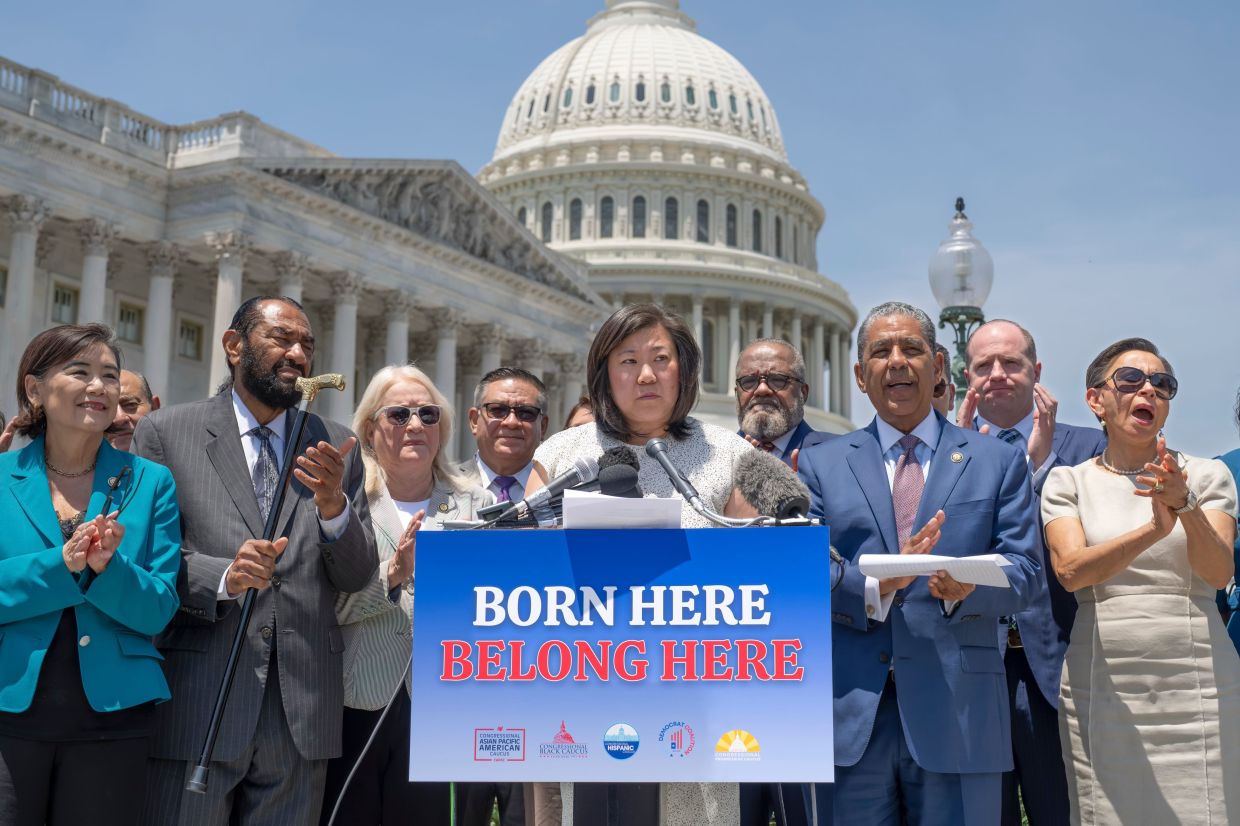
The United States Supreme Court has dealt a significant blow to President Donald Trump's immigration agenda, ruling 6-3 in Trump vs Barbara that children born within American borders to undocumented parents or parents holding temporary visas retain full entitlement to US citizenship. The decision represents a major setback for one of the Trump administration's cornerstone second-term policies, which had targeted what officials characterised as an expensive and unfair practice threatening national integrity.
Trump signed the executive order in early 2025 with the intention of terminating automatic citizenship for infants born to non-citizen parents, a measure designed to take effect shortly thereafter. The Supreme Court's ruling has now blocked this initiative entirely, prompting Trump to respond with characteristic defiance on social media. While extending congratulations to Chinese President Xi Jinping in what observers interpreted as sarcasm regarding China's own restrictive citizenship policies, Trump simultaneously dismissed the court's judgment as detrimental to American interests and signalled his intent to pursue legislative alternatives through Congress rather than pursue a constitutional amendment.
The case centred on the 14th Amendment's Citizenship Clause, a post-Civil War provision ratified in 1868 specifically to protect the rights of emancipated slaves and other marginalised populations. Chief Justice John Roberts articulated the majority's reasoning in sweeping constitutional language, declaring that citizenship represents the fundamental right to possess rights and participate fully in the nation's political community. The framers of the amendment, Roberts wrote, extended this promise to every person born free in American territory, a pledge the court reaffirmed through its decision. This interpretation has remained consistent for over 150 years, since the landmark 1898 case of Wong Kim Ark, which established that nearly all persons born on US soil qualify as citizens regardless of parental nationality or immigration status.
Wong Kim Ark himself was a cook of Chinese descent who had been denied re-entry after visiting China, with authorities claiming he lacked citizenship under the exclusionary immigration laws of that era. His legal victory became foundational to modern birthright citizenship doctrine. Remarkably, Wong's descendants addressed the court's ruling more than a century later, with Norman Wong, his great-grandson, reflecting that his ancestor was simply one man who stood up for what he believed was right, yet that single act of principle reverberated across generations and communities.
The Trump administration's order had actually targeted a broader population than public rhetoric typically acknowledged. While undocumented immigration dominated political discussion surrounding birthright citizenship, the executive action also encompassed individuals lawfully present in the United States on temporary status—those on highly skilled employment visas such as H-1B or L-1 classifications, as well as holders of dependent visas, student visas, temporary labour visas, and achievement visas. The USCIS classifies all of these categories as lawfully present but temporary, distinguishing them from undocumented entrants. Only when one parent held US citizenship would children have retained automatic citizenship under Trump's proposed policy, creating a tiered system based on parental legal status.
The administration had increasingly emphasised so-called birth tourism as justification for restricting birthright citizenship, pivoting away from the traditional focus on undocumented immigration. Birth tourism allegations have centred particularly on wealthy Chinese nationals who allegedly travel to the United States specifically to give birth and secure American citizenship for their offspring. The Trump administration cited a 2024 prosecution case in which Michael Wei Yueh Liu and Jing Dong, a husband-and-wife team, each received 41-month prison sentences for operating such a scheme, charging Chinese clients substantial fees to facilitate American births. The Justice Department subsequently issued a memo directing federal prosecutors to prioritise investigations into birth tourism operations, promising to protect the sanctity of citizenship by prosecuting those who exploited immigration systems.
Solicitor General D. John Sauer, Trump's lead litigator before the Supreme Court, had emphasised during April oral arguments that birthright citizenship had spawned sprawling commercial industries around birth tourism, with uncounted thousands of foreigners from potentially hostile nations reportedly exploiting the system. Yet the scope of actual birth tourism remains disputed among policy analysts, with critics noting that public claims regarding its scale significantly outpace documented evidence. The administration's executive order would have essentially transformed American maternity wards into customs checkpoints, according to advocacy groups opposing the measure.
For Asian-American communities and other populations of colour, the Supreme Court's decision carries particular resonance rooted in historical experience. Stop AAPI Hate and similar organisations emphasised that birthright citizenship survived both the Chinese Exclusion Act of the 19th century and Jim Crow segregation policies of the 20th century, and now has survived Trump's contemporary challenge. These organisations noted that birthright citizenship directly enabled Asian-American communities and other communities of colour to grow in both demographic size and political power—precisely the outcome the Trump administration attempted to prevent. Krish O'Mara Vignarajah, president of Global Refuge, a non-profit serving refugee populations, characterised the ruling as a vindication of foundational American democratic principles against an executive overreach that would have fundamentally altered citizenship acquisition.
Trump has indicated his administration will not accept the Supreme Court's verdict as final, instead pivoting toward legislative action. He called upon Congress to begin immediate work on ending what he characterised as expensive and unfair birthright citizenship practices, promising complete and total support for congressional efforts. Notably, Trump asserted that achieving this outcome through legislation would prove simpler than pursuing the constitutionally complex amendment process, despite the 14th Amendment's supermajority requirements for modification. This strategy faces substantial congressional hurdles, as birthrights citizenship enjoys broader public support than Trump's restrictive immigration positions, and any legislative attempt would likely trigger intense legal challenges.
The ruling demonstrates the Supreme Court's willingness to constrain executive immigration authority, even under a conservative majority. Whether Congress will attempt to legislate restrictions on birthright citizenship remains uncertain, particularly given the political and international dimensions of such a move. For Malaysia and Southeast Asian observers, the decision underscores ongoing American legal and political contestation over immigration policy, with implications for how the United States approaches temporary worker visas and student admissions that affect regional populations seeking American opportunities.

