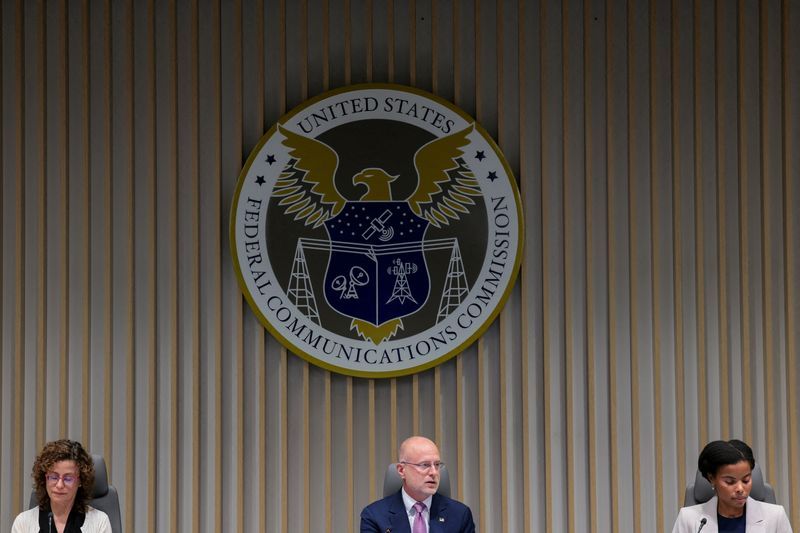
The United States Federal Communications Commission has escalated its technological standoff with China by voting to prohibit the sale of devices within American borders that incorporate critical hardware manufactured by Chinese companies considered threats to national security. The decision, announced on Wednesday, represents a significant expansion of existing restrictions and reflects the Trump administration's aggressive posture toward Chinese technology imports across multiple sectors.
The FCC maintains a curated list of organisations regarded as posing national security risks, prominently featuring the telecom giants Huawei and ZTE. For years, the regulator has enforced bans on these companies' finished products, yet a substantial gap existed in the enforcement framework. While complete devices manufactured by blacklisted firms have been prohibited from securing new authorizations since 2022, the previous rules permitted gadgets built by other manufacturers using components sourced from Huawei to continue receiving approval for market entry. This distinction proved crucial in allowing technically compliant products to circumvent the spirit of the restrictions.
FCC Chair Brendan Carr characterised the new measure as closing what had been termed "the component part loophole," signalling the agency's determination to eliminate remaining pathways for restricted Chinese technology to infiltrate the US market. Under the revised regulations, any device containing logic-bearing hardware components manufactured by Huawei—a classification that encompasses semiconductors and similar critical circuit components—will be denied market entry regardless of the device's final assembler or its original design origin. This approach effectively extends the net of restriction backward along the supply chain rather than merely targeting finished consumer goods.
Chris McGuire, a former official within the White House National Security Council during the Biden administration, articulated the reasoning behind such comprehensive measures when speaking to Reuters. He emphasized that compromised components, particularly semiconductors serving computing functions or devices engineered for communications purposes, possess the technical capability to undermine the integrity of entire systems in which they operate. The concern reflects broader cybersecurity doctrine suggesting that infiltration at the component level allows adversaries access points that may prove undetectable through conventional security audits of completed products.
This regulatory action forms part of a coordinated campaign launched by President Donald Trump's administration targeting Chinese technology across the economic spectrum. The FCC has pursued multiple complementary restrictions in recent months, each designed to diminish Chinese technological presence within American infrastructure and consumer markets. In July alone, the commission banned the importation of additional equipment from a consortium of Chinese manufacturers, with the restrictions becoming effective on July 16. The agency has simultaneously proposed prohibitions on most military-grade unmanned aerial vehicles sourced from Chinese suppliers, reflecting concern about surveillance and reconnaissance capabilities embedded in such devices.
Beyond components and specific device categories, the FCC has restricted the introduction of new drone and router models manufactured abroad, effectively freezing the product lines that Chinese firms can legally offer within US jurisdiction. The regulatory environment has become progressively more hostile to Chinese commercial participation in American telecommunications infrastructure. The commission has proposed additional measures that would prohibit American telecommunications service providers from establishing interconnection arrangements with Chinese telecom companies deemed security threats, fundamentally disrupting the technical backbone through which international voice and data traffic flows.
Yet perhaps most consequential among the proposed actions is the FCC's consideration of prohibiting Chinese telecommunications corporations from operating facilities within the United States, specifically targeting data centers and Points of Presence—specialised infrastructure installations positioned at internet exchange facilities where data traffic converges and routes outward. Such facilities represent critical nodes within the global internet architecture, offering unparalleled access to communications traffic and network routing decisions. Should these proposals advance to implementation, they would effectively compel Chinese telecom operators to cease American operations entirely, severing direct Chinese corporate presence from the infrastructure underpinning digital communications within and beyond the United States.
The cumulative effect of these measures reveals a strategic objective extending far beyond simple protectionism. American policymakers appear committed to systematically reducing Chinese influence over critical technological infrastructure, from the component level through to network architecture. For Malaysian and Southeast Asian technology professionals and businesses, these developments carry substantial implications. Many regional enterprises depend upon supply chains that traverse through or incorporate Chinese components, and the expanding American restrictions may necessitate redesign of products intended for the North American market or force difficult sourcing decisions.
Huawei, the most prominently affected corporation, declined to offer immediate comment on the FCC's decision. The company has previously contested American accusations, arguing that the restrictions lack sufficient technical or evidential foundation. The absence of a rapid response may reflect the company's depleted capacity to influence American regulatory processes following years of accumulated restrictions. For the broader ecosystem of Chinese technology exporters and their global supply chain partners, the regulatory trajectory suggests mounting pressure to prove security compliance or risk exclusion from the world's largest technology market.
The FCC's action occurs within a broader geopolitical context characterised by deepening technological competition between the United States and China. Both nations regard dominance in semiconductors, communications infrastructure, and data management as essential to future economic and military advantage. American actions reflect concern about embedded vulnerabilities, while Chinese officials characterise such measures as economic aggression designed to preserve American technological hegemony. For Southeast Asian nations positioning themselves within this competition, these developments underscore the reality that technology supply chains increasingly reflect geopolitical alignment rather than purely economic efficiency.

