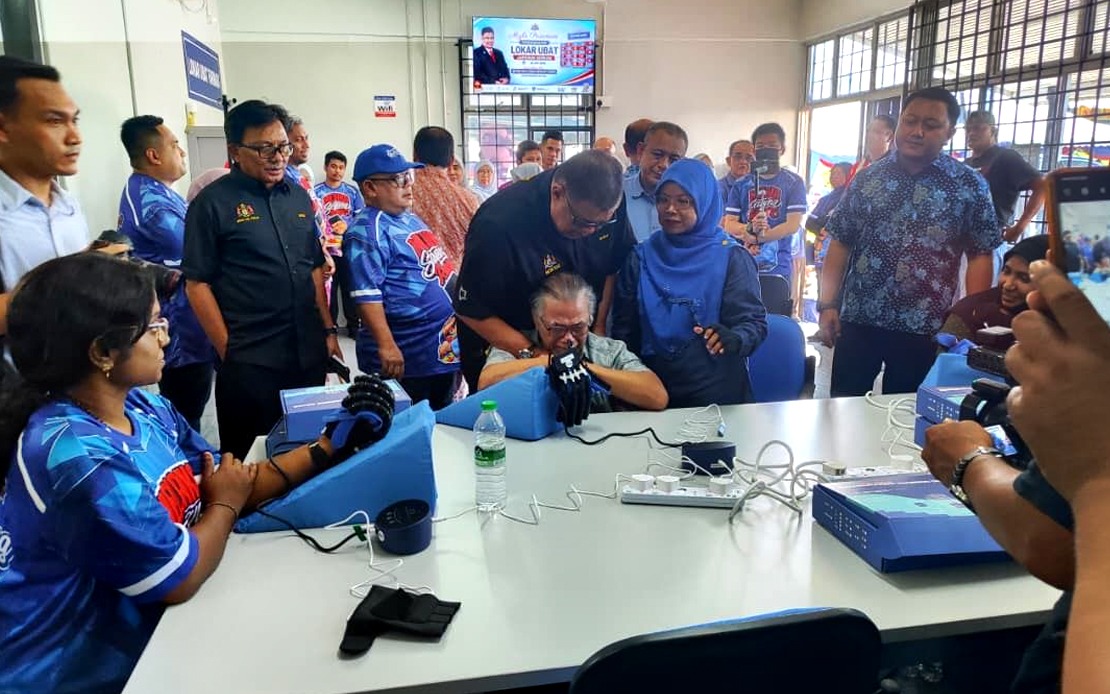
Universiti Teknikal Malaysia Melaka (UTeM) has inaugurated a community-focused rehabilitation facility in Serkam, Jasin, that leverages cutting-edge technological innovations to transform how patients recover from stroke, injury, and mobility disorders. The MADANI Community Rehabilitation Centre and Gymnasium, officially opened by Melaka Chief Minister Datuk Seri Ab Rauf Yusoh, represents a significant step forward in bringing university research directly into practical healthcare applications that serve everyday Malaysians seeking accessible recovery solutions.
Funded through the Finance Ministry's UniMADANI 2024 Grant programme, the centre integrates several proprietary technologies developed by UTeM researchers to enhance treatment outcomes. These innovations address specific rehabilitation challenges: the Roboglove system provides guided hand rehabilitation training for patients recovering fine motor control, the Assistive Lower Limb Chair (ALLC) automates lower limb exercise routines to maintain muscle strength and mobility, and an exoskeleton apparatus amplifies the effectiveness of movement retraining. Together, these systems create a comprehensive technology ecosystem that allows patients to undergo structured recovery programmes with greater precision and repeatability than traditional manual therapy alone.
The centre's establishment emerges from a broader university initiative to democratise access to advanced rehabilitation services across Malaysian communities. UTeM Vice-Chancellor Prof Datuk Dr Massila Kamalrudin emphasised that the facility serves as a demonstration model showing how academic institutions can bridge the gap between laboratory innovation and community healthcare needs. By situating cutting-edge equipment in a publicly accessible centre rather than confining it to university laboratories, UTeM signals a commitment to ensuring that technological advancement translates into tangible quality-of-life improvements for residents who might otherwise lack access to such treatments.
The project was realised through an unusually collaborative ecosystem spanning multiple stakeholders. Beyond UTeM's technical expertise, the initiative involved coordination with the Serkam State Constituency Development and Coordination Committee (Japerun), the Kampung Pulai Village Development and Security Committee, the Social Welfare Department, and the Social Security Organisation (PERKESO). This multi-agency partnership reflects recognition that rehabilitation services require alignment across education, local governance, welfare provision, and social security frameworks—a model with potentially significant implications for how other communities might organise similar ventures across Malaysia.
For stroke survivors and individuals with acquired mobility limitations, access to consistent, technology-assisted rehabilitation often determines whether recovery plateaus or continues progressing. Malaysia's ageing population faces rising stroke incidence, yet rehabilitation capacity remains unevenly distributed across urban and semi-rural areas. By establishing this centre in Melaka rather than concentrating advanced services in major metropolitan hubs, UTeM addresses a geographic equity issue that affects patient outcomes across the country. Individuals who previously required expensive private therapy or travelled considerable distances for specialist treatment now have a nearby alternative.
The technological dimension of this centre carries broader implications for Southeast Asian healthcare infrastructure. Most regional rehabilitation services rely on manual physiotherapy delivered by trained professionals—effective but labour-intensive and dependent on therapist availability. Robotic and exoskeleton-assisted systems can standardise treatment protocols, reduce therapist workload, and potentially train more patients simultaneously. As Malaysia and its neighbours grapple with healthcare worker shortages, such technology-augmented service models may become increasingly critical for sustaining rehabilitation capacity as populations age.
UTeM's development of these rehabilitation technologies also represents a homegrown innovation achievement worthy of regional attention. Rather than importing expensive foreign medical devices, the university has engineered locally appropriate solutions that can potentially be manufactured and maintained within Malaysia's industrial ecosystem. This capability reduces long-term costs for healthcare facilities and creates potential export opportunities if these systems prove commercially viable. The centre effectively serves as both a patient facility and a real-world testing ground where researchers can validate system performance and gather data for refinement.
The involvement of PERKESO, Malaysia's workers' compensation authority, suggests the centre may play a role in occupational rehabilitation for workers recovering from workplace injuries. This intersection between social security provision and rehabilitation innovation deserves particular attention, as industrial accidents and work-related disabilities impose substantial costs on workers, employers, and social protection systems. Technology-enabled rehabilitation that accelerates return-to-work outcomes could generate significant economic benefits alongside improved individual wellbeing.
Vice-Chancellor Kamalrudin's call for expanding this collaboration model to additional locations indicates UTeM's ambitions to replicate the Serkam model across other Malaysian communities. Such expansion would require sustained funding beyond single-year grants, institutional commitment, and careful evaluation of which technologies work most effectively in community settings versus laboratory conditions. The success of this initial facility will likely determine whether similar centres materialise elsewhere or whether resource constraints limit the model to this single demonstration site.
For Malaysian healthcare planners and university administrators watching this development, the MADANI Centre offers a template worth studying closely. It demonstrates that integrating research universities with community health services, social welfare agencies, and local governance structures can generate innovative service delivery models addressing real patient needs. Whether this collaborative approach becomes a replicable template across Malaysian higher education institutions or remains an isolated success story will significantly shape the country's capacity to deliver technology-enhanced healthcare services equitably across urban and semi-rural populations.

